




Process layout
Process Overview
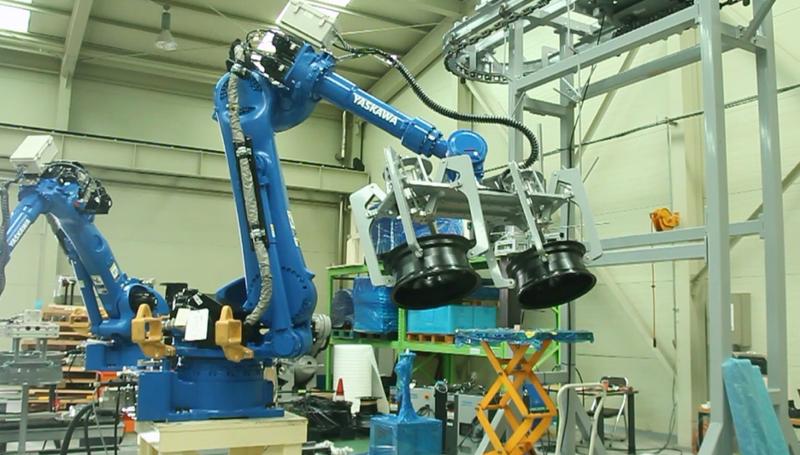
This loading/unloading automation solution uses a Yaskawa robot to automate handling processes for heavy workpieces such as automotive wheels.
For automotive wheels, which are heavy workpieces weighing over 8 kg, manual handling is physically difficult and often avoided by operators. Through robotic automation, the system can handle two wheels simultaneously, increasing productivity while improving operator satisfaction.
Components
| Robot |
|
|---|---|
| Peripherals |
|
Workflow
| STEP 1. | Workpiece moves to the target position via infeed/transfer conveyor |
|---|---|
| STEP 2. | Positioning guide engages when the workpiece is detected |
| STEP 3. | Robot picks the wheel |
| STEP 4. | Load onto the discharge pallet |
Features
Improves both working environment and productivity at the same time
Prevents musculoskeletal disorders by automating heavy product handling (8 kg or more)
Shortens cycle time by handling two workpieces simultaneously
Performs continuous operation while maintaining transfer tasks via the conveyor
Enables optimized design and pre-validation based on process conditions
Enables optimized tool design and manufacturing based on process conditions and performance requirements
Designs tools and layouts to enable simultaneous handling of two workpieces
Enables accurate picking even under high-variability conditions (chain conveyor characteristics)
Enables pre-validation of interference and operational performance through offline simulation
Results
| Key Benefits | Improved productivity through reduced cycle time
Prevented musculoskeletal disorders for operators |
|---|---|
| Client Feedback | Since handling heavy products was physically demanding, operators struggled with the process. Through automation, we were able to reassign operators to other processes and improve both work efficiency and productivity. We initially thought automation would be difficult due to chain conveyor instability and vibration, but we succeeded with the J-Tech solution. |
Unauthorized copying or reproduction of any content on Marosol may violate the Unfair Competition Prevention Act and Copyright Act.
Recommended Solution

Gear Tooth Profile Inspection using NACHI MZ07 + QRS Vision
Process Overview This solution automates gear tooth profile inspection and sorting by combining QRS 2D/3D vision inspection with the NACHI MZ07 robot. It detects the position of randomly stacked gears, performs shape inspection, and classifies parts into OK/NG automatically. Since the vision system is developed by QRS, it can be tuned and customized to match on-site requirements, enabling accurate inspection across various product shapes.

Automotive Parts Roll Forming & Deburring Automation with Kawasaki and ABB Robots
Process Overview This solution uses a total of four robots—one KAWASAKI ZX165U, two ABB IRB 2600 units, and one ABB IRB 6700—to transfer automotive parts after roll forming and perform deburring operations. By transferring parts to the next process in sync with the continuous forming cycle time, it reduces operation time and maximizes productivity.

NACHI MZ07L-based Air-Blowing Automation for Automotive Brake Parts
Process Overview This solution automates the air-blowing process for automotive brake components using a NACHI MZ07L robot, replacing manual operations with a consistent, repeatable robotic process. With conveyor tracking, the robot performs air-blowing during part transfer, reducing cycle time and stabilizing downstream quality.
Process layout
Process Overview
This loading/unloading automation solution uses a Yaskawa robot to automate handling processes for heavy workpieces such as automotive wheels.
For automotive wheels, which are heavy workpieces weighing over 8 kg, manual handling is physically difficult and often avoided by operators. Through robotic automation, the system can handle two wheels simultaneously, increasing productivity while improving operator satisfaction.
Components
| Robot |
|
|---|---|
| Peripherals |
|
Workflow
| STEP 1. | Workpiece moves to the target position via infeed/transfer conveyor |
|---|---|
| STEP 2. | Positioning guide engages when the workpiece is detected |
| STEP 3. | Robot picks the wheel |
| STEP 4. | Load onto the discharge pallet |
Features
Improves both working environment and productivity at the same time
Prevents musculoskeletal disorders by automating heavy product handling (8 kg or more)
Shortens cycle time by handling two workpieces simultaneously
Performs continuous operation while maintaining transfer tasks via the conveyor
Enables optimized design and pre-validation based on process conditions
Enables optimized tool design and manufacturing based on process conditions and performance requirements
Designs tools and layouts to enable simultaneous handling of two workpieces
Enables accurate picking even under high-variability conditions (chain conveyor characteristics)
Enables pre-validation of interference and operational performance through offline simulation
Results
| Key Benefits | Improved productivity through reduced cycle time
Prevented musculoskeletal disorders for operators |
|---|---|
| Client Feedback | Since handling heavy products was physically demanding, operators struggled with the process. Through automation, we were able to reassign operators to other processes and improve both work efficiency and productivity. We initially thought automation would be difficult due to chain conveyor instability and vibration, but we succeeded with the J-Tech solution. |
Unauthorized copying or reproduction of any content on Marosol may violate the Unfair Competition Prevention Act and Copyright Act.
Recommended Solution
Gear Tooth Profile Inspection using NACHI MZ07 + QRS Vision
Process Overview This solution automates gear tooth profile inspection and sorting by combining QRS 2D/3D vision inspection with the NACHI MZ07 robot. It detects the position of randomly stacked gears, performs shape inspection, and classifies parts into OK/NG automatically. Since the vision system is developed by QRS, it can be tuned and customized to match on-site requirements, enabling accurate inspection across various product shapes.
Automotive Parts Roll Forming & Deburring Automation with Kawasaki and ABB Robots
Process Overview This solution uses a total of four robots—one KAWASAKI ZX165U, two ABB IRB 2600 units, and one ABB IRB 6700—to transfer automotive parts after roll forming and perform deburring operations. By transferring parts to the next process in sync with the continuous forming cycle time, it reduces operation time and maximizes productivity.
NACHI MZ07L-based Air-Blowing Automation for Automotive Brake Parts
Process Overview This solution automates the air-blowing process for automotive brake components using a NACHI MZ07L robot, replacing manual operations with a consistent, repeatable robotic process. With conveyor tracking, the robot performs air-blowing during part transfer, reducing cycle time and stabilizing downstream quality.