
Process layout
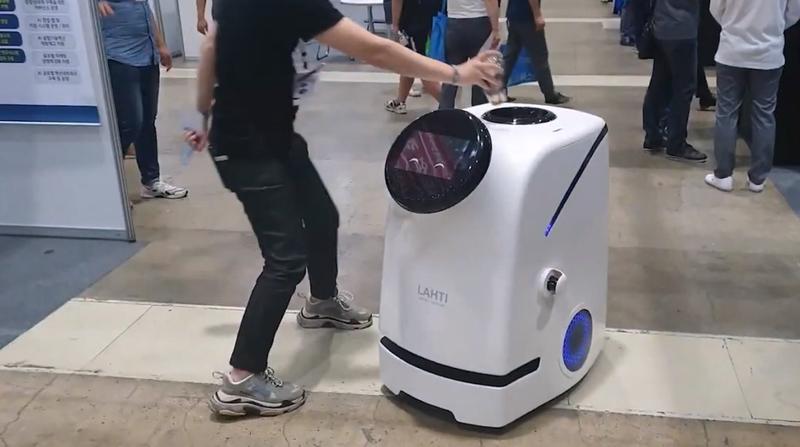
Rati is a rental-ready, autonomous trash bin robot designed for high-traffic customer areas such as exhibitions and hospitals. It is a service robot that not only sparks visitor curiosity but also enhances the overall cleanliness of the environment.
The system can be easily deployed without any additional infrastructure, and its human-friendly design and interface are highly effective at engaging customers. Furthermore, the display mounted on the front of the robot allows for various event promotions and advertisements, delivering a "triple-threat" effect of hygiene, engagement, and marketing.
Components
| Robot | Mobile Service Robot
|
|---|---|
| Peripherals | - |
Workflow
| STEP 1. | Moves freely within the designated area |
|---|---|
| STEP 2. | Stops and evasives when a person approaches |
| STEP 3. | Displays an alarm and moves to the disposal location when the trash can is full |
Features
Easy installation
Minimize implementation time and cost with simple installation
It is possible to determine one's own location and search for a path without installing separate equipment, enabling reduced implementation time and cost savings by eliminating the need for additional facilities
Flexible response possible when changing layout or work location
Composed of modular components, it can be used for various purposes by attaching or detaching modules (trash can/item transport/ Disinfection Robot robot, etc.)
A friendly robot
Human-friendly exterior design and human interface
It conveys a friendly image to people through its soft, curved exterior
It is possible to convey a friendly image and emotion to people through the front display
Customer-tailored services, such as promotions, are available through the front display
All-in-one rental program
Rental & Service Program
Initial investment costs can be reduced through the rental program
Service management and response to issues are possible through the control and remote center (when 5G network is established)
Regular maintenance services can be performed
Results
| Key Benefits | Qualitative Indicators: Improvement in cleanliness within the reception area
Enhancement of customer image through increased customer satisfaction and engagement
Increased marketing effectiveness through the use of displays |
|---|---|
| Client Feedback | Customers found disposing of trash fun, which stimulated their interest and improved the cleanliness of the space, allowing us to achieve a double benefit. |
Unauthorized copying or reproduction of any content on Marosol may violate the Unfair Competition Prevention Act and Copyright Act.
Recommended Solution

Moderntec Electric Vehicle Automatic Charging System (RACS) using Doosan's Collaborative Robot
Moderntek’s Robot Arm Charger System (RACS) is a charging automation system utilizing Collaborative to enable 24-hour 1:N automatic charging for the convenience and safety of electric Automotive charging stations. Because the RACS system charges multiple Automotive simultaneously and sequentially using a single robot and power unit, it can be implemented at a lower cost (approximately 60%) compared to competitor products. * Estimated costs are subject to change depending on charger capacity (120–240kW) and robot rail structure (ground-mounted or ceiling-mounted).

The Application of LG CLOi Serving Robot (Shelf Type) at SFAW Exhibition
This application demonstrates the use of the LG CLOi ServeBot (Tray type), developed by LG Electronics, to place pamphlets and drive along a designated route in cruise mode. The LG CLOi ServeBot (Tray type) is divided into an entry-level Serving robot (T1) suitable for small stores and a standard Serving robot (T2) capable of self-service. It autonomously travels from the kitchen to the customer's table and automatically detects when a customer removes food from the shelf to move to the next destination. It also provides an escort function to Guide customers from the store entrance to their seats.

The Industrial Cleaning Robot Takes Charge of Shinjeon Tteokbokki's Hygiene Management! 😎
This case study involves the introduction of industrial cleaning robots to provide a pleasant environment at the Shinjeon Tteokbokki factory/company. The introduced robots, Phantas and VC40, are being utilized in various spaces, including Shinjeon Tteokbokki's manufacturing lines, the Shinjeon Museum (Tteokbokki Museum), and even the tennis courts for employee welfare. In particular, the introduction of the robots has significantly improved work efficiency and hygiene management, contributing to the provision of a pleasant space where both employees and customers can feel safe.