




Process layout
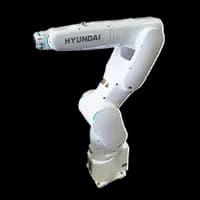
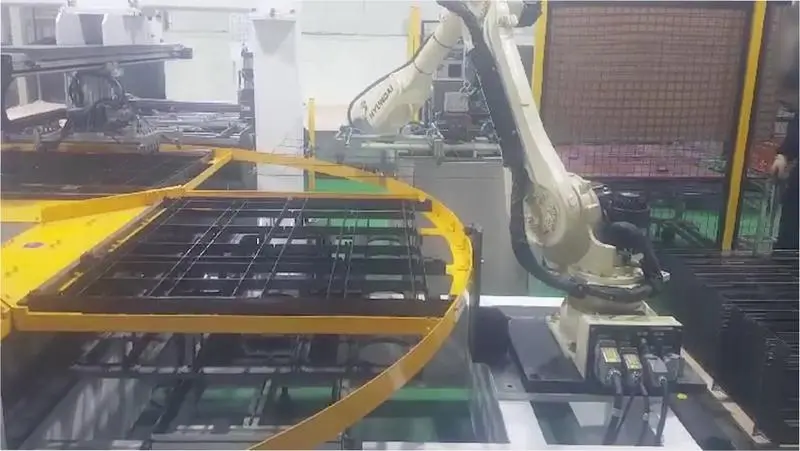
This application is a solution that implements welding automation using the Hyundai HH020.
Before automation, when humans performed this process, there was an issue where the quality of the finished product varied depending on the worker's skill level. Additionally, as a dangerous process, workers were always exposed to the risk of industrial accidents. Furthermore, securing labor was difficult due to the avoidance of 3D (Dirty, Dangerous, and Difficult) industries. By replacing tasks previously performed by humans with robots through this solution, it is possible to prevent industrial accidents and ensure consistent quality.
Components
| Robot | Robot Hyundai HH020: 6-axis articulated, payload 20kg, horizontal reach 1,742mm, weight 225kg, repeatability: ± 0.06 mm |
|---|
Workflow
| STEP 1. | Cartesian robot arranges products and adjusts positions. |
|---|---|
| STEP 2. | Welding robot performs spot welding. |
| STEP 3. | Welding of the coating hook part. |
| STEP 4. | Loading finished products with the HH020. |
| STEP 5. | Repeat the previous process |
Features
Increased productivity by replacing all manual tasks with robots
: Performs everything from basic forming and bending to spot welding, coating hook welding, and final palletizing
Consistent repetitive production at a constant speed allows for easier scheduling and improved production efficiency
Enhanced quality through minimized welding errors
Affordable solution that replaces humans in dangerous tasks
: Robots perform high-risk tasks previously prone to industrial accidents
Prevents musculoskeletal disorders caused by handling heavy and large workpieces
Eligible for government support through the Ministry of SMEs and Startups' Smart Manufacturing Innovation project
Results
| Key Benefits | Improved welding quality
Productivity increased to expert level
Preparedness for the Serious Accidents Punishment Act |
|---|---|
| Client Feedback | By implementing robot automation with welding robots, we achieved uniform product quality and significantly increased production efficiency.
|
Unauthorized copying or reproduction of any content on Marosol may violate the Unfair Competition Prevention Act and Copyright Act.
Recommended Solution

Bolt Fastening Automation Using Hanwha Momentum HCR-12A
This application is a solution that automates bolt fastening using two Hanwha Momentum HCR-12A collaborative robots. Bolt fastening often leads to task failure even if the position is slightly off, and products can be damaged or misassembled if not assembled with appropriate force. The high positioning precision of the HCR-12A minimizes errors and allows for the task to be performed.

ARC Welding using the Rainbow Robotics RB-5
Process Overview This welding automation solution uses the Rainbow Robotics RB-5 and a NOUBELON DIGITAL MIG/MAG welder to weld cylindrical workpieces onto a plate, featuring fast teaching and high space efficiency. In manual welding, quality can vary significantly depending on operator skill, and the harsh working environment makes it difficult to secure experienced welders. With this cell, even non-expert operators can simply load and unload parts, while the robot performs the critical welding process—enabling consistent weld quality and stable production output.

Why Did Luminous Robotics Entrust Solar Panel Installation to a Mobile Manipulator (Mobile robot arm) for Automation?
Gemini의 응답 Project Overview This solution, applied to a large-scale solar power plant construction site in Australia, is an automation system for installation based on a Mobile Manipulator, centered around 'LUMI', an autonomous mobile robot developed by Luminous Robotics. The site presented challenging conditions for human workers, including high temperatures, strong winds, and rough terrain. Consequently, there has been a rising demand for Construction Automation due to labor shortages and increasing labor costs. LUMI is a mobile robot arm designed to install heavy solar panels quickly and accurately, featuring an integrated structure of autonomous driving capabilities, a robot arm, and high-precision sensors. Notably, it is designed to integrate seamlessly with existing labor-centered installation methods, enabling a transition to site automation without requiring separate infrastructure changes. Project Background & Objectives Background While Australia has an environment favorable for creating large-scale solar power complexes due to abundant solar radiation, the nature of remote areas—where securing construction labor is difficult—has led to continuous issues with slow installation speeds and rising costs. In particular, with panels weighing over 36kg, repetitive installation tasks under hot and humid conditions increased the risk of worker injury and led to decreased productivity. Objectives Improve solar panel installation speed and reduce labor costs Ensure consistency in installation quality Secure operational safety in extreme environments Establish a foundation for large-scale automation to expand Renewable Energy infrastructure
Process layout
This application is a solution that implements welding automation using the Hyundai HH020.
Before automation, when humans performed this process, there was an issue where the quality of the finished product varied depending on the worker's skill level. Additionally, as a dangerous process, workers were always exposed to the risk of industrial accidents. Furthermore, securing labor was difficult due to the avoidance of 3D (Dirty, Dangerous, and Difficult) industries. By replacing tasks previously performed by humans with robots through this solution, it is possible to prevent industrial accidents and ensure consistent quality.
Components
| Robot | Robot Hyundai HH020: 6-axis articulated, payload 20kg, horizontal reach 1,742mm, weight 225kg, repeatability: ± 0.06 mm |
|---|
Workflow
| STEP 1. | Cartesian robot arranges products and adjusts positions. |
|---|---|
| STEP 2. | Welding robot performs spot welding. |
| STEP 3. | Welding of the coating hook part. |
| STEP 4. | Loading finished products with the HH020. |
| STEP 5. | Repeat the previous process |
Features
Increased productivity by replacing all manual tasks with robots
: Performs everything from basic forming and bending to spot welding, coating hook welding, and final palletizing
Consistent repetitive production at a constant speed allows for easier scheduling and improved production efficiency
Enhanced quality through minimized welding errors
Affordable solution that replaces humans in dangerous tasks
: Robots perform high-risk tasks previously prone to industrial accidents
Prevents musculoskeletal disorders caused by handling heavy and large workpieces
Eligible for government support through the Ministry of SMEs and Startups' Smart Manufacturing Innovation project
Results
| Key Benefits | Improved welding quality
Productivity increased to expert level
Preparedness for the Serious Accidents Punishment Act |
|---|---|
| Client Feedback | By implementing robot automation with welding robots, we achieved uniform product quality and significantly increased production efficiency.
|
Unauthorized copying or reproduction of any content on Marosol may violate the Unfair Competition Prevention Act and Copyright Act.
Recommended Solution
Bolt Fastening Automation Using Hanwha Momentum HCR-12A
This application is a solution that automates bolt fastening using two Hanwha Momentum HCR-12A collaborative robots. Bolt fastening often leads to task failure even if the position is slightly off, and products can be damaged or misassembled if not assembled with appropriate force. The high positioning precision of the HCR-12A minimizes errors and allows for the task to be performed.
ARC Welding using the Rainbow Robotics RB-5
Process Overview This welding automation solution uses the Rainbow Robotics RB-5 and a NOUBELON DIGITAL MIG/MAG welder to weld cylindrical workpieces onto a plate, featuring fast teaching and high space efficiency. In manual welding, quality can vary significantly depending on operator skill, and the harsh working environment makes it difficult to secure experienced welders. With this cell, even non-expert operators can simply load and unload parts, while the robot performs the critical welding process—enabling consistent weld quality and stable production output.
Why Did Luminous Robotics Entrust Solar Panel Installation to a Mobile Manipulator (Mobile robot arm) for Automation?
Gemini의 응답 Project Overview This solution, applied to a large-scale solar power plant construction site in Australia, is an automation system for installation based on a Mobile Manipulator, centered around 'LUMI', an autonomous mobile robot developed by Luminous Robotics. The site presented challenging conditions for human workers, including high temperatures, strong winds, and rough terrain. Consequently, there has been a rising demand for Construction Automation due to labor shortages and increasing labor costs. LUMI is a mobile robot arm designed to install heavy solar panels quickly and accurately, featuring an integrated structure of autonomous driving capabilities, a robot arm, and high-precision sensors. Notably, it is designed to integrate seamlessly with existing labor-centered installation methods, enabling a transition to site automation without requiring separate infrastructure changes. Project Background & Objectives Background While Australia has an environment favorable for creating large-scale solar power complexes due to abundant solar radiation, the nature of remote areas—where securing construction labor is difficult—has led to continuous issues with slow installation speeds and rising costs. In particular, with panels weighing over 36kg, repetitive installation tasks under hot and humid conditions increased the risk of worker injury and led to decreased productivity. Objectives Improve solar panel installation speed and reduce labor costs Ensure consistency in installation quality Secure operational safety in extreme environments Establish a foundation for large-scale automation to expand Renewable Energy infrastructure