



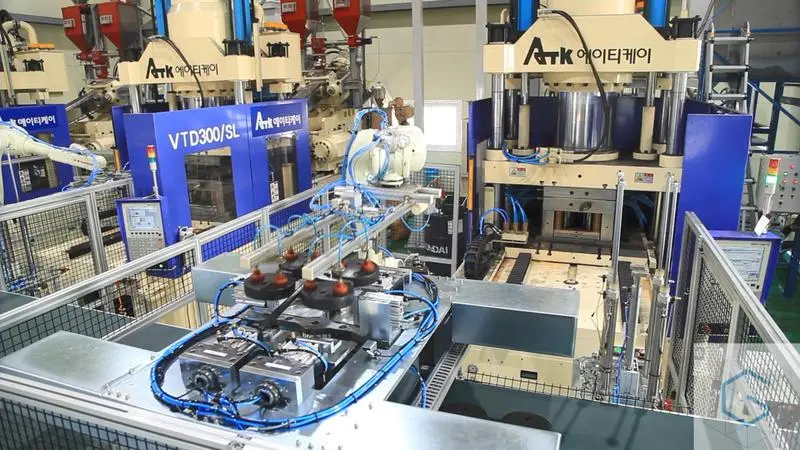
Process layout
This application case features an automated injection molding solution utilizing the Kawasaki RS020N. The system is designed to extract products made from a mixture of recycled plastic and iron oxide. It includes a process to compress the parts for a set duration to prevent deformation caused by internal high heat, followed by the removal and separation of the runners.
Components
| Robot |
|
|---|
Workflow
| STEP 1. | Extraction: Extract the molded product from the injection molding machine. |
|---|---|
| STEP 2. | Compression: Insert the product into the compressor and extract it after the designated time. |
| STEP 3. | Cutting: Feed the product into the cutting machine. |
| STEP 4. | Separation: Separate the runners and discharge the finished product. |
Features
Integrated Control System: A robot-only control method that manages the compressor and cutter collectively.
High-Temperature Handling: Extracts 7kg high-heat products using vacuum pads for subsequent compression and cutting.
Automated Sorting: Extracted runners are separated and stacked in a dedicated discharge area.
Results
| Key Benefits | Safety Enhancement: Eliminates risk of burns and contusions associated with manual handling of high-temperature heavy loads.
Quality Control: Solves product deformation issues caused by internal heat through an automated compression process.
Workflow Simplification: Reduces worker workload by automatically separating and processing runners and products.
|
|---|---|
| Client Feedback | "Handling 7kg products at nearly 100°C used to cause frequent minor and major burns to our workers' hands and arms, but that risk has been completely eliminated. We also struggled with products swelling due to residual heat after extraction, but the automated compression process solved the deformation issue. Eliminating manual runner separation has simplified the workflow, leading to high satisfaction on the shop floor."
|
Unauthorized copying or reproduction of any content on Marosol may violate the Unfair Competition Prevention Act and Copyright Act.
Recommended Solution

Automated Nut Loading Into the Machine Tool—Plus Complete Teaching Support!
Process Overview Philliper had been handling the process of inserting nuts into the machine tool manually. Due to the repetitive nature of the work and insufficient precision, this led to reduced productivity and quality issues. To resolve this, they implemented an automation solution using four Hyundai robots and two Doosan robots. Project Background and Objectives Background Philliper was experiencing work inefficiency and inconsistent quality in the existing nut-loading operation due to a manual process. Key issues Speed loss and quality variation occurring during manual operations Increased operator fatigue and reduced productivity Operator burden caused by repetitive tasks in the nut insertion process Objectives Improve production efficiency by automating repetitive tasks through robot deployment Secure consistent quality and reduce defect rates through accurate insertion Improve the work environment by reducing operator fatigue and strengthening safety

Electronic Component Insert Molding Automation using a Yushin Take-Out Robot
Process Overview This assembly automation solution uses a YUSHIN take-out robot (SCⅡ-150) to automate the process of insert-molding a steel plate into a plastic injection-molded part during production. By automating both the insert-loading operation and the downstream inspection process, the system minimizes control points while improving overall productivity.

Automotive Wheel Handling Automation using Yaskawa Robot
Process Overview This loading/unloading automation solution uses a Yaskawa robot to automate handling processes for heavy workpieces such as automotive wheels. For automotive wheels, which are heavy workpieces weighing over 8 kg, manual handling is physically difficult and often avoided by operators. Through robotic automation, the system can handle two wheels simultaneously, increasing productivity while improving operator satisfaction.
Process layout
This application case features an automated injection molding solution utilizing the Kawasaki RS020N. The system is designed to extract products made from a mixture of recycled plastic and iron oxide. It includes a process to compress the parts for a set duration to prevent deformation caused by internal high heat, followed by the removal and separation of the runners.
Components
| Robot |
|
|---|
Workflow
| STEP 1. | Extraction: Extract the molded product from the injection molding machine. |
|---|---|
| STEP 2. | Compression: Insert the product into the compressor and extract it after the designated time. |
| STEP 3. | Cutting: Feed the product into the cutting machine. |
| STEP 4. | Separation: Separate the runners and discharge the finished product. |
Features
Integrated Control System: A robot-only control method that manages the compressor and cutter collectively.
High-Temperature Handling: Extracts 7kg high-heat products using vacuum pads for subsequent compression and cutting.
Automated Sorting: Extracted runners are separated and stacked in a dedicated discharge area.
Results
| Key Benefits | Safety Enhancement: Eliminates risk of burns and contusions associated with manual handling of high-temperature heavy loads.
Quality Control: Solves product deformation issues caused by internal heat through an automated compression process.
Workflow Simplification: Reduces worker workload by automatically separating and processing runners and products.
|
|---|---|
| Client Feedback | "Handling 7kg products at nearly 100°C used to cause frequent minor and major burns to our workers' hands and arms, but that risk has been completely eliminated. We also struggled with products swelling due to residual heat after extraction, but the automated compression process solved the deformation issue. Eliminating manual runner separation has simplified the workflow, leading to high satisfaction on the shop floor."
|
Unauthorized copying or reproduction of any content on Marosol may violate the Unfair Competition Prevention Act and Copyright Act.
Recommended Solution
Automated Nut Loading Into the Machine Tool—Plus Complete Teaching Support!
Process Overview Philliper had been handling the process of inserting nuts into the machine tool manually. Due to the repetitive nature of the work and insufficient precision, this led to reduced productivity and quality issues. To resolve this, they implemented an automation solution using four Hyundai robots and two Doosan robots. Project Background and Objectives Background Philliper was experiencing work inefficiency and inconsistent quality in the existing nut-loading operation due to a manual process. Key issues Speed loss and quality variation occurring during manual operations Increased operator fatigue and reduced productivity Operator burden caused by repetitive tasks in the nut insertion process Objectives Improve production efficiency by automating repetitive tasks through robot deployment Secure consistent quality and reduce defect rates through accurate insertion Improve the work environment by reducing operator fatigue and strengthening safety
Electronic Component Insert Molding Automation using a Yushin Take-Out Robot
Process Overview This assembly automation solution uses a YUSHIN take-out robot (SCⅡ-150) to automate the process of insert-molding a steel plate into a plastic injection-molded part during production. By automating both the insert-loading operation and the downstream inspection process, the system minimizes control points while improving overall productivity.
Automotive Wheel Handling Automation using Yaskawa Robot
Process Overview This loading/unloading automation solution uses a Yaskawa robot to automate handling processes for heavy workpieces such as automotive wheels. For automotive wheels, which are heavy workpieces weighing over 8 kg, manual handling is physically difficult and often avoided by operators. Through robotic automation, the system can handle two wheels simultaneously, increasing productivity while improving operator satisfaction.