
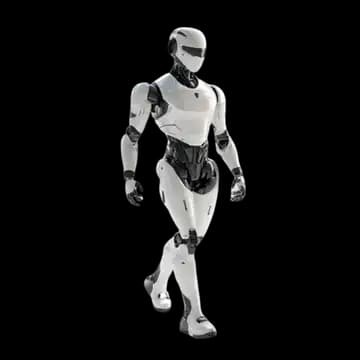
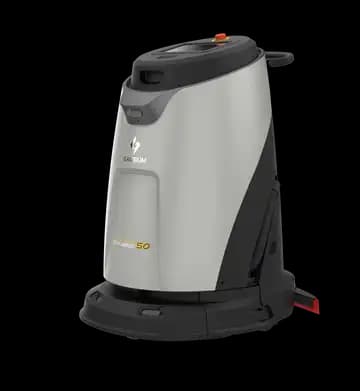
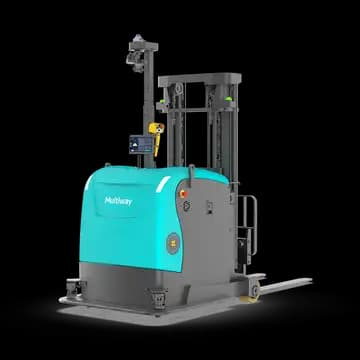

This logistics automation solution utilizes two Twinny NarGo 100 AMRs equipped with advanced collision avoidance to transport incoming component pallets to subsequent processing areas.
Twinny’s NarGo 100 solution features triple-layer safety sensors and autonomous driving technology, allowing it to operate safely in any factory environment—even those with complex layouts and high pedestrian traffic.
In the previous manual process, after forklifts unloaded parts at the receiving dock, downstream workers had to leave their stations to retrieve the pallets. This resulted in significant process wait times and idle periods. By implementing autonomous robots, components are transported directly to the internal workstations immediately after arrival. This minimizes "external setup time" (non-value-added transport time) and substantially boosts overall productivity.
Components
| Robot |
|
|---|
Workflow
| STEP 1. | Loading: A forklift places the incoming pallet onto the waiting NarGo 100. |
|---|---|
| STEP 2. | Command: Once loading is complete, an operator issues a command for the robot to move to the next process. |
| STEP 3. | Navigation: The robot autonomously navigates to the designated downstream workstation. |
| STEP 4. | Arrival: The robot arrives at the designated production line input point. |
| STEP 5. | Unloading: A nearby worker removes the components and feeds them into the production line. |
| STEP 6. | Return: After unloading, a command is issued for the robot to return to the receiving dock for the next mission. |
※ The content provided by Bigwave Robotics is protected under U.S. and Canadian copyright and intellectual property laws. Unauthorized reproduction, distribution, or use of this content is strictly prohibited.
Recommended Use Cases

Position and Orientation Compensation using Hyundai HH7 and Conveyor Tracking
This logistics automation solution utilizes the Hyundai HH7 robot, the HRVision 3D vision system, and conveyor tracking technology to automate the manual task of recognizing text on boxes and aligning them according to the text orientation. By leveraging the high-speed processing of HRVision, the system can identify product images while in motion. Combined with conveyor tracking, the robot can pick and align moving objects without stopping the belt, ensuring a seamless and highly efficient workflow.

Logistics Robot 'KARRY' by DOGU
The autonomous logistics robot KARRY by DOGU KONGAN is a robotic solution designed for logistics centers, factories, and warehouses. It optimizes operations by either following a human worker to transport cargo or navigating autonomously to designated locations. The primary objective of this project was to automate heavy-load transport tasks to resolve the issue of cumulative worker fatigue. In this setup, human workers remain at fixed stations while the logistics transport process itself is fully automated. Featuring efficient and safe autonomous navigation, KARRY is easy to deploy in any logistics environment due to its intuitive user-recognition system and low barrier to entry.

Processed Parts Transfer using Potenit Mobile Manipulator & 5G Integration
This logistics automation solution utilizes a Mobile Manipulator integrated with 5G technology to transfer workpieces between distant processing stages. Potenit's AMR solution can be deployed easily without the need for additional infrastructure (like floor markers or rails) and offers high flexibility when layouts or work positions change. Through Potenit's proprietary MOS (Multi Robot Operating System), operators can monitor and direct tasks in real-time via mobile devices. By syncing equipment data with the AMR, the system automates the necessary tasks between pre- and post-processing stages. It is an ideal solution for 24/7 operations that require high productivity without human intervention. *This specific solution involved Potenit supplying the AMR and Doosan Robotics arm to ETRI (Electronics and Telecommunications Research Institute), followed by 5G integration. Detailed tool fabrication and task-specific teaching/tuning were conducted internally by ETRI.
This logistics automation solution utilizes two Twinny NarGo 100 AMRs equipped with advanced collision avoidance to transport incoming component pallets to subsequent processing areas.
Twinny’s NarGo 100 solution features triple-layer safety sensors and autonomous driving technology, allowing it to operate safely in any factory environment—even those with complex layouts and high pedestrian traffic.
In the previous manual process, after forklifts unloaded parts at the receiving dock, downstream workers had to leave their stations to retrieve the pallets. This resulted in significant process wait times and idle periods. By implementing autonomous robots, components are transported directly to the internal workstations immediately after arrival. This minimizes "external setup time" (non-value-added transport time) and substantially boosts overall productivity.
Components
| Robot |
|
|---|
Workflow
| STEP 1. | Loading: A forklift places the incoming pallet onto the waiting NarGo 100. |
|---|---|
| STEP 2. | Command: Once loading is complete, an operator issues a command for the robot to move to the next process. |
| STEP 3. | Navigation: The robot autonomously navigates to the designated downstream workstation. |
| STEP 4. | Arrival: The robot arrives at the designated production line input point. |
| STEP 5. | Unloading: A nearby worker removes the components and feeds them into the production line. |
| STEP 6. | Return: After unloading, a command is issued for the robot to return to the receiving dock for the next mission. |
※ The content provided by Bigwave Robotics is protected under U.S. and Canadian copyright and intellectual property laws. Unauthorized reproduction, distribution, or use of this content is strictly prohibited.