


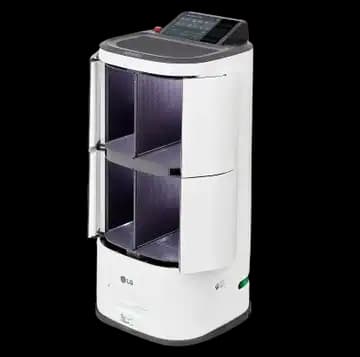

The autonomous logistics robot KARRY by DOGU KONGAN is a robotic solution designed for logistics centers, factories, and warehouses. It optimizes operations by either following a human worker to transport cargo or navigating autonomously to designated locations.
The primary objective of this project was to automate heavy-load transport tasks to resolve the issue of cumulative worker fatigue. In this setup, human workers remain at fixed stations while the logistics transport process itself is fully automated. Featuring efficient and safe autonomous navigation, KARRY is easy to deploy in any logistics environment due to its intuitive user-recognition system and low barrier to entry.
Components
| Robot |
|
|---|
Workflow
| STEP 1. | Person Following: The robot follows the worker to the specific task location. |
|---|---|
| STEP 2. | Loading: The worker loads products onto KARRY’s shelves. |
| STEP 3. | Instruction: Once loading is complete, a command is given to move to the next location. |
| STEP 4. | Autonomous Navigation: The robot moves to the designated destination independently. |
| STEP 5. | Unloading: A worker at the destination performs the unloading of the delivered goods. |
※ The content provided by Bigwave Robotics is protected under U.S. and Canadian copyright and intellectual property laws. Unauthorized reproduction, distribution, or use of this content is strictly prohibited.
Recommended Use Cases

Indoor Logistics Transport using VisionNav VNP15
Indoor Logistics Transport using VisionNav VNP15 This application case is an automated loading and unloading solution that utilizes VisionNav's VNP15 to automate the process of transporting and stacking packed products. Based on strict safety features, it minimizes changes to existing processes, enables unmanned loading/unloading tasks, and allows for effective monitoring and control of the work status.

Unmanned Warehouse System using Geek+ P800
This application case features an unmanned warehouse system utilizing the Geek+ P800 picking robot. By distinguishing between long-term storage items and high-frequency goods, the system implements an intelligent warehouse management model that enhances customer accessibility and convenience. This solution maximizes space utilization by storing a high volume of goods within a compact footprint.

LG CNS Smart Logistics Equipment (Hybrid Wheel Sorter)
This application case features the LG CNS Hybrid Wheel Sorter, a smart logistics solution that enhances sorting accuracy and stability by improving the structural drawbacks of conventional circular roller wheel sorters through a belt-type application. It is an ideal solution for scenarios requiring the stable sorting of long items, sacks, and irregular-shaped cargo. The Belt-Type Wheel Sorter is a next-generation wheel sorter developed to overcome sorting errors caused by the narrow contact surfaces of traditional circular rollers. By replacing circular rollers with belt-type rollers, the contact area with the cargo is widened, significantly improving both sorting precision and stability. Additionally, its modular configuration ensures easy installation and maintenance. This system enables the construction of efficient logistics centers capable of handling high throughput by stably transporting and sorting diverse types of goods.
The autonomous logistics robot KARRY by DOGU KONGAN is a robotic solution designed for logistics centers, factories, and warehouses. It optimizes operations by either following a human worker to transport cargo or navigating autonomously to designated locations.
The primary objective of this project was to automate heavy-load transport tasks to resolve the issue of cumulative worker fatigue. In this setup, human workers remain at fixed stations while the logistics transport process itself is fully automated. Featuring efficient and safe autonomous navigation, KARRY is easy to deploy in any logistics environment due to its intuitive user-recognition system and low barrier to entry.
Components
| Robot |
|
|---|
Workflow
| STEP 1. | Person Following: The robot follows the worker to the specific task location. |
|---|---|
| STEP 2. | Loading: The worker loads products onto KARRY’s shelves. |
| STEP 3. | Instruction: Once loading is complete, a command is given to move to the next location. |
| STEP 4. | Autonomous Navigation: The robot moves to the designated destination independently. |
| STEP 5. | Unloading: A worker at the destination performs the unloading of the delivered goods. |
※ The content provided by Bigwave Robotics is protected under U.S. and Canadian copyright and intellectual property laws. Unauthorized reproduction, distribution, or use of this content is strictly prohibited.