




Process layout
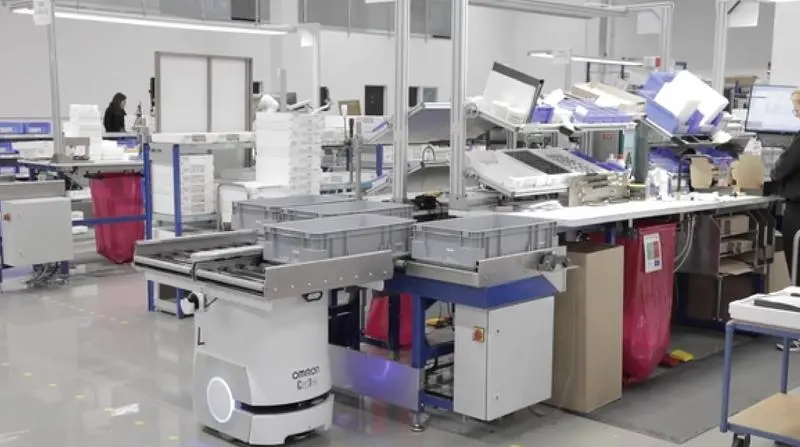
This solution implements in-line product transport using OMRON's LD-60/90.
OMRON’s LD-60/90 mobile robots are Autonomous Mobile Robots (AMRs) that create their own maps and navigate autonomously along optimal paths according to real-time changes on-site. By mounting a conveyor on top of the LD-60/90, it can perform automated transport tasks, such as loading or unloading goods from existing conveyor systems. A total of nine LD mobile robots were used, and their flow is managed by an advanced fleet management system (FLOW, Fleet Operations Workspace). This solution, utilizing roller conveyors, enables more flexible production within the line.
Components
| Robot |
|
|---|
Workflow
| STEP 1. | Robot job inquiry is generated by the ACS and transmitted to the EM via communication. |
|---|---|
| STEP 2. | Robot job allocation, path planning, and flow control are continuously managed by the EM. |
| STEP 3. | LD-60/90 receives the signal. |
| STEP 4. | Moves to the designated pick-up location. |
| STEP 5. | Loads goods using the roller conveyor. |
| STEP 6. | Navigates to the set destination. |
| STEP 7. | Unloads goods using the roller conveyor. |
| STEP 8. | Repeats the process for the next destination |
Features
Robots replacing humans in strenuous and dangerous delivery tasks
Saves time by having robots move goods instead of people
Enhances safety by removing humans from hazardous tasks and preventing injuries
Capable of continuously transporting heavy objects up to 60/90kg without fatigue
A solution adaptable to diverse environments
Compact design allows for navigation even in tight spaces
Robots are driven along optimal paths controlled by a management system
Front-facing sensors enable automatic avoidance when people approach
Battery management system ensures zero production downtime
Infrastructure-free autonomous driving allows for easy changes to routes and destinations without auxiliary devices
Logistics with increased productivity and reduced delivery errors
Decreases delivery errors by transporting goods only to precise locations
Enables continuous, tireless production
Results
| Key Benefits | Increased productivity and reduced delivery errors
Prevention of safety accidents and savings in transport time
Cost savings through the reduction of labor input
|
|---|---|
| Client Feedback | Thanks to the efficient fleet management system, we can maintain continuous production without interruptions in the manufacturing process. |
Unauthorized copying or reproduction of any content on Marosol may violate the Unfair Competition Prevention Act and Copyright Act.
Recommended Solution

Gate Cutting and Vision Inspection for Injection Molding using Extraction Robots
This application is a solution that performs injection molding gate cutting and vision inspection using an extraction robot. In plastic injection automation, extraction robots do more than just retrieve parts; they handle post-processing tasks such as gate cutting and finishing. This solution goes beyond simple cutting by integrating vision inspection into the workflow.

Haemil FA Unmanned Forklift SFL-COD140
This video information presents an autonomous logistics transport Forklift system based on SLAM (Simultaneous Localization and Mapping). It provides an autonomous unmanned method for logistics transport and stacking tasks, ensuring safety through Navigation Scan Lidar for positioning, Multi-Lidar for object and obstacle recognition, and 2D/3D cameras for pallet and cage loading. What is SLAM (Simultaneous Localization and Mapping)? It is a core technology for autonomous driving where a robot creates an accurate map of its work environment using only its onboard autonomous sensors while navigating the workspace. Project Background & Objectives Accurate and repetitive logistics tasks using autonomous robots.

CMES Palletizing Solution Revealed: Why Coupang Chose This AI-Powered Robot
Project Overview The CMES Palletizing solution is a robot automation system designed to automatically stack boxes of various sizes and shapes onto pallets. This system optimizes palletizing—one of the most critical tasks in Logistics—by integrating 3D vision and AI technology. Even when irregular boxes arrive at random, the AI independently generates optimal stacking patterns, providing high efficiency and space utilization. Project Background & Objectives Palletizing is crucial in large-scale logistics centers and manufacturing, but the increasing variety of box sizes and shapes makes manual labor time-consuming and costly. To address this, CMES has developed AI learning algorithms since 2014 and finalized an automated palletizing solution through various verification stages. This solution was specifically implemented to meet the technical need for fast and accurate processing of irregular boxes in large-scale logistics centers like Coupang.
Process layout
This solution implements in-line product transport using OMRON's LD-60/90.
OMRON’s LD-60/90 mobile robots are Autonomous Mobile Robots (AMRs) that create their own maps and navigate autonomously along optimal paths according to real-time changes on-site. By mounting a conveyor on top of the LD-60/90, it can perform automated transport tasks, such as loading or unloading goods from existing conveyor systems. A total of nine LD mobile robots were used, and their flow is managed by an advanced fleet management system (FLOW, Fleet Operations Workspace). This solution, utilizing roller conveyors, enables more flexible production within the line.
Components
| Robot |
|
|---|
Workflow
| STEP 1. | Robot job inquiry is generated by the ACS and transmitted to the EM via communication. |
|---|---|
| STEP 2. | Robot job allocation, path planning, and flow control are continuously managed by the EM. |
| STEP 3. | LD-60/90 receives the signal. |
| STEP 4. | Moves to the designated pick-up location. |
| STEP 5. | Loads goods using the roller conveyor. |
| STEP 6. | Navigates to the set destination. |
| STEP 7. | Unloads goods using the roller conveyor. |
| STEP 8. | Repeats the process for the next destination |
Features
Robots replacing humans in strenuous and dangerous delivery tasks
Saves time by having robots move goods instead of people
Enhances safety by removing humans from hazardous tasks and preventing injuries
Capable of continuously transporting heavy objects up to 60/90kg without fatigue
A solution adaptable to diverse environments
Compact design allows for navigation even in tight spaces
Robots are driven along optimal paths controlled by a management system
Front-facing sensors enable automatic avoidance when people approach
Battery management system ensures zero production downtime
Infrastructure-free autonomous driving allows for easy changes to routes and destinations without auxiliary devices
Logistics with increased productivity and reduced delivery errors
Decreases delivery errors by transporting goods only to precise locations
Enables continuous, tireless production
Results
| Key Benefits | Increased productivity and reduced delivery errors
Prevention of safety accidents and savings in transport time
Cost savings through the reduction of labor input
|
|---|---|
| Client Feedback | Thanks to the efficient fleet management system, we can maintain continuous production without interruptions in the manufacturing process. |
Unauthorized copying or reproduction of any content on Marosol may violate the Unfair Competition Prevention Act and Copyright Act.
Recommended Solution
Gate Cutting and Vision Inspection for Injection Molding using Extraction Robots
This application is a solution that performs injection molding gate cutting and vision inspection using an extraction robot. In plastic injection automation, extraction robots do more than just retrieve parts; they handle post-processing tasks such as gate cutting and finishing. This solution goes beyond simple cutting by integrating vision inspection into the workflow.
Haemil FA Unmanned Forklift SFL-COD140
This video information presents an autonomous logistics transport Forklift system based on SLAM (Simultaneous Localization and Mapping). It provides an autonomous unmanned method for logistics transport and stacking tasks, ensuring safety through Navigation Scan Lidar for positioning, Multi-Lidar for object and obstacle recognition, and 2D/3D cameras for pallet and cage loading. What is SLAM (Simultaneous Localization and Mapping)? It is a core technology for autonomous driving where a robot creates an accurate map of its work environment using only its onboard autonomous sensors while navigating the workspace. Project Background & Objectives Accurate and repetitive logistics tasks using autonomous robots.
CMES Palletizing Solution Revealed: Why Coupang Chose This AI-Powered Robot
Project Overview The CMES Palletizing solution is a robot automation system designed to automatically stack boxes of various sizes and shapes onto pallets. This system optimizes palletizing—one of the most critical tasks in Logistics—by integrating 3D vision and AI technology. Even when irregular boxes arrive at random, the AI independently generates optimal stacking patterns, providing high efficiency and space utilization. Project Background & Objectives Palletizing is crucial in large-scale logistics centers and manufacturing, but the increasing variety of box sizes and shapes makes manual labor time-consuming and costly. To address this, CMES has developed AI learning algorithms since 2014 and finalized an automated palletizing solution through various verification stages. This solution was specifically implemented to meet the technical need for fast and accurate processing of irregular boxes in large-scale logistics centers like Coupang.