
Process layout
Process Overview
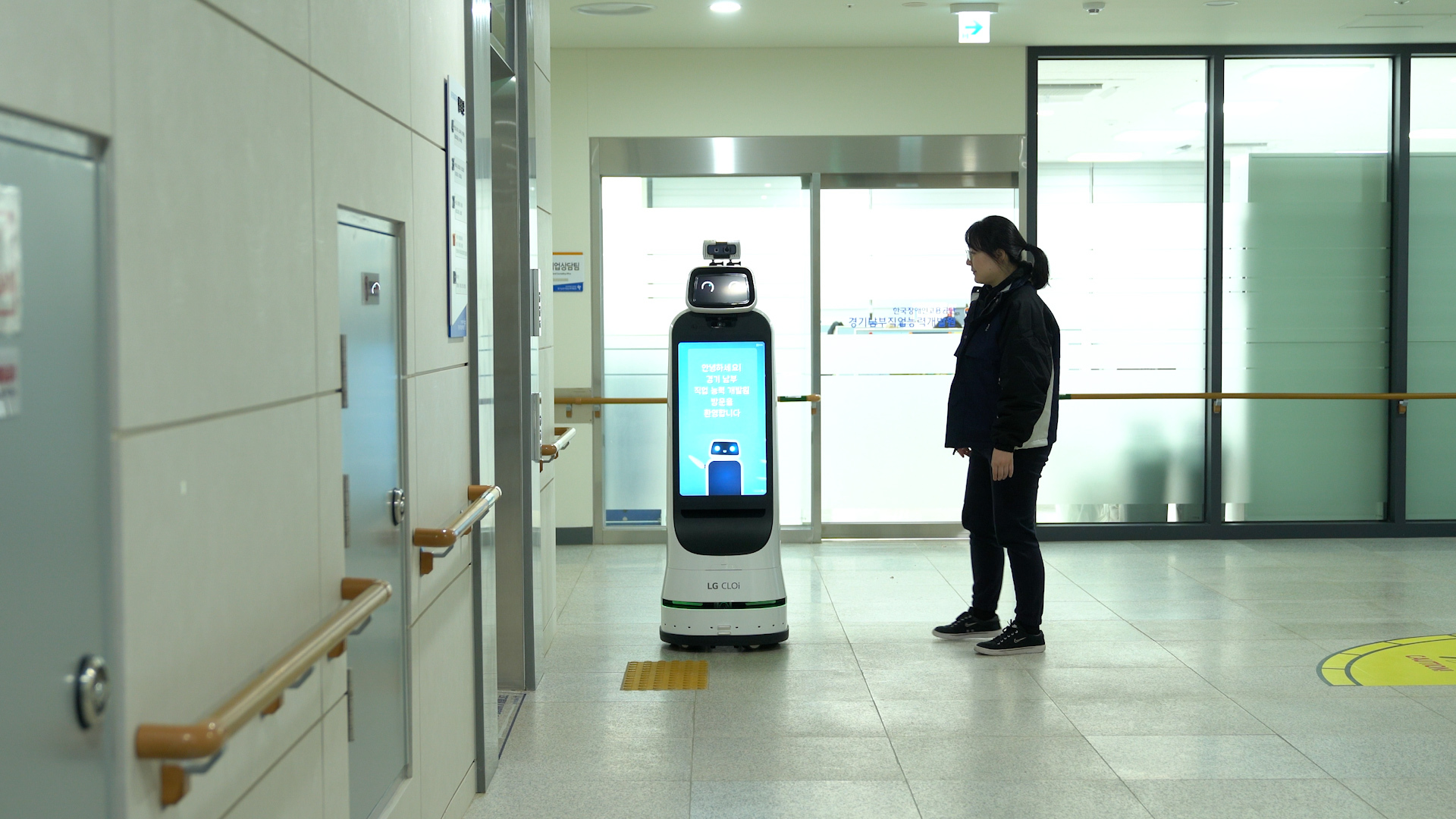
The Korea Employment Agency for Persons with Disabilities (Gyeonggi Southern Vocational Ability Development Center) introduced LG CLOi guide robots through Bigwave Robotics (Marosol) so that various users, including students, outside instructors, and visitors, can find educational facilities and office spaces more easily and conveniently.
Beyond simple wayfinding, this project aimed to build a guidance environment that prioritizes accessibility and convenience for users with disabilities. Particularly at the 1st-floor information desk, a Barrier-Free (BF) control system was applied, designed to allow wheelchair users and individuals with disabilities to operate the robot intuitively through on-screen and voice guidance.
Furthermore, considering wheelchair movement paths, instead of having the guide robot board the elevator directly, a structure was implemented where guide robots installed on the 1st and 2nd floors are linked to provide floor-specific wayfinding. This reduced constraints on robot movement while simultaneously increasing space utilization efficiency and guidance accuracy.
Project Background and Objective
The Gyeonggi Southern Vocational Ability Development Center faced the following concerns:
Continuous demand for wayfinding due to a high volume of incoming personnel, including students, outside instructors, and visitors.
Need for an intuitive guidance system considering users with disabilities.
Guidance gaps occurring due to elevator usage during inter-floor movement.
Need for an immediate response system in case of safety accidents such as fires or falls.
To resolve these, the following objectives were set:
Establishment of an unmanned guidance service based on autonomous driving, cameras, and sensors.
Maximization of utilization efficiency through a linked guidance method via inter-floor robot integration.
Enhancement of convenience for users with disabilities by developing a Barrier-Free control system.
Implementation of fire and fall detection and on-site image storage functions using the AOD system.
Establishment of a remote control and monitoring environment based on SOLlink.
Through this introduction, the Gyeonggi Southern Vocational Ability Development Center was able to reduce the burden of repetitive manual guidance tasks while building a smart guidance environment where all users can utilize the facilities without discrimination.
Components
| Robot | Guide robot LG CLOi |
|---|---|
| Peripherals | Robot Integrated Control System SOLlink |
Workflow
| STEP 1. | A visitor selects a destination on the BF control at the 1st-floor desk (BF Control: Provides screen and voice guidance) |
|---|---|
| STEP 2. | The 1st-floor guide robot, which was at the waiting area, moves to the front of the elevator the visitor will board |
| STEP 3. | STEP 3. The 1st-floor guide robot does not board the elevator |
| STEP 4. | only the visitor boards the elevator |
| STEP 5. | When the visitor gets off on the 2nd floor, the 2nd-floor guide robot is waiting. |
| STEP 6. | The 2nd-floor guide robot provides final guidance to the location selected by the visitor. |
Features
Convenience
By applying a relay guide system, robots do not board the elevator, allowing for more efficient utilization of the elevator's interior space.
By utilizing BF control, people with disabilities can also use it more conveniently.
Remote control function using SOLlink (possible but not actually used)
Safety using front and rear cameras and sensors
Streamlining Work Processes
Smart obstacle avoidance and simple operation using paths
Simplification of automatic charging via a wireless charging station after all guide is finished
Securing outstanding safety using front and rear cameras and various sensors, as well as safe driving capabilities such as LiDAR sensors, front and rear cameras, and tilt cameras.
Results
| Key Benefits | By applying a relay Guide system, robots do not board the elevator, allowing for more efficient utilization of the elevator's interior space. |
|---|---|
| Client Feedback | Due to the large number of visiting students, external instructors, and visitors, inquiries for guide occurred repeatedly however, since the introduction of the robot, user satisfaction has increased as necessary information can be checked immediately. In particular, the overall facility experience has been significantly improved as users with disabilities can also use the facility conveniently through voice and screen guide. |
Unauthorized copying or reproduction of any content on Marosol may violate the Unfair Competition Prevention Act and Copyright Act.
Curious about the robots used?
![[해운대백병원 도입] LG전자 안내로봇 CLOi GuideBot (RSCGD20)](/_next/image?url=https%3A%2F%2Fd1fchzsdhim61l.cloudfront.net%2FStore%2Fthumbnail%2F961%2Ffd9b226b-fcc2-4260-bb19-d63cf28b5a17%2F1764117928243961.png&w=256&q=75)
Recommended Solution

Three LG CLOi Guide Robots Will Accompany Patients throughout Their Examinations! 🏥🤖 (LG CLOi Guide Robots Introduced at Haeundae Baek Hospital in Busan)
Process Overview This is a case study of Bigwave Robotics (Marosol) deploying three guide robots at Haeundae Paik Hospital to automate patient navigation. Using the LG CLOi guide robots, the hospital automatically guided patients through their examinations. The three guide robots were interconnected using the SOLlink integrated robot control system. This enabled seamless guidance for patients moving between floors. Warranty Period 1 Year Performance Year 2024 Project Background and Objectives Robots don't board elevators; patients move between floors. Robots on each floor are interconnected through a highly integrated control system (relay function). This system accompanies and guides patients as they move between floors.

From Barista Robots to Beverage Serving Robots! ☕🤖 Real-life Examples of Robot Automation At a Cafe that Transformed the Working Environment for the Disabled
The Gyeonggi Southern Vocational Training Center of the Korea Employment Agency for Persons with Disabilities has introduced a combination of the Manufacturing robot 'Servi+' and a Serving robot through Big Wave Robotics (Marosol) to reduce the repetitive movement and physical strain involved in the process of ordering, preparing, and Barista Robot beverages, and to create an environment where disabled workers can work more stably.

Miryang Elementary School Changed by the Introduction of Cleaning Robot and Guide Robot 🏫
Big Wave Robotics (Marosol) introduced the Cleaning Robot robot Phantas and the Guide robot Fomi to Miryang Elementary School. This project was undertaken to improve hygiene management within the School and enhance visitor convenience. The Cleaning Robot robot Phantas utilizes autonomous driving capabilities and high-performance sensors to automatically Cleaning Robot school hallways, classrooms, and common areas. This has reduced the workload of cleaning staff and significantly improved efficiency relative to Cleaning Robot time. Due to the School 's limited cleaning staff, there were previously instances where Cleaning Robot management was insufficient or work hours were restricted; however, satisfaction among both workers and administrators has increased since the introduction of the robots. The Guide robot Fomi serves the role of Guide and explaining the School interior to visitors. It is now possible to provide Guide on the location of key facilities and events without the need for assistance from the administrative office or school staff, thereby increasing the efficiency of School operations.