
Process layout
Process Overview
The cafeteria at the Gyeonggi Southern Vocational Training Center of the Korea Employment Agency for Persons with Disabilities, located in Gyeonggi-do, is a facility within a public Institution that supports vocational training and employment for persons with disabilities, and is a space where visitors and internal users consistently come and go.
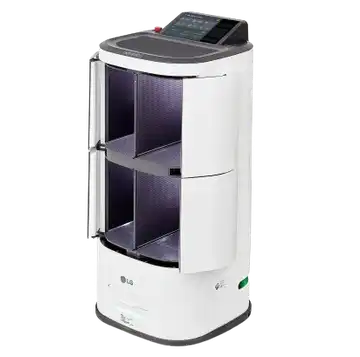
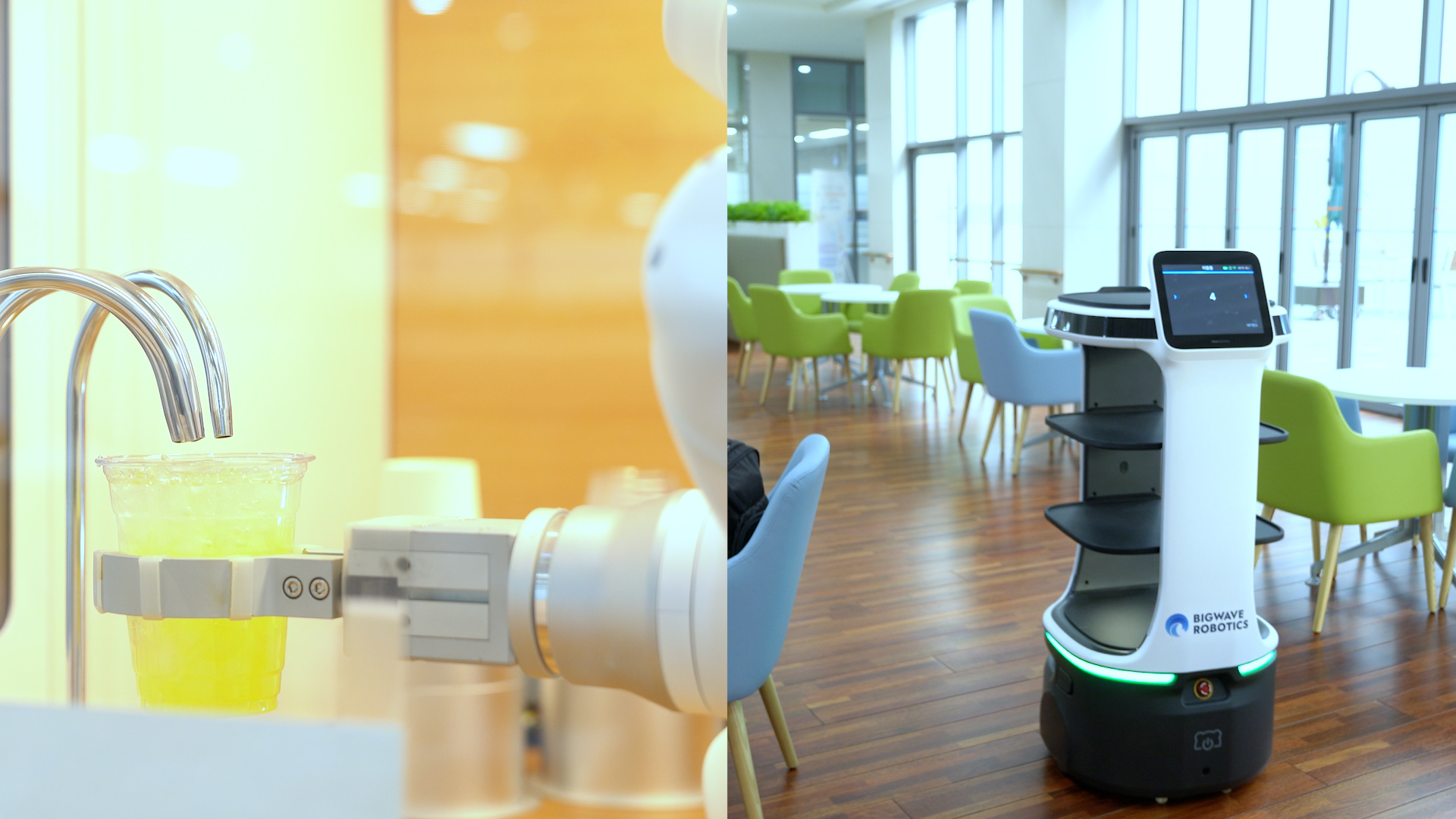
This cafe has introduced the Serving robot 'Servi+' and barista robot in combination through Big Wave Robotics (Marosol) to reduce the repetitive movement and physical strain involved in the process of ordering, manufacturing, and serving drinks, and to create an environment where a barista robot can work more stably.
By utilizing serving robots and barista robots together, we have automated the overall operation of the cafe and established a structure that allows humans to focus on roles centered on order management, operations, and customer service.
In particular, we have implemented a stable and repeatable cafe robot automation operation model even in cafe environments at public institutions through a flow extending from QR-based ordering to robot beverage manufacturing and autonomous serving .
Project Background and Objective
As the cafe at the Gyeonggi Southern Vocational Training Center of the Korea Employment Agency for Persons with Disabilities is a space where disabled workers actually work, it faced the following operational concerns.
The burden of repetitive movement tasks, from taking orders and Manufacturing beverages to serving tables
Traffic congestion and safety issues during the beverage serving process
Need to improve the work environment to enhance employment continuity
The challenge of expanding employment for people with disabilities from mere assistance to 'sustainable jobs'
Components
| Robot | Doosan Robotics's Barista Robot Dr. Presso Bear Robotics's serving robot |
|---|---|
| Peripherals | SOLlink Remote Monitoring and Job Reporting System |
Workflow
| STEP 1. | The customer orders a beverage by scanning the QR code attached to the table |
|---|---|
| STEP 2. | The employee checks the beverage order details via a tablet and verifies the ordered beverage and table number |
| STEP 3. | The employee enters the beverage order into the barista robot robot kiosk to manufacturing the drink |
| STEP 4. | The employee loads the beverage onto a serving robot and moves it to the table where the order was received |
| STEP 5. | The customer receives the beverage from the serving robot that has arrived at the table |
Features
Convenience
You don't have to go directly to the table thanks to serving robot-based beverage delivery
Simple ordering and management structure utilizing a QR ordering system
Safe autonomous driving utilizing front and rear cameras and sensors
Driving design capable of stable operation even in public Institution environments
Expandable structure capable of future integration with SOLlink-based remote monitoring
Streamlining Work processes
An intuitive process leading from QR ordering to tablet order confirmation, followed by robot manufacturing and serving.
Simple operation through smart obstacle avoidance and path setting
Robots handle repetitive movement tasks to minimize the workload on workers.
A structure with clearly separated movement paths and roles for cafe operations staff
Results
| Key Benefits | Relief from work fatigue due to reduced repetitive movement tasks
Improving job sustainability and job satisfaction of workers with disabilities
Enhancing the image of the public Institution through the operation of robot cafes for visitors
Securing a symbolic demonstration case combining employment for the disabled and robotic automation |
|---|---|
| Client Feedback | Previously, employees had to perform both beverage manufacturing and serving directly, placing a heavy burden on movement and physical exertion. Since the introduction of robots, repetitive serving tasks have been handled by the robots, creating an environment where workers can focus more on order management and operations. Safety was particularly critical given the characteristic of a cafe in a public Institution the robots accurately recognized people and obstacles and drove stably, allowing us to operate with peace of mind. Through this implementation, we were able to simultaneously improve the working environment for people with disabilities and enhance the operational efficiency of the cafe. |
Unauthorized copying or reproduction of any content on Marosol may violate the Unfair Competition Prevention Act and Copyright Act.
From Barista Robots to Beverage Serving Robots! ☕🤖 Real-life Examples of Robot Automation At a Cafe that Transformed the Working Environment for the Disabled

Recommended Solution

Industrial Cleaning Robots Now Cover Incheon Airport. Gausium's SC75 Industrial Cleaning Robot, Unveiled at Incheon Airport 🙌
Process Overview Two cleaning robots in Terminal 1 and six in Terminal 2, operating in each area of Incheon Airport, were verified for operational stability. Based on the verification of operational stability, the goal is to expand the introduction of cleaning robots across all areas of Incheon Airport. Warranty Period 1 Year Performance Year 2024 Project Duration 30 days Project Background and Objectives Disadvantages of Previous Robots The robot does not have an automatic water supply and drainage system, so personnel must manually carry and dispose of the water. When full, the robot can weigh hundreds of pounds, making it difficult to manage because of the heavy load. Proposed water supply and drainage options include workstation and SOLlink remote control. The Gausium cleaning robot supports automatic charging and features automatic water supply and drainage through the workstation. If the water supply and drainage functions are unavailable due to insufficient facility coordination, the kitchenette can be set as a maintenance point via SOLlink, allowing the robot to be remotely moved to that location for easier management.

Review of a Commercial Robot Vacuum Cleaner for a Large 900-pyeong Restaurant: "It Reduced Human Labor and Improved Hygiene"
International Food Chowon Farm Yangjeong Branch in Busan is a large dining establishment with a total size of approximately 900 pyeong (2 floors) and Phantas dry/wet commercial robot vacuum cleaners

The Industrial Robot Vacuum Cleaner Chosen by Inha Technical College! Capable of Cleaning Up To 212 pyeong Per Hour?! 😎
This is an example of the installation of the Cleaning Robot robot Fantas by Big Wave Robotics (Marosol) for Cleaning Robot the hallways of the Inha Technical College dormitory. By utilizing Fantas’s excellent Cleaning Robot performance, convenience, and charging station, automated cleaning management was implemented in the 1st-floor lobby and hallway areas on all floors, and an unmanned automatic system was put into operation.