


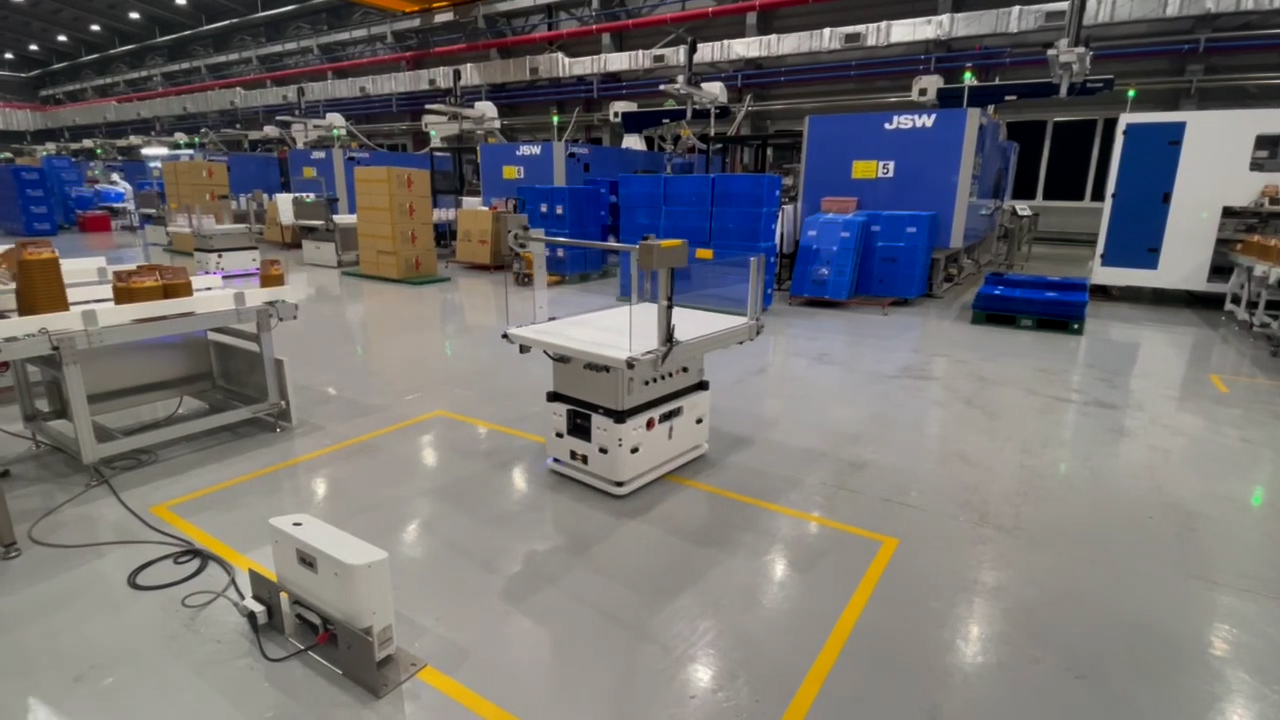
Process layout
Process Overview
This case study demonstrates an inline logistics solution that utilizes the Yujin Robot GoCart180 and an upper conveyor module to automatically transport plastic injection products from the injection molding machine to the shipping facility.
By developing a conveyor module tailored to the customer's production line, we automated product loading and unloading, achieving complete automation throughout the entire inline transport process without operator intervention.
Warranty Period
- 1 Year
Performance Year
- 2023
Project Duration
- Need for consultation
Project Background and Objectives
- Injection molding manufacturing in-line labor shortage
- Factory operations are disrupted due to difficulties securing workers
- Workers avoid work due to the risk of musculoskeletal disorders and industrial accidents
Components
| Robot | Two Yujin Robot GoCart180 ; Payload: 180kg ; ISO 13482 PLd safety standard certified ; Operating speed: up to 1.0m/s |
|---|---|
| Peripherals | Upper electric conveyor module ; Order picking cart ; Middleware |
Workflow
| STEP 1. | After the injection molding machine injects the food container, it is discharged onto the conveyor |
|---|---|
| STEP 2. | When the injection product reaches a certain amount, the AMR is automatically called |
| STEP 3. | The injection product is automatically loaded from the injection molding machine conveyor to the upper conveyor of the AMR |
| STEP 4. | The AMR moves the injection product to the shipping space |
| STEP 5. | The injection product is automatically unloaded from the AMR conveyor to the shipping conveyor |
| STEP 6. | The worker packages and ships the product. |
Features
- Fully automated inline logistics using electric conveyor modules
- ISO 13482 PLd certification, safe AMR movement utilizing seven sensors
- Preventing industrial accidents through automated transport of high-temperature plastic injection molded parts
- Consulting to optimize robot operation based on operational data after solution implementation
Results
| Key Benefits | The introduction of robots has reduced the amount of simple transportation work, and the number of simple walking routes for workers during work hours has been reduced by 90%. Robots have replaced these tasks, reducing labor costs by 33%. |
|---|---|
| Client Feedback | By replacing the 25-meter-long transport task, which required a single worker to walk every five minutes, with AMRs, worker satisfaction has increased and they can now focus on higher-value tasks. By completely separating the hazardous injection molding machine workspace from the worker's workspace, we have eliminated safety risks such as noise and crushing. Furthermore, by establishing the image of a state-of-the-art factory utilizing AMRs during customer visits, we have positively impacted customer orders. |
Unauthorized copying or reproduction of any content on Marosol may violate the Unfair Competition Prevention Act and Copyright Act.
Recommended Solution

Boston Dynamics Spot: The Autonomous Mobile Robot (Robot Dog)
This security and patrol automation solution utilizes Spot, the quadruped robot dog developed by Boston Dynamics. Spot is an agile, four-legged robot designed to be rugged and highly customizable. It is perfectly suited for unstructured environments, capable of climbing stairs and traversing rough, uneven terrain that traditional wheeled robots cannot access. By incorporating the Clearpath ROS Package for Spot, robotics researchers and developers can take full advantage of out-of-the-box ROS (Robot Operating System) functionality. This allows for accelerated development by leveraging widely available open-source libraries, tools, and the extensive global ROS community.

Yaskawa Industrial Robots + Automatic Styrofoam Placement?! Korea & Company Battery Palletizing Automation Case Study 🔋🤖
Korea & Company's palletizing solution prioritizes increasing production volume and reducing the workforce. We secured production capacity by dismantling the existing single-palletizer line, branching it into two lines, and configuring two palletizers. Additionally, by automating the manual stacking of styrofoam and plywood, we reduced the need for worker intervention, allowing a single worker to manage both lines.

Potenit Lift-type AMR for Home Appliance Part Rack Transfer
This logistics automation solution utilizes Potenit's Lift-type AMR to automatically transfer component racks for home appliances according to the manufacturing process sequence. Potenit's AMR solution can be deployed easily without additional infrastructure (such as magnetic tapes or floor markers) and responds flexibly to changes in factory layout or work positions. Through the proprietary MOS (Multi-Robot Operating System), operators can monitor real-time status and issue commands via mobile devices, tablets, or PCs. By automating material input and transfer across processes, idle time caused by preparation work has been reduced, leading to increased operational efficiency and productivity. This project was implemented as part of a Smart Factory advancement initiative to optimize worker movement, minimize production lead times, and increase overall production capacity to respond flexibly to shifting market demands.
Process layout
Process Overview
This case study demonstrates an inline logistics solution that utilizes the Yujin Robot GoCart180 and an upper conveyor module to automatically transport plastic injection products from the injection molding machine to the shipping facility.
By developing a conveyor module tailored to the customer's production line, we automated product loading and unloading, achieving complete automation throughout the entire inline transport process without operator intervention.
Warranty Period
- 1 Year
Performance Year
- 2023
Project Duration
- Need for consultation
Project Background and Objectives
- Injection molding manufacturing in-line labor shortage
- Factory operations are disrupted due to difficulties securing workers
- Workers avoid work due to the risk of musculoskeletal disorders and industrial accidents
Components
| Robot | Two Yujin Robot GoCart180 ; Payload: 180kg ; ISO 13482 PLd safety standard certified ; Operating speed: up to 1.0m/s |
|---|---|
| Peripherals | Upper electric conveyor module ; Order picking cart ; Middleware |
Workflow
| STEP 1. | After the injection molding machine injects the food container, it is discharged onto the conveyor |
|---|---|
| STEP 2. | When the injection product reaches a certain amount, the AMR is automatically called |
| STEP 3. | The injection product is automatically loaded from the injection molding machine conveyor to the upper conveyor of the AMR |
| STEP 4. | The AMR moves the injection product to the shipping space |
| STEP 5. | The injection product is automatically unloaded from the AMR conveyor to the shipping conveyor |
| STEP 6. | The worker packages and ships the product. |
Features
- Fully automated inline logistics using electric conveyor modules
- ISO 13482 PLd certification, safe AMR movement utilizing seven sensors
- Preventing industrial accidents through automated transport of high-temperature plastic injection molded parts
- Consulting to optimize robot operation based on operational data after solution implementation
Results
| Key Benefits | The introduction of robots has reduced the amount of simple transportation work, and the number of simple walking routes for workers during work hours has been reduced by 90%. Robots have replaced these tasks, reducing labor costs by 33%. |
|---|---|
| Client Feedback | By replacing the 25-meter-long transport task, which required a single worker to walk every five minutes, with AMRs, worker satisfaction has increased and they can now focus on higher-value tasks. By completely separating the hazardous injection molding machine workspace from the worker's workspace, we have eliminated safety risks such as noise and crushing. Furthermore, by establishing the image of a state-of-the-art factory utilizing AMRs during customer visits, we have positively impacted customer orders. |
Unauthorized copying or reproduction of any content on Marosol may violate the Unfair Competition Prevention Act and Copyright Act.
Recommended Solution
Boston Dynamics Spot: The Autonomous Mobile Robot (Robot Dog)
This security and patrol automation solution utilizes Spot, the quadruped robot dog developed by Boston Dynamics. Spot is an agile, four-legged robot designed to be rugged and highly customizable. It is perfectly suited for unstructured environments, capable of climbing stairs and traversing rough, uneven terrain that traditional wheeled robots cannot access. By incorporating the Clearpath ROS Package for Spot, robotics researchers and developers can take full advantage of out-of-the-box ROS (Robot Operating System) functionality. This allows for accelerated development by leveraging widely available open-source libraries, tools, and the extensive global ROS community.
Yaskawa Industrial Robots + Automatic Styrofoam Placement?! Korea & Company Battery Palletizing Automation Case Study 🔋🤖
Korea & Company's palletizing solution prioritizes increasing production volume and reducing the workforce. We secured production capacity by dismantling the existing single-palletizer line, branching it into two lines, and configuring two palletizers. Additionally, by automating the manual stacking of styrofoam and plywood, we reduced the need for worker intervention, allowing a single worker to manage both lines.
Potenit Lift-type AMR for Home Appliance Part Rack Transfer
This logistics automation solution utilizes Potenit's Lift-type AMR to automatically transfer component racks for home appliances according to the manufacturing process sequence. Potenit's AMR solution can be deployed easily without additional infrastructure (such as magnetic tapes or floor markers) and responds flexibly to changes in factory layout or work positions. Through the proprietary MOS (Multi-Robot Operating System), operators can monitor real-time status and issue commands via mobile devices, tablets, or PCs. By automating material input and transfer across processes, idle time caused by preparation work has been reduced, leading to increased operational efficiency and productivity. This project was implemented as part of a Smart Factory advancement initiative to optimize worker movement, minimize production lead times, and increase overall production capacity to respond flexibly to shifting market demands.