


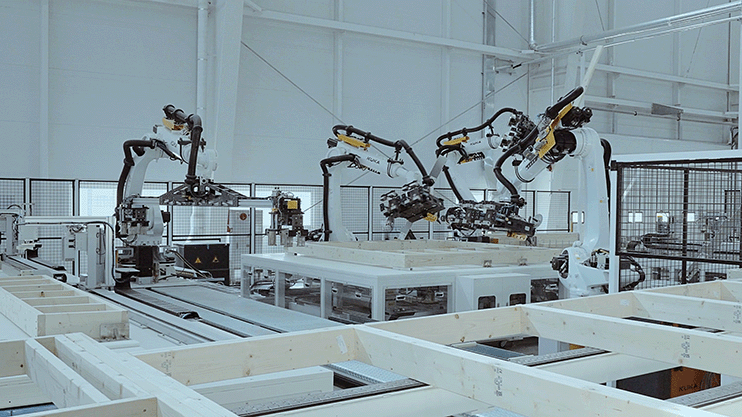
Process layout
Project Overview
This case marks Korea’s first automated solution for modular housing window assembly, combining a KUKA industrial robot, a custom-designed robotic gripper, and a High Payload Track Motion system.
Space Factory introduced this automation system to reduce construction costs and ensure consistent quality in modular housing production.
Background & Objective
Traditionally, skilled workers manually assembled window frames on-site, which was time-consuming and labor-intensive. Meeting diverse client requirements also demanded a large workforce. In addition, the wide and complex work environment made real-time monitoring and process control difficult.
The goal of this project was to automate the window assembly process to significantly reduce work time, establish a standardized production system for consistent quality, and enhance process management through real-time production monitoring.
Components
| Robot | KUKA KR 210 R3100 Industrial Robot With a maximum payload of 210kg and a working radius of 3,065mm, this robot is optimized for heavy-duty, high-precision operations. |
|---|---|
| Peripherals | These enable precise alignment and movement of wooden materials, automatic assembly of upper and lower window components, and transport of completed frames. |
Workflow
| STEP 1. | Material Input : Wooden materials are accurately aligned and transported using the custom-designed robotic gripper. |
|---|---|
| STEP 2. | Window Assembly : Based on a modular production system, upper and lower window components are assembled automatically. |
| STEP 3. | Frame Transfer : Completed wooden frames are safely and precisely moved by the robot. |
Features
Flexible Assembly:
Capable of assembling 42 different window patterns, allowing for customized modular production.Automated Process & Monitoring:
Real-time monitoring of robot operations enables rapid issue response and efficient process management.
Results
| Key Benefits | Increased Efficiency:
Compared to manual labor, work time was reduced by 30–40%, greatly improving productivity.
Cost Savings:
Standardized production and lower defect rates led to reduced construction costs.
Stable Quality:
Automation ensures consistent housing quality regardless of worker experience.
Mass Production Capability:
A small team can mass-produce a wide range of wooden housing windows in a short period. |
|---|---|
| Client Feedback | Space Factory commented:
"By automating the window assembly process, we were able to maintain consistent quality while significantly reducing construction time and cost. The real-time monitoring system powered by SOLlink Industrial has enabled us to manage production processes more efficiently and respond to issues on the ground with greater agility." |
Unauthorized copying or reproduction of any content on Marosol may violate the Unfair Competition Prevention Act and Copyright Act.
Recommended Solution

Faucet Assembly using Five Doosan M0609 Units
This assembly automation solution utilizes five Doosan M0609 collaborative robots to fully automate the end-to-end assembly process of faucets. Previously, this process required a large number of workers to manually assemble each unit. By integrating collaborative robots with a conveyor system, continuous production across the entire process has been achieved. The transition from a manual line (where 5 workers produced 1,000 units per day) to an automated line (where 2 workers produce 1,200 units per day) has resulted in a significant improvement in productivity.

PCB Flex Cable Insertion using Epson N2 and FT Sensors
This assembly automation solution utilizes the Epson N2 robot and FT (Force-Torque) sensors to automate the highly difficult process of inserting Flex Cables into PCB connectors. It is the optimal solution for performing high-precision assembly tasks while minimizing cycle times within confined workspaces. This project was initiated to automate the Flex Cable insertion process, which previously relied entirely on manual labor.

Order Picking using Yaskawa and Mech-Mind
This logistics automation solution utilizes Mech-Mind 3D Vision and the Yaskawa GP8 robot to automate the order picking of various unstructured objects. By leveraging a highly cost-effective 3D vision system that recognizes both the position and shape of products, the system can perform picking tasks without additional manual teaching—even when new products are added or existing ones are changed. The project was specifically designed to automate the picking of irregular items in logistics center picking zones.
Process layout
Project Overview
This case marks Korea’s first automated solution for modular housing window assembly, combining a KUKA industrial robot, a custom-designed robotic gripper, and a High Payload Track Motion system.
Space Factory introduced this automation system to reduce construction costs and ensure consistent quality in modular housing production.
Background & Objective
Traditionally, skilled workers manually assembled window frames on-site, which was time-consuming and labor-intensive. Meeting diverse client requirements also demanded a large workforce. In addition, the wide and complex work environment made real-time monitoring and process control difficult.
The goal of this project was to automate the window assembly process to significantly reduce work time, establish a standardized production system for consistent quality, and enhance process management through real-time production monitoring.
Components
| Robot | KUKA KR 210 R3100 Industrial Robot With a maximum payload of 210kg and a working radius of 3,065mm, this robot is optimized for heavy-duty, high-precision operations. |
|---|---|
| Peripherals | These enable precise alignment and movement of wooden materials, automatic assembly of upper and lower window components, and transport of completed frames. |
Workflow
| STEP 1. | Material Input : Wooden materials are accurately aligned and transported using the custom-designed robotic gripper. |
|---|---|
| STEP 2. | Window Assembly : Based on a modular production system, upper and lower window components are assembled automatically. |
| STEP 3. | Frame Transfer : Completed wooden frames are safely and precisely moved by the robot. |
Features
Flexible Assembly:
Capable of assembling 42 different window patterns, allowing for customized modular production.Automated Process & Monitoring:
Real-time monitoring of robot operations enables rapid issue response and efficient process management.
Results
| Key Benefits | Increased Efficiency:
Compared to manual labor, work time was reduced by 30–40%, greatly improving productivity.
Cost Savings:
Standardized production and lower defect rates led to reduced construction costs.
Stable Quality:
Automation ensures consistent housing quality regardless of worker experience.
Mass Production Capability:
A small team can mass-produce a wide range of wooden housing windows in a short period. |
|---|---|
| Client Feedback | Space Factory commented:
"By automating the window assembly process, we were able to maintain consistent quality while significantly reducing construction time and cost. The real-time monitoring system powered by SOLlink Industrial has enabled us to manage production processes more efficiently and respond to issues on the ground with greater agility." |
Unauthorized copying or reproduction of any content on Marosol may violate the Unfair Competition Prevention Act and Copyright Act.
Recommended Solution
Faucet Assembly using Five Doosan M0609 Units
This assembly automation solution utilizes five Doosan M0609 collaborative robots to fully automate the end-to-end assembly process of faucets. Previously, this process required a large number of workers to manually assemble each unit. By integrating collaborative robots with a conveyor system, continuous production across the entire process has been achieved. The transition from a manual line (where 5 workers produced 1,000 units per day) to an automated line (where 2 workers produce 1,200 units per day) has resulted in a significant improvement in productivity.
PCB Flex Cable Insertion using Epson N2 and FT Sensors
This assembly automation solution utilizes the Epson N2 robot and FT (Force-Torque) sensors to automate the highly difficult process of inserting Flex Cables into PCB connectors. It is the optimal solution for performing high-precision assembly tasks while minimizing cycle times within confined workspaces. This project was initiated to automate the Flex Cable insertion process, which previously relied entirely on manual labor.
Order Picking using Yaskawa and Mech-Mind
This logistics automation solution utilizes Mech-Mind 3D Vision and the Yaskawa GP8 robot to automate the order picking of various unstructured objects. By leveraging a highly cost-effective 3D vision system that recognizes both the position and shape of products, the system can perform picking tasks without additional manual teaching—even when new products are added or existing ones are changed. The project was specifically designed to automate the picking of irregular items in logistics center picking zones.