



Process layout
Process Overview
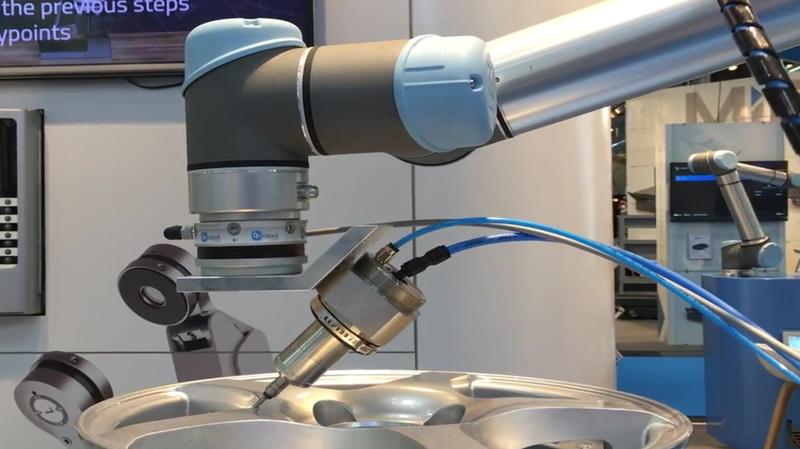
This application performs deburring on the edge area of automotive wheels using a Universal Robots UR10 and the OnRobot HEX force/torque sensor.
By utilizing the OnRobot force/torque sensor, the system can perform consistent deburring while moving along the curved surface geometry of the wheel.
Components
| Robot |
|
|---|---|
| Peripherals |
|
Workflow
| STEP 1. | Part input |
|---|---|
| STEP 2. | 3D deburring operation |
| STEP 3. | Task complete |
Features
Compact installation and high cost-effectiveness
Can be installed by adding a collaborative robot within the existing process without changing the layout
Minimizes investment cost through a compact setup
Improved quality through consistent operation
Enables uniform and precise deburring on 3D curved surfaces using a high-precision force/torque sensor
Results
| Key Benefits | Improved labor conditions by preventing operator musculoskeletal disorders Secured consistent deburring quality Increased productivity through minimized downtime and continuous operation |
|---|---|
| Client Feedback | Due to consistent work quality, the rework time was significantly reduced. |

Unauthorized copying or reproduction of any content on Marosol may violate the Unfair Competition Prevention Act and Copyright Act.
Recommended Solution

Deburring Robot Automation: Burr Removal on Ibarri Parts — Seriously This Easy?! 😮
A robotic deburring system that automatically removes burrs (BURR) generated on the machined surfaces of nickel parts applied to Honda Accord vehicles using two robots. Collaboration between a positioning robot and a deburring robot. For areas where the deburring tool cannot access, a dedicated deburring device is configured to fully perform deburring on complex-shaped machined surfaces. Integrated with the machining line to implement full-process automation, including deburring, washing, inspection, rust prevention, and packaging.

Battery Palletizing Automation: Safely Stack Batteries Weighing Over 60kg With the YASKAWA GP225 💪
Standardized over 200 palletizing variables to achieve a consistent cycle time

Automotive Hood Polishing with UR10 and OnRobot Sander
Process Overview This application performs uniform polishing on the 3D surface of an automotive hood by utilizing a Universal Robots UR10, an OnRobot HEX force/torque sensor, and an OnRobot Sander. With the combination of the OnRobot force/torque sensor and the sander, polishing can be performed while applying consistent force to match 3D curved surfaces.
Process layout
Process Overview
This application performs deburring on the edge area of automotive wheels using a Universal Robots UR10 and the OnRobot HEX force/torque sensor.
By utilizing the OnRobot force/torque sensor, the system can perform consistent deburring while moving along the curved surface geometry of the wheel.
Components
| Robot |
|
|---|---|
| Peripherals |
|
Workflow
| STEP 1. | Part input |
|---|---|
| STEP 2. | 3D deburring operation |
| STEP 3. | Task complete |
Features
Compact installation and high cost-effectiveness
Can be installed by adding a collaborative robot within the existing process without changing the layout
Minimizes investment cost through a compact setup
Improved quality through consistent operation
Enables uniform and precise deburring on 3D curved surfaces using a high-precision force/torque sensor
Results
| Key Benefits | Improved labor conditions by preventing operator musculoskeletal disorders Secured consistent deburring quality Increased productivity through minimized downtime and continuous operation |
|---|---|
| Client Feedback | Due to consistent work quality, the rework time was significantly reduced. |
Unauthorized copying or reproduction of any content on Marosol may violate the Unfair Competition Prevention Act and Copyright Act.
Recommended Solution
Deburring Robot Automation: Burr Removal on Ibarri Parts — Seriously This Easy?! 😮
A robotic deburring system that automatically removes burrs (BURR) generated on the machined surfaces of nickel parts applied to Honda Accord vehicles using two robots. Collaboration between a positioning robot and a deburring robot. For areas where the deburring tool cannot access, a dedicated deburring device is configured to fully perform deburring on complex-shaped machined surfaces. Integrated with the machining line to implement full-process automation, including deburring, washing, inspection, rust prevention, and packaging.
Battery Palletizing Automation: Safely Stack Batteries Weighing Over 60kg With the YASKAWA GP225 💪
Standardized over 200 palletizing variables to achieve a consistent cycle time
Automotive Hood Polishing with UR10 and OnRobot Sander
Process Overview This application performs uniform polishing on the 3D surface of an automotive hood by utilizing a Universal Robots UR10, an OnRobot HEX force/torque sensor, and an OnRobot Sander. With the combination of the OnRobot force/torque sensor and the sander, polishing can be performed while applying consistent force to match 3D curved surfaces.