




Process layout
Project Overview
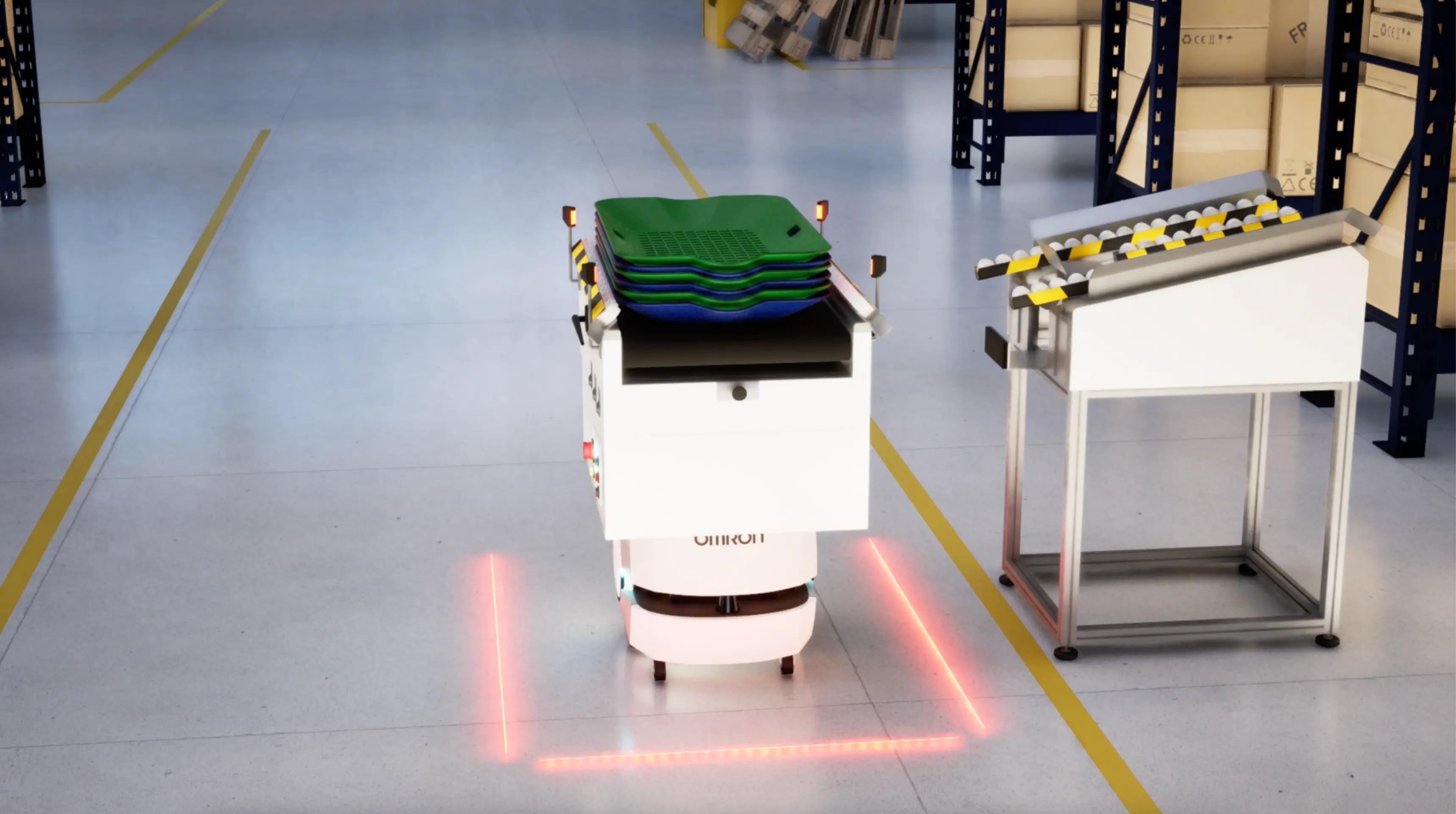
This implementation case is designed to utilize Omron AMR Logistics robots to automatically retrieve and transport individual products weighing approximately 20–30kg. Previously, workers had to manually move heavy items, leading to a high risk of musculoskeletal disorders and decreased logistics efficiency due to misclassification issues arising from repetitive manual labor. The Omron AMR was introduced to solve these problems and is configured to stably transport products of various sizes and shapes. The AMR's top module is equipped with photo sensors to detect the presence of products and includes a distance setting function to ensure the safe and smooth transport of goods.
Project Background & Objectives
The objective of this project is to reduce the physical burden on workers and improve the accuracy of logistics processes by minimizing misclassifications that occur during repetitive tasks. By introducing automation through AMRs, the primary goals of this project are: ① protecting the health and safety of workers, ② improving the accuracy and speed of logistics flow, and ③ optimizing initial investment costs while reducing maintenance expenses.
Components
| Robot | Robot Omron AMR Logistics Robot: Introduces an AMR Logistics robot that stably transports individual products and automates product retrieval in collaboration with workers. |
|---|
Workflow
| STEP 1. | Send Work Command: The product retrieval task begins via a wireless switch. |
|---|---|
| STEP 2. | Individual Product Retrieval: Products of various sizes and shapes are loaded onto the station and retrieved by the AMR's top module. |
| STEP 3. | AMR Movement: The AMR safely transports the products to the designated destination. |
| STEP 4. | Product Discharge: Accurately discharges individual products at the destination. |
Features
Flexible Adaptation to Various Logistics Environments: Capable of automatically transporting diverse products, including boxed goods, individual tools, and irregular items across general and manufacturing logistics settings.
Seamless Automation via Conveyor and Top Module Integration: Automated the product transfer process without manual intervention through 'Conveyor ↔ AMR integration' and 'Top Module Push Tool ↔ Stopper integration.'
Low Installation Costs: Minimized driving components to ensure affordable installation, with reduced maintenance burdens thanks to gravity-assisted transport methods.
Customized Top Modules: Supports various retrieval tasks with options such as driven push-type, driven rotary-type, or non-driven rotary-type modules tailored to site-specific needs.
Results
| Key Benefits | Reduced Physical Strain on Workers: Guaranteed worker health and safety by decreasing the musculoskeletal burden stemming from repetitive tasks.
Increased Efficiency: Improved productivity through an accurate and fast logistics process by lowering misclassification and collection error rates.
Cost Reduction: Achieved high maintenance efficiency while reducing initial investment costs through non-driven conveyors and automated systems.
|
|---|---|
| Client Feedback | The client stated, "Thanks to the AMR automation solution, our work environment has significantly improved, creating a space where workers can operate safely. The increased logistics efficiency has also been a major boost to our productivity."
|
Unauthorized copying or reproduction of any content on Marosol may violate the Unfair Competition Prevention Act and Copyright Act.
Recommended Solution

AI Palletizing + Omron AMR Logistics Robots for End-to-End Warehouse Automation 👏
Process Overview This implementation combines Omron AMR logistics robots with an AI-based palletizing system to achieve logistics automation. The customer showed strong interest in adopting an AI-powered logistics automation system to strengthen future competitiveness and to maximize cost savings and operational efficiency through automated palletizing and material handling. This solution autonomously transports and loads various types of goods, improving efficiency and accuracy in inbound and outbound operations, while reducing physical workload for operators and ensuring workplace safety. Project Background and Objectives The customer aimed to optimize logistics operations and reduce costs by adopting an AI-driven automation solution to enhance future logistics competitiveness. In particular, automation was urgently needed for repetitive and heavy palletizing tasks and material transport operations. The objective of this project is to maximize outbound operation efficiency using AMRs and industrial robots, ensure operator safety, and enable real-time tracking and management of goods. Through this, the customer sought to improve productivity at the logistics site and secure long-term stability and flexibility in future logistics operations.

Omron AMR Logistics Robot Implements Logistics Automation by Carrying 300kg Rolltainers
Project Overview This implementation case features a solution utilizing Omron AMR Logistics robots to automatically transport rolltainers weighing over 300kg. Previously, workers had to manually move heavy rolltainers, leading to a high risk of musculoskeletal disorders and potential safety issues during the bulk loading of irregular goods. Through this solution, the AMR automatically recognizes the rolltainers and moves them to designated locations via safe autonomous driving, establishing a work environment that significantly reduces worker burden and increases efficiency. Project Background & Objectives In logistics sites, the repetitive task of moving rolltainers weighing over 300kg placed a significant physical strain on workers, leading to frequent musculoskeletal disorders. Additionally, manually moving various products, including irregular items, resulted in decreased safety and efficiency. The objective of this project is to protect worker health and maximize operational efficiency by automating rolltainer transport with AMRs. Through this, the goal is to enhance overall logistics safety, reduce worker fatigue, and maximize productivity and efficiency in the long term.
.jpeg&w=3840&q=75)
Japanese Fashion Retailer’s Warehouse Automation Success Story 😎 (Case Study: Deployment of 181 HIK AMR Logistics Robots)
A leading Japanese fashion company introduced an HIK robotics solution to optimize apparel logistics operations in a large-scale warehouse spanning over 11,000 m². The STP (Shelf-to-Person) system—integrating a fleet of 181 AMRs (Autonomous Mobile Robots) with 26 workstations—has transformed the facility into a smart fulfillment center, delivering productivity aligned with the latest trends in the apparel logistics industry.
Process layout
Project Overview
This implementation case is designed to utilize Omron AMR Logistics robots to automatically retrieve and transport individual products weighing approximately 20–30kg. Previously, workers had to manually move heavy items, leading to a high risk of musculoskeletal disorders and decreased logistics efficiency due to misclassification issues arising from repetitive manual labor. The Omron AMR was introduced to solve these problems and is configured to stably transport products of various sizes and shapes. The AMR's top module is equipped with photo sensors to detect the presence of products and includes a distance setting function to ensure the safe and smooth transport of goods.
Project Background & Objectives
The objective of this project is to reduce the physical burden on workers and improve the accuracy of logistics processes by minimizing misclassifications that occur during repetitive tasks. By introducing automation through AMRs, the primary goals of this project are: ① protecting the health and safety of workers, ② improving the accuracy and speed of logistics flow, and ③ optimizing initial investment costs while reducing maintenance expenses.
Components
| Robot | Robot Omron AMR Logistics Robot: Introduces an AMR Logistics robot that stably transports individual products and automates product retrieval in collaboration with workers. |
|---|
Workflow
| STEP 1. | Send Work Command: The product retrieval task begins via a wireless switch. |
|---|---|
| STEP 2. | Individual Product Retrieval: Products of various sizes and shapes are loaded onto the station and retrieved by the AMR's top module. |
| STEP 3. | AMR Movement: The AMR safely transports the products to the designated destination. |
| STEP 4. | Product Discharge: Accurately discharges individual products at the destination. |
Features
Flexible Adaptation to Various Logistics Environments: Capable of automatically transporting diverse products, including boxed goods, individual tools, and irregular items across general and manufacturing logistics settings.
Seamless Automation via Conveyor and Top Module Integration: Automated the product transfer process without manual intervention through 'Conveyor ↔ AMR integration' and 'Top Module Push Tool ↔ Stopper integration.'
Low Installation Costs: Minimized driving components to ensure affordable installation, with reduced maintenance burdens thanks to gravity-assisted transport methods.
Customized Top Modules: Supports various retrieval tasks with options such as driven push-type, driven rotary-type, or non-driven rotary-type modules tailored to site-specific needs.
Results
| Key Benefits | Reduced Physical Strain on Workers: Guaranteed worker health and safety by decreasing the musculoskeletal burden stemming from repetitive tasks.
Increased Efficiency: Improved productivity through an accurate and fast logistics process by lowering misclassification and collection error rates.
Cost Reduction: Achieved high maintenance efficiency while reducing initial investment costs through non-driven conveyors and automated systems.
|
|---|---|
| Client Feedback | The client stated, "Thanks to the AMR automation solution, our work environment has significantly improved, creating a space where workers can operate safely. The increased logistics efficiency has also been a major boost to our productivity."
|
Unauthorized copying or reproduction of any content on Marosol may violate the Unfair Competition Prevention Act and Copyright Act.
Recommended Solution
AI Palletizing + Omron AMR Logistics Robots for End-to-End Warehouse Automation 👏
Process Overview This implementation combines Omron AMR logistics robots with an AI-based palletizing system to achieve logistics automation. The customer showed strong interest in adopting an AI-powered logistics automation system to strengthen future competitiveness and to maximize cost savings and operational efficiency through automated palletizing and material handling. This solution autonomously transports and loads various types of goods, improving efficiency and accuracy in inbound and outbound operations, while reducing physical workload for operators and ensuring workplace safety. Project Background and Objectives The customer aimed to optimize logistics operations and reduce costs by adopting an AI-driven automation solution to enhance future logistics competitiveness. In particular, automation was urgently needed for repetitive and heavy palletizing tasks and material transport operations. The objective of this project is to maximize outbound operation efficiency using AMRs and industrial robots, ensure operator safety, and enable real-time tracking and management of goods. Through this, the customer sought to improve productivity at the logistics site and secure long-term stability and flexibility in future logistics operations.
Omron AMR Logistics Robot Implements Logistics Automation by Carrying 300kg Rolltainers
Project Overview This implementation case features a solution utilizing Omron AMR Logistics robots to automatically transport rolltainers weighing over 300kg. Previously, workers had to manually move heavy rolltainers, leading to a high risk of musculoskeletal disorders and potential safety issues during the bulk loading of irregular goods. Through this solution, the AMR automatically recognizes the rolltainers and moves them to designated locations via safe autonomous driving, establishing a work environment that significantly reduces worker burden and increases efficiency. Project Background & Objectives In logistics sites, the repetitive task of moving rolltainers weighing over 300kg placed a significant physical strain on workers, leading to frequent musculoskeletal disorders. Additionally, manually moving various products, including irregular items, resulted in decreased safety and efficiency. The objective of this project is to protect worker health and maximize operational efficiency by automating rolltainer transport with AMRs. Through this, the goal is to enhance overall logistics safety, reduce worker fatigue, and maximize productivity and efficiency in the long term.
Japanese Fashion Retailer’s Warehouse Automation Success Story 😎 (Case Study: Deployment of 181 HIK AMR Logistics Robots)
A leading Japanese fashion company introduced an HIK robotics solution to optimize apparel logistics operations in a large-scale warehouse spanning over 11,000 m². The STP (Shelf-to-Person) system—integrating a fleet of 181 AMRs (Autonomous Mobile Robots) with 26 workstations—has transformed the facility into a smart fulfillment center, delivering productivity aligned with the latest trends in the apparel logistics industry.