




Process layout
Project Overview
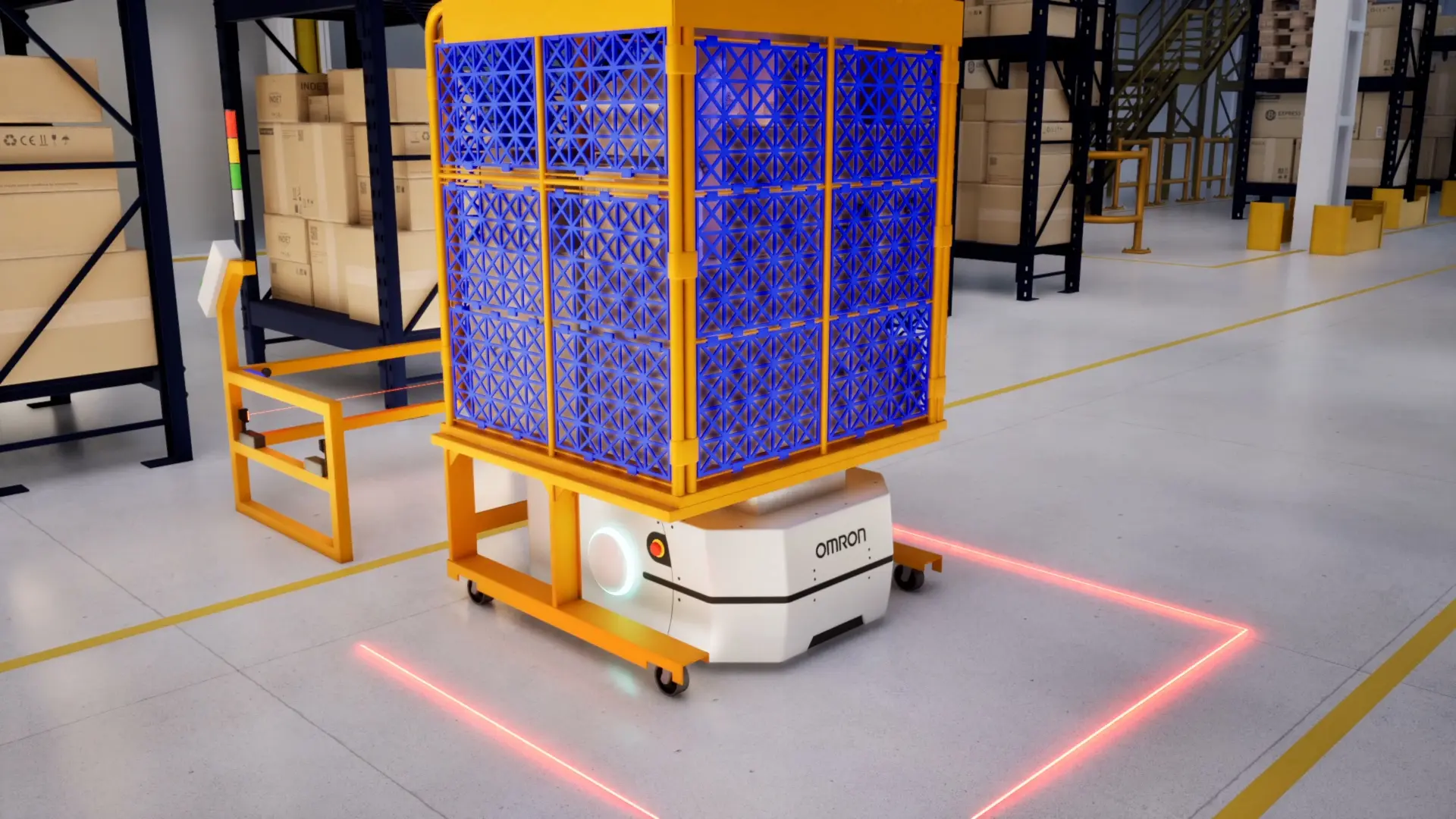
This implementation case features a solution utilizing Omron AMR Logistics robots to automatically transport rolltainers weighing over 300kg. Previously, workers had to manually move heavy rolltainers, leading to a high risk of musculoskeletal disorders and potential safety issues during the bulk loading of irregular goods. Through this solution, the AMR automatically recognizes the rolltainers and moves them to designated locations via safe autonomous driving, establishing a work environment that significantly reduces worker burden and increases efficiency.
Project Background & Objectives
In logistics sites, the repetitive task of moving rolltainers weighing over 300kg placed a significant physical strain on workers, leading to frequent musculoskeletal disorders. Additionally, manually moving various products, including irregular items, resulted in decreased safety and efficiency. The objective of this project is to protect worker health and maximize operational efficiency by automating rolltainer transport with AMRs. Through this, the goal is to enhance overall logistics safety, reduce worker fatigue, and maximize productivity and efficiency in the long term.
Components
| Robot | Robot: Omron LD-250 |
|---|
Workflow
| STEP 1. | Send Rolltainer Retrieval Command: A work command is generated via a switch. |
|---|---|
| STEP 2. | Rolltainer Retrieval: After recognizing the rolltainer's location with a photo sensor, the AMR hitches the rolltainer with a hook through precise docking. |
| STEP 3. | AMR Movement: Transports the rolltainer to the destination using safe autonomous driving functions. |
| STEP 4. | Rolltainer Destination Discharge: Upon reaching the destination, the rolltainer is stably discharged through an automatic release function. |
Features
Adaptable to Various Logistics Environments: Capable of automatically transporting diverse goods, including boxed packages, individual tools, and irregular products loaded onto rolltainers in both general and manufacturing logistics settings.
Enclosed Structure Optimized for Irregular Goods: The enclosed design of the rolltainer allows for the safe loading and transport of irregular items.
High Payload Capacity: Due to the weight-distribution structure of the rolltainer, the system can stably accommodate weights that slightly exceed the AMR's standard payload.
Automatic Hitching/Release System: Reduces the burden of manual labor by enabling automatic hitching and release between the AMR and the rolltainer.
(Note: Tug-type models support the automatic release function only.)
Results
| Key Benefits | Reduced Physical Strain on Workers: Decreased incidence of musculoskeletal disorders and improved worker health as they no longer need to manually move heavy rolltainers.
Increased Operational Efficiency: Automated rolltainer transport has shortened task times and reduced misclassification issues, enhancing overall logistics efficiency.
Cost Reduction: Labor cost savings are expected by reducing manual work hours compared to traditional methods.
|
|---|---|
| Client Feedback | The client stated, "The automated rolltainer transport solution using AMRs has significantly reduced the physical burden on our workers and noticeably improved on-site efficiency. We are particularly satisfied with the labor cost-saving effects resulting from the reduction in manual work hours."
|
Unauthorized copying or reproduction of any content on Marosol may violate the Unfair Competition Prevention Act and Copyright Act.
Recommended Solution

An Order Picking System Solution for Logistics Warehouses using AMRs
Process Overview This case study demonstrates an order picking system that optimizes the operation of ten Eugene Gocart 180s using Marosol's remote control system, SOLlink. With the self-developed SOLlink, multiple AMRs are clustered and controlled to maximize logistics system efficiency. The order picking system, integrated with WMS, allows for flexible handling during peak periods without the need for additional workers. Warranty Period 1 Year Performance Year 2023 Project Duration Need for consultation Project Background and Objectives Improved workforce supply and employment stability through the introduction of logistics robots Introducing robots for high-intensity, repetitive tasks reduces the risk of musculoskeletal disorders and industrial accidents among workers Integrating WMS and order picking systems increases work efficiency and reduces error rates
.jpeg&w=3840&q=75)
Japanese Fashion Retailer’s Warehouse Automation Success Story 😎 (Case Study: Deployment of 181 HIK AMR Logistics Robots)
A leading Japanese fashion company introduced an HIK robotics solution to optimize apparel logistics operations in a large-scale warehouse spanning over 11,000 m². The STP (Shelf-to-Person) system—integrating a fleet of 181 AMRs (Autonomous Mobile Robots) with 26 workstations—has transformed the facility into a smart fulfillment center, delivering productivity aligned with the latest trends in the apparel logistics industry.

AMR Logistics Robots Introduced to Manufacturing Factory ✨ Logistics Automation that Quickly Resolves Even 1 Ton of Waste Derbris (2 KUKA KMP 1500P Logistics Robots)
Process Overview This case study demonstrates the installation of a KUKA KMP 1500P logistics robot at Bigwave Robotics (Marosol) to transport rollers and scrap debris within the space manufacturing facility. The KMP 1500P autonomously handles up to 1 ton of scrap debris over a 1.2 km distance and automatically transports heavy-duty roller modules weighing up to 1 ton. Furthermore, sensors embedded in the KMP 1500P enabled the development of an unmanned system capable of safely transporting heavy-duty materials. Project Background and Purpose Automated unmanned transport using autonomous robots Robots perform simple, repetitive tasks Safe operation of heavy-duty products using various sensors Remote control and monitoring using SOLlink
Process layout
Project Overview
This implementation case features a solution utilizing Omron AMR Logistics robots to automatically transport rolltainers weighing over 300kg. Previously, workers had to manually move heavy rolltainers, leading to a high risk of musculoskeletal disorders and potential safety issues during the bulk loading of irregular goods. Through this solution, the AMR automatically recognizes the rolltainers and moves them to designated locations via safe autonomous driving, establishing a work environment that significantly reduces worker burden and increases efficiency.
Project Background & Objectives
In logistics sites, the repetitive task of moving rolltainers weighing over 300kg placed a significant physical strain on workers, leading to frequent musculoskeletal disorders. Additionally, manually moving various products, including irregular items, resulted in decreased safety and efficiency. The objective of this project is to protect worker health and maximize operational efficiency by automating rolltainer transport with AMRs. Through this, the goal is to enhance overall logistics safety, reduce worker fatigue, and maximize productivity and efficiency in the long term.
Components
| Robot | Robot: Omron LD-250 |
|---|
Workflow
| STEP 1. | Send Rolltainer Retrieval Command: A work command is generated via a switch. |
|---|---|
| STEP 2. | Rolltainer Retrieval: After recognizing the rolltainer's location with a photo sensor, the AMR hitches the rolltainer with a hook through precise docking. |
| STEP 3. | AMR Movement: Transports the rolltainer to the destination using safe autonomous driving functions. |
| STEP 4. | Rolltainer Destination Discharge: Upon reaching the destination, the rolltainer is stably discharged through an automatic release function. |
Features
Adaptable to Various Logistics Environments: Capable of automatically transporting diverse goods, including boxed packages, individual tools, and irregular products loaded onto rolltainers in both general and manufacturing logistics settings.
Enclosed Structure Optimized for Irregular Goods: The enclosed design of the rolltainer allows for the safe loading and transport of irregular items.
High Payload Capacity: Due to the weight-distribution structure of the rolltainer, the system can stably accommodate weights that slightly exceed the AMR's standard payload.
Automatic Hitching/Release System: Reduces the burden of manual labor by enabling automatic hitching and release between the AMR and the rolltainer.
(Note: Tug-type models support the automatic release function only.)
Results
| Key Benefits | Reduced Physical Strain on Workers: Decreased incidence of musculoskeletal disorders and improved worker health as they no longer need to manually move heavy rolltainers.
Increased Operational Efficiency: Automated rolltainer transport has shortened task times and reduced misclassification issues, enhancing overall logistics efficiency.
Cost Reduction: Labor cost savings are expected by reducing manual work hours compared to traditional methods.
|
|---|---|
| Client Feedback | The client stated, "The automated rolltainer transport solution using AMRs has significantly reduced the physical burden on our workers and noticeably improved on-site efficiency. We are particularly satisfied with the labor cost-saving effects resulting from the reduction in manual work hours."
|
Unauthorized copying or reproduction of any content on Marosol may violate the Unfair Competition Prevention Act and Copyright Act.
Recommended Solution
An Order Picking System Solution for Logistics Warehouses using AMRs
Process Overview This case study demonstrates an order picking system that optimizes the operation of ten Eugene Gocart 180s using Marosol's remote control system, SOLlink. With the self-developed SOLlink, multiple AMRs are clustered and controlled to maximize logistics system efficiency. The order picking system, integrated with WMS, allows for flexible handling during peak periods without the need for additional workers. Warranty Period 1 Year Performance Year 2023 Project Duration Need for consultation Project Background and Objectives Improved workforce supply and employment stability through the introduction of logistics robots Introducing robots for high-intensity, repetitive tasks reduces the risk of musculoskeletal disorders and industrial accidents among workers Integrating WMS and order picking systems increases work efficiency and reduces error rates
Japanese Fashion Retailer’s Warehouse Automation Success Story 😎 (Case Study: Deployment of 181 HIK AMR Logistics Robots)
A leading Japanese fashion company introduced an HIK robotics solution to optimize apparel logistics operations in a large-scale warehouse spanning over 11,000 m². The STP (Shelf-to-Person) system—integrating a fleet of 181 AMRs (Autonomous Mobile Robots) with 26 workstations—has transformed the facility into a smart fulfillment center, delivering productivity aligned with the latest trends in the apparel logistics industry.
AMR Logistics Robots Introduced to Manufacturing Factory ✨ Logistics Automation that Quickly Resolves Even 1 Ton of Waste Derbris (2 KUKA KMP 1500P Logistics Robots)
Process Overview This case study demonstrates the installation of a KUKA KMP 1500P logistics robot at Bigwave Robotics (Marosol) to transport rollers and scrap debris within the space manufacturing facility. The KMP 1500P autonomously handles up to 1 ton of scrap debris over a 1.2 km distance and automatically transports heavy-duty roller modules weighing up to 1 ton. Furthermore, sensors embedded in the KMP 1500P enabled the development of an unmanned system capable of safely transporting heavy-duty materials. Project Background and Purpose Automated unmanned transport using autonomous robots Robots perform simple, repetitive tasks Safe operation of heavy-duty products using various sensors Remote control and monitoring using SOLlink