





Process layout
Process Overview
This implementation combines Omron AMR logistics robots with an AI-based palletizing system to achieve logistics automation. The customer showed strong interest in adopting an AI-powered logistics automation system to strengthen future competitiveness and to maximize cost savings and operational efficiency through automated palletizing and material handling.
This solution autonomously transports and loads various types of goods, improving efficiency and accuracy in inbound and outbound operations, while reducing physical workload for operators and ensuring workplace safety.
Project Background and Objectives
The customer aimed to optimize logistics operations and reduce costs by adopting an AI-driven automation solution to enhance future logistics competitiveness. In particular, automation was urgently needed for repetitive and heavy palletizing tasks and material transport operations.
The objective of this project is to maximize outbound operation efficiency using AMRs and industrial robots, ensure operator safety, and enable real-time tracking and management of goods. Through this, the customer sought to improve productivity at the logistics site and secure long-term stability and flexibility in future logistics operations.
Components
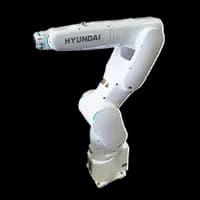
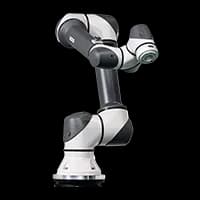
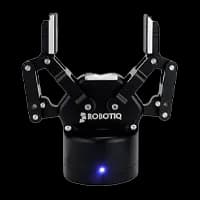
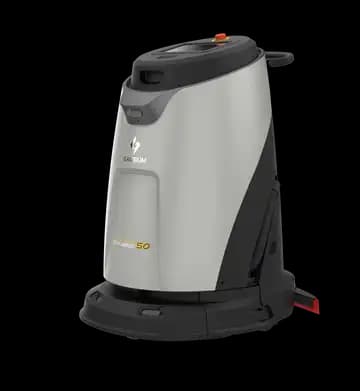
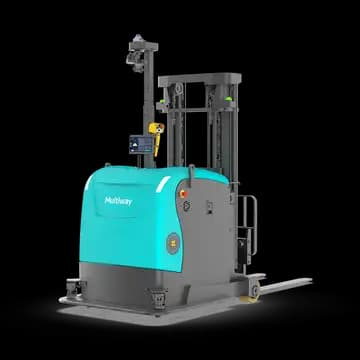
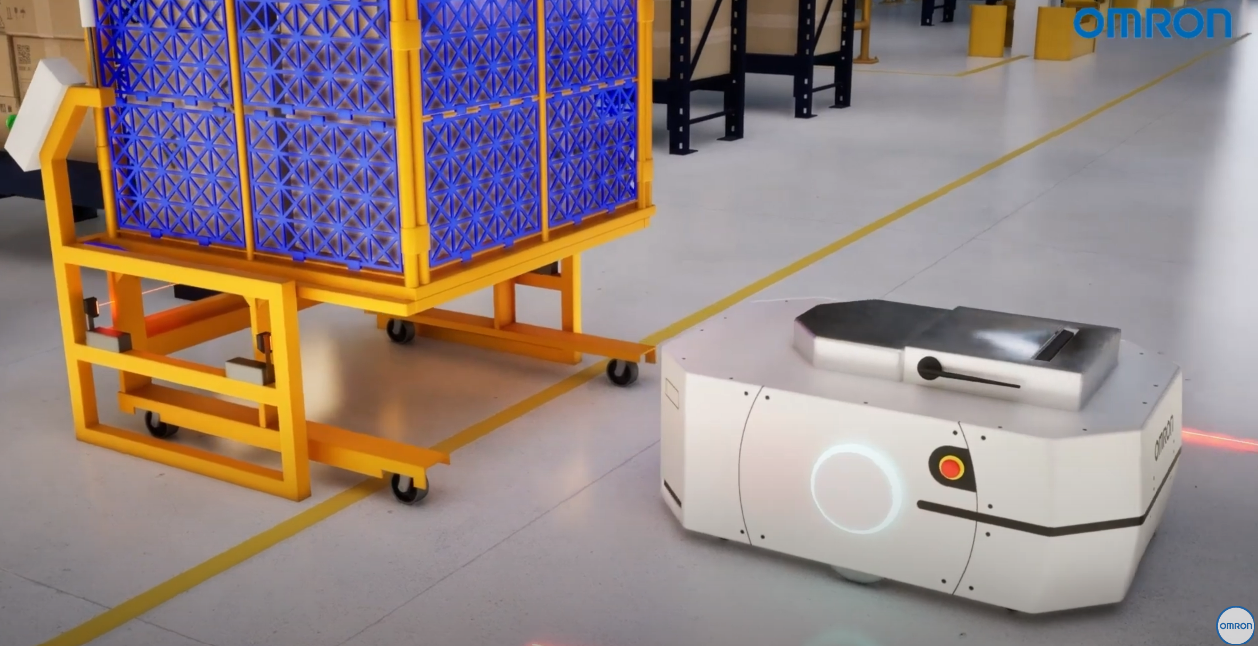
| Robot | Omron AMR logistics robot: A mobile robot equipped with autonomous driving and obstacle avoidance capabilities. It can freely perform material handling tasks by coupling and decoupling carts as needed. |
|---|---|
| Peripherals |
|
Workflow
| STEP 1. | Outbound command: When the operator presses the outbound button, the AMR receives an outbound task from the warehouse management system and autonomously drives to the designated location |
|---|---|
| STEP 2. | Cart preparation and locking: The AMR identifies the cart and secures it with a hook to complete stable transport readiness |
| STEP 3. | Arrival at picking station: The AMR moves to the picking station and prepares for palletizing for loading |
| STEP 4. | Palletizing: The industrial robot stacks boxes onto the cart in an optimized pattern using an AI algorithm |
| STEP 5. | Full cart pickup: When the cart is full, the AMR automatically detects it and proceeds to retrieve it to the designated outbound area |
| STEP 6. | Arrival at outbound area and dispatch: The AMR arrives at the outbound area, detaches the cart, and tracks inventory status in real time through the inbound/outbound management system |
| STEP 7. | Task completion and return to charging: After the task is completed, the AMR automatically returns to the charging station to prepare for the next task. |
Features
Supports a wide range of logistics and manufacturing environments: Not only standardized boxes, but also various non-standard products can be loaded onto carts and transported.
Cart and AMR separation available: Full carts can be stored at the post station, allowing the AMR to continue additional tasks.
Enhanced safety system: Safety light curtains and fences separate the operator and AMR work areas to prevent accidents, and the system can automatically stop when an operator approaches via the light curtain.
AI palletizing efficiency: AI-based algorithms optimize stacking patterns for various box types, maximizing space utilization.
Results
| Key Benefits | Improved efficiency: Palletizing and transport tasks are automated, increasing work speed and reducing operator fatigue.
Cost reduction: Automating the logistics process enables labor cost savings and more efficient operations.
Enhanced safety: Safety light curtains and autonomous driving functions minimize accident risks during operation.
Optimized inventory tracking: A real-time tracking system enables efficient management of outbound status and location tracking. |
|---|---|
| Client Feedback | The customer commented, “With the introduction of AMRs and palletizing robots, not only has the physical workload for operators been reduced, but logistics efficiency has also improved significantly. In particular, the well-established safety system has created an environment where workers can focus on their tasks with greater confidence.” |
Unauthorized copying or reproduction of any content on Marosol may violate the Unfair Competition Prevention Act and Copyright Act.
Recommended Solution

Battery Palletizing Automation: Safely Stack Batteries Weighing Over 60kg With the YASKAWA GP225 💪
Standardized over 200 palletizing variables to achieve a consistent cycle time

An Order Picking System Solution for Logistics Warehouses using AMRs
Process Overview This case study demonstrates an order picking system that optimizes the operation of ten Eugene Gocart 180s using Marosol's remote control system, SOLlink. With the self-developed SOLlink, multiple AMRs are clustered and controlled to maximize logistics system efficiency. The order picking system, integrated with WMS, allows for flexible handling during peak periods without the need for additional workers. Warranty Period 1 Year Performance Year 2023 Project Duration Need for consultation Project Background and Objectives Improved workforce supply and employment stability through the introduction of logistics robots Introducing robots for high-intensity, repetitive tasks reduces the risk of musculoskeletal disorders and industrial accidents among workers Integrating WMS and order picking systems increases work efficiency and reduces error rates

Yuhan-Kimberly's Choice! Fully Automated Depalletizing and String Cutting 📦
Process Overview This implementation case, implemented at Yuhan-Kimberly's Chungju factory , combines a Yaskawa industrial robot with a string cutting workstation to achieve automated depalletizing and string cutting. The client introduced the depalletizing system to reduce labor costs and work fatigue, and expressed strong interest in automating rope cutting and discharge to maximize cost savings and efficiency. This solution sorts and cuts boxes of various sizes before feeding them to the case packer, improving the efficiency of the box feeding and rope cutting processes, while also reducing the physical burden on workers and ensuring safety. Project Background and Objectives At Yuhan-Kimberly's Chungju factory , the process of dismantling palletized boxes and loading them into case packers individually was entirely manual. This process was highly repetitive and presented a constant risk of safety accidents due to the use of knives during the removal of the twine. The goal of this project was to automate the entire process, from depalletizing to loading into the case packer, minimizing human dependence. Furthermore, by unmanning the twine cutting process, we aimed to ensure worker safety, reduce fatigue and on-site personnel burden, and ensure stable plant operations.
Process layout
Process Overview
This implementation combines Omron AMR logistics robots with an AI-based palletizing system to achieve logistics automation. The customer showed strong interest in adopting an AI-powered logistics automation system to strengthen future competitiveness and to maximize cost savings and operational efficiency through automated palletizing and material handling.
This solution autonomously transports and loads various types of goods, improving efficiency and accuracy in inbound and outbound operations, while reducing physical workload for operators and ensuring workplace safety.
Project Background and Objectives
The customer aimed to optimize logistics operations and reduce costs by adopting an AI-driven automation solution to enhance future logistics competitiveness. In particular, automation was urgently needed for repetitive and heavy palletizing tasks and material transport operations.
The objective of this project is to maximize outbound operation efficiency using AMRs and industrial robots, ensure operator safety, and enable real-time tracking and management of goods. Through this, the customer sought to improve productivity at the logistics site and secure long-term stability and flexibility in future logistics operations.
Components
| Robot | Omron AMR logistics robot: A mobile robot equipped with autonomous driving and obstacle avoidance capabilities. It can freely perform material handling tasks by coupling and decoupling carts as needed. |
|---|---|
| Peripherals |
|
Workflow
| STEP 1. | Outbound command: When the operator presses the outbound button, the AMR receives an outbound task from the warehouse management system and autonomously drives to the designated location |
|---|---|
| STEP 2. | Cart preparation and locking: The AMR identifies the cart and secures it with a hook to complete stable transport readiness |
| STEP 3. | Arrival at picking station: The AMR moves to the picking station and prepares for palletizing for loading |
| STEP 4. | Palletizing: The industrial robot stacks boxes onto the cart in an optimized pattern using an AI algorithm |
| STEP 5. | Full cart pickup: When the cart is full, the AMR automatically detects it and proceeds to retrieve it to the designated outbound area |
| STEP 6. | Arrival at outbound area and dispatch: The AMR arrives at the outbound area, detaches the cart, and tracks inventory status in real time through the inbound/outbound management system |
| STEP 7. | Task completion and return to charging: After the task is completed, the AMR automatically returns to the charging station to prepare for the next task. |
Features
Supports a wide range of logistics and manufacturing environments: Not only standardized boxes, but also various non-standard products can be loaded onto carts and transported.
Cart and AMR separation available: Full carts can be stored at the post station, allowing the AMR to continue additional tasks.
Enhanced safety system: Safety light curtains and fences separate the operator and AMR work areas to prevent accidents, and the system can automatically stop when an operator approaches via the light curtain.
AI palletizing efficiency: AI-based algorithms optimize stacking patterns for various box types, maximizing space utilization.
Results
| Key Benefits | Improved efficiency: Palletizing and transport tasks are automated, increasing work speed and reducing operator fatigue.
Cost reduction: Automating the logistics process enables labor cost savings and more efficient operations.
Enhanced safety: Safety light curtains and autonomous driving functions minimize accident risks during operation.
Optimized inventory tracking: A real-time tracking system enables efficient management of outbound status and location tracking. |
|---|---|
| Client Feedback | The customer commented, “With the introduction of AMRs and palletizing robots, not only has the physical workload for operators been reduced, but logistics efficiency has also improved significantly. In particular, the well-established safety system has created an environment where workers can focus on their tasks with greater confidence.” |
Unauthorized copying or reproduction of any content on Marosol may violate the Unfair Competition Prevention Act and Copyright Act.
Recommended Solution
Battery Palletizing Automation: Safely Stack Batteries Weighing Over 60kg With the YASKAWA GP225 💪
Standardized over 200 palletizing variables to achieve a consistent cycle time
An Order Picking System Solution for Logistics Warehouses using AMRs
Process Overview This case study demonstrates an order picking system that optimizes the operation of ten Eugene Gocart 180s using Marosol's remote control system, SOLlink. With the self-developed SOLlink, multiple AMRs are clustered and controlled to maximize logistics system efficiency. The order picking system, integrated with WMS, allows for flexible handling during peak periods without the need for additional workers. Warranty Period 1 Year Performance Year 2023 Project Duration Need for consultation Project Background and Objectives Improved workforce supply and employment stability through the introduction of logistics robots Introducing robots for high-intensity, repetitive tasks reduces the risk of musculoskeletal disorders and industrial accidents among workers Integrating WMS and order picking systems increases work efficiency and reduces error rates
Yuhan-Kimberly's Choice! Fully Automated Depalletizing and String Cutting 📦
Process Overview This implementation case, implemented at Yuhan-Kimberly's Chungju factory , combines a Yaskawa industrial robot with a string cutting workstation to achieve automated depalletizing and string cutting. The client introduced the depalletizing system to reduce labor costs and work fatigue, and expressed strong interest in automating rope cutting and discharge to maximize cost savings and efficiency. This solution sorts and cuts boxes of various sizes before feeding them to the case packer, improving the efficiency of the box feeding and rope cutting processes, while also reducing the physical burden on workers and ensuring safety. Project Background and Objectives At Yuhan-Kimberly's Chungju factory , the process of dismantling palletized boxes and loading them into case packers individually was entirely manual. This process was highly repetitive and presented a constant risk of safety accidents due to the use of knives during the removal of the twine. The goal of this project was to automate the entire process, from depalletizing to loading into the case packer, minimizing human dependence. Furthermore, by unmanning the twine cutting process, we aimed to ensure worker safety, reduce fatigue and on-site personnel burden, and ensure stable plant operations.