




Process layout
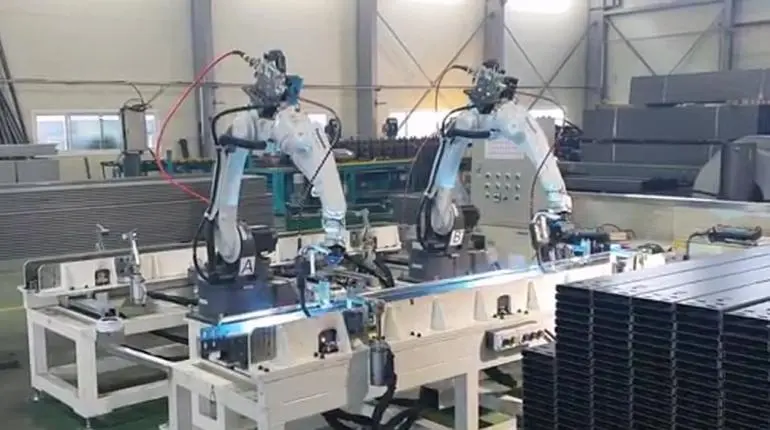
This welding automation solution features two Panasonic industrial robots working in perfect synchronization to perform multi-angle welding on long beam structures.
By deploying dual robots to work simultaneously on both sides of the beam and utilizing a dual-jig (front and back) arrangement, the system ensures continuous operation and exceptionally high productivity. The integrated Panasonic TAWERS system enables high-speed welding and superior bead quality. Since the welding power source, robot, and wire feeder are provided as a single unified package, rapid installation and precise tuning are possible.
Components
| Robot |
|
|---|
Workflow
| STEP 1. | Loading: The operator secures the beam structure into the welding jig. |
|---|---|
| STEP 2. | Command: The operator initiates the process by clicking the work instruction button. |
| STEP 3. | Primary Welding: Both robots perform synchronized welding on the first workpiece. |
| STEP 4. | Maintenance: The robots execute an automatic wire nozzle cleaning cycle. |
| STEP 5. | Secondary Welding: The robots move to the second workpiece positioned in the rear jig and perform welding. |
| STEP 6. | Concurrent Operation: While the robots are welding, the operator unloads finished parts or loads new raw materials into the inactive jig. |
Features
High Operational Efficiency and Quality
Optimized Human-Robot Collaboration: Tasks requiring consistent quality and high skill are performed by the robots, while the operator handles loading/unloading, simultaneously boosting productivity and output quality.
Minimized Cycle Times via Dual-Robot Layout:
Parallel Configuration: Two robots are positioned in parallel to perform simultaneous welding on a single workpiece.
Zero-Downtime Workflow: The efficient layout allows the operator to load new materials or unload finished parts while the robots are actively welding in another zone.
Advanced Motion & Feed Control: Utilizes specialized logic for starting and ending welds to shave seconds off the cycle time.
Auto-Re-ignition Logic: Minimizes downtime by automatically re-attempting arc ignition in the event of an initial failure.
Superior Welding Quality and Reduced Post-Processing Costs
Panasonic Spatter Reduction: Incorporates proprietary technology to drastically reduce spatter and surface cleaning requirements.
Precision Heat Control: Minimizes thermal distortion by managing heat input throughout the process.
Intelligent Sensor Integration:
Gap Sensing: Recognizes the distance between the welding tip and the workpiece to correct for uneven surfaces.
Touch Sensors: Compensates for alignment errors between workpieces.
Arc Sensors: Provides real-time automatic compensation during welding to maintain uniform bead quality.
Simplified Installation and Monitoring
Rapid Deployment: As an integrated system (Robot + Power Source + Controller), no separate interface development is required.
Weld Navigation: Features a user-friendly interface for rapid parameter setting and fine-tuning.
Seamless Synchronized Motion: Enables easy coordination with external positioners or other robots, significantly reducing overall installation and setup time.
Data Management: Simplifies the monitoring and logging of welding performance data for quality assurance.
Results
| Key Benefits | Massive boost in overall throughput.
Significant improvement in welding quality and consistency.
Productivity levels rivaling or exceeding highly skilled veteran welders.
|
|---|---|
| Client Feedback | The combination of high-speed welding performance and the ability of two robots to work simultaneously has led to a major increase in productivity. Furthermore, because we can prepare the next workpiece while the robots are busy welding, we've drastically shortened our overall setup and production lead times. |
Unauthorized copying or reproduction of any content on Marosol may violate the Unfair Competition Prevention Act and Copyright Act.
Recommended Solution

High-Speed Press Machine Tending with 10 NACHI MC50 Units
This machine tending automation solution utilizes ten NACHI MC50 robots to automate the loading of workpieces required for press molding and to execute continuous press forming operations. By synchronizing the robots' rapid loading and transfer speeds with the press cycle, the system significantly reduces cycle times and boosts overall productivity.

Aluminum Storage Tank Welding using Panasonic Welding System
This welding automation solution utilizes the Panasonic Automatic Welding System (Active-TAWERS) to enable multi-angle welding of aluminum storage tanks. By incorporating a positioner, the system can flawlessly perform tasks on large structures like silos or in locations that are difficult for human workers to reach. Implementing automation with the Panasonic system allows for the simultaneous achievement of high welding speeds and superior quality. Since the integrated welding system, robot, and positioner are provided as a single package, rapid installation and tuning are possible.

Plastic Container Production through Hanwha HCR-5
This is an injection molding and assembly automation solution that utilizes three Hanwha HCR-5 collaborative robots to manufacture plastic containers. When a human operator inputs the container components, the cobots take over to combine the parts and perform quality testing. This system eliminates idle time typically caused by manual task switching, thereby maximizing productivity. Furthermore, the integration of 100% automated testing ensures superior product quality and consistency.
Process layout
This welding automation solution features two Panasonic industrial robots working in perfect synchronization to perform multi-angle welding on long beam structures.
By deploying dual robots to work simultaneously on both sides of the beam and utilizing a dual-jig (front and back) arrangement, the system ensures continuous operation and exceptionally high productivity. The integrated Panasonic TAWERS system enables high-speed welding and superior bead quality. Since the welding power source, robot, and wire feeder are provided as a single unified package, rapid installation and precise tuning are possible.
Components
| Robot |
|
|---|
Workflow
| STEP 1. | Loading: The operator secures the beam structure into the welding jig. |
|---|---|
| STEP 2. | Command: The operator initiates the process by clicking the work instruction button. |
| STEP 3. | Primary Welding: Both robots perform synchronized welding on the first workpiece. |
| STEP 4. | Maintenance: The robots execute an automatic wire nozzle cleaning cycle. |
| STEP 5. | Secondary Welding: The robots move to the second workpiece positioned in the rear jig and perform welding. |
| STEP 6. | Concurrent Operation: While the robots are welding, the operator unloads finished parts or loads new raw materials into the inactive jig. |
Features
High Operational Efficiency and Quality
Optimized Human-Robot Collaboration: Tasks requiring consistent quality and high skill are performed by the robots, while the operator handles loading/unloading, simultaneously boosting productivity and output quality.
Minimized Cycle Times via Dual-Robot Layout:
Parallel Configuration: Two robots are positioned in parallel to perform simultaneous welding on a single workpiece.
Zero-Downtime Workflow: The efficient layout allows the operator to load new materials or unload finished parts while the robots are actively welding in another zone.
Advanced Motion & Feed Control: Utilizes specialized logic for starting and ending welds to shave seconds off the cycle time.
Auto-Re-ignition Logic: Minimizes downtime by automatically re-attempting arc ignition in the event of an initial failure.
Superior Welding Quality and Reduced Post-Processing Costs
Panasonic Spatter Reduction: Incorporates proprietary technology to drastically reduce spatter and surface cleaning requirements.
Precision Heat Control: Minimizes thermal distortion by managing heat input throughout the process.
Intelligent Sensor Integration:
Gap Sensing: Recognizes the distance between the welding tip and the workpiece to correct for uneven surfaces.
Touch Sensors: Compensates for alignment errors between workpieces.
Arc Sensors: Provides real-time automatic compensation during welding to maintain uniform bead quality.
Simplified Installation and Monitoring
Rapid Deployment: As an integrated system (Robot + Power Source + Controller), no separate interface development is required.
Weld Navigation: Features a user-friendly interface for rapid parameter setting and fine-tuning.
Seamless Synchronized Motion: Enables easy coordination with external positioners or other robots, significantly reducing overall installation and setup time.
Data Management: Simplifies the monitoring and logging of welding performance data for quality assurance.
Results
| Key Benefits | Massive boost in overall throughput.
Significant improvement in welding quality and consistency.
Productivity levels rivaling or exceeding highly skilled veteran welders.
|
|---|---|
| Client Feedback | The combination of high-speed welding performance and the ability of two robots to work simultaneously has led to a major increase in productivity. Furthermore, because we can prepare the next workpiece while the robots are busy welding, we've drastically shortened our overall setup and production lead times. |
Unauthorized copying or reproduction of any content on Marosol may violate the Unfair Competition Prevention Act and Copyright Act.
Recommended Solution
High-Speed Press Machine Tending with 10 NACHI MC50 Units
This machine tending automation solution utilizes ten NACHI MC50 robots to automate the loading of workpieces required for press molding and to execute continuous press forming operations. By synchronizing the robots' rapid loading and transfer speeds with the press cycle, the system significantly reduces cycle times and boosts overall productivity.
Aluminum Storage Tank Welding using Panasonic Welding System
This welding automation solution utilizes the Panasonic Automatic Welding System (Active-TAWERS) to enable multi-angle welding of aluminum storage tanks. By incorporating a positioner, the system can flawlessly perform tasks on large structures like silos or in locations that are difficult for human workers to reach. Implementing automation with the Panasonic system allows for the simultaneous achievement of high welding speeds and superior quality. Since the integrated welding system, robot, and positioner are provided as a single package, rapid installation and tuning are possible.
Plastic Container Production through Hanwha HCR-5
This is an injection molding and assembly automation solution that utilizes three Hanwha HCR-5 collaborative robots to manufacture plastic containers. When a human operator inputs the container components, the cobots take over to combine the parts and perform quality testing. This system eliminates idle time typically caused by manual task switching, thereby maximizing productivity. Furthermore, the integration of 100% automated testing ensures superior product quality and consistency.