




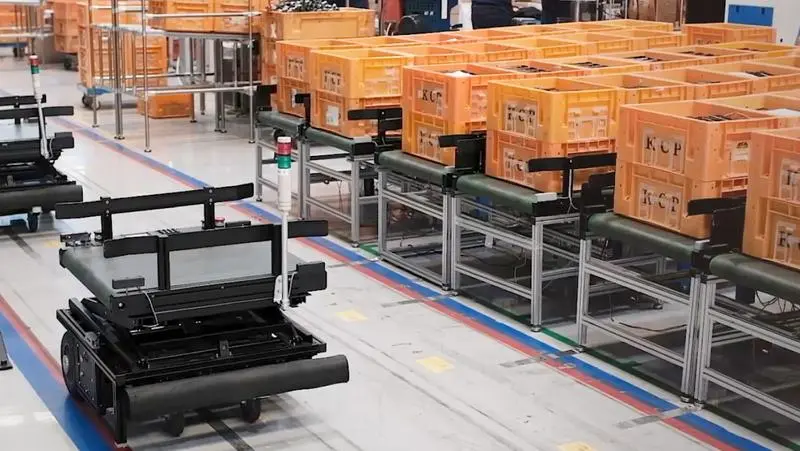
Process layout
Are you burdened by the high cost of logistics robots for moving items weighing 1 to 20kg? Between massive equipment investments and ongoing maintenance, the barriers to entry can be high.
Omorobot offers a solution with our OAGV (DIY-type Logistics Robot)—an affordable, simple, and highly reliable system. The OAGV is a modular logistics robot assembled using controllers and sensors designed and manufactured in-house by Omorobot, drawing from extensive robot development experience.
The standard platform can carry up to 150kg and navigates by following reflective tape on the floor, using credit-card-sized tags to identify specific locations for transport or return. It is ideal for transporting rectangular loads like plastic (PP, PE) or cardboard boxes (up to 650mm x 550mm), making it perfect for facilities requiring repetitive transport of low-to-medium loads.
Components
| Robot |
|
|---|
Workflow
| STEP 1. | Command: Dispatch instructions (manually or via the control server). |
|---|---|
| STEP 2. | Navigation: Follows the line and recognizes TAGs to identify the target location. |
| STEP 3. | Loading: Automatically loads the workpiece at the Depot. |
| STEP 4. | Transit: Travels along the line while monitoring TAGs. |
| STEP 5. | Unloading: Automatically unloads the workpiece at the POU (Point of Use). |
| STEP 6. | Return: Navigates back to the starting point. |
| STEP 7. | Repeat: The process repeats for the next cycle. |
Features
Cost-Effective Logistics Automation
Affordable Investment: Build an entire automation system for under 6 million KRW per unit (approx. 8 million KRW with an added auto-conveyor).
Low Maintenance: Operational costs are kept low at approximately 100,000 KRW/month per unit.
Value-Focused Design: By removing non-essential elements like high-end external housing and decorative lighting, Omorobot focuses on core functionality to provide a more reasonable price point.
Simple Line Installation
Reflective Tape Navigation: The CL100 follows basic reflective tape, allowing a single line to be installed in just one day.
No Major Infrastructure Changes: Implementation requires no additional facility investment; simply apply the floor tape and attach RF tags to get started.
High Flexibility for Layout Changes
DIY Modifications: On-site workers can easily adjust or move lines whenever production layouts change.
Customizable Tags: An RF-TAG reader/writer is provided, allowing users to modify tag data and destination logic as needed.
Results
| Key Benefits | Worker Safety: Protects employees from high-risk or physically straining transport tasks.
Economical Scalability: Provides a high-performance logistics system at a fraction of the cost of traditional AGVs.
|
|---|---|
| Client Feedback | "We used to deploy 5 to 6 full-time workers just to transport various raw materials to our production lines. After introducing three CL100 robots, we were able to replace those manual tasks with just one robot manager."
"To supply product boxes of various sizes and collect finished goods, we previously had 4 to 5 workers constantly moving carts. By adopting Omorobot’s logistics solution, a single dedicated staff member now manages the entire workflow."
|
Unauthorized copying or reproduction of any content on Marosol may violate the Unfair Competition Prevention Act and Copyright Act.
Recommended Solution

Haemil FA Roller Conveyor AMR
Project Overview This video presents an autonomous mobile robot (AMR) logistics transport system based on SLAM (Simultaneous Localization and Mapping). It provides an optimal solution for logistics and precision repetitive tasks on production sites by implementing autonomous unmanned transport and loading. Key features include Laser Sensing-based self-mapping and optimal path securing with safety through 2D/3D cameras for object recognition and obstacle identification. The system can be equipped with various applications such as collaborative robots (Co-Bots), roller conveyors, and Jack-Up systems. What is SLAM (Simultaneous Localization and Mapping)? It is a core technology for autonomous driving where a robot creates an accurate map of its work environment using only its onboard autonomous sensors while navigating the workspace. Project Background & Objectives Accurate and repetitive logistics tasks using autonomous robots.

Vulcan, the AI Logistics Robot that Handles 75% of Amazon's Warehouse Operations!
Project Overview This implementation case features the 'Vulcan' robot deployed in Amazon fulfillment centers to advance automated picking and stowing operations. Amazon introduced tactile-based robots to simultaneously secure efficiency and precision in stowing tasks that require repetition and delicacy. Using AI and a tactile sensor-based gripper that functions like a human hand, Vulcan adjusts pressure based on the weight or material of items and automatically stows products by efficiently utilizing space. Through this, Amazon has further expanded the accuracy and scope of its Logistics automation. Project Background & Objectives While existing Logistics robot systems (G2P methods) succeeded in automating tasks such as shelf movement, organizing products onto shelves still relied on manual labor. Amazon developed and introduced the Vulcan robot to reduce these repetitive tasks and implement advanced automation that considers space utilization and worker safety. This project aims for the following: Automation and advancement of product stowing Improved task precision through the application of perception-based robot technology Ensuring worker safety and reducing musculoskeletal strain

Haemil FA Unmanned Forklift SFL-COD140
This video information presents an autonomous logistics transport Forklift system based on SLAM (Simultaneous Localization and Mapping). It provides an autonomous unmanned method for logistics transport and stacking tasks, ensuring safety through Navigation Scan Lidar for positioning, Multi-Lidar for object and obstacle recognition, and 2D/3D cameras for pallet and cage loading. What is SLAM (Simultaneous Localization and Mapping)? It is a core technology for autonomous driving where a robot creates an accurate map of its work environment using only its onboard autonomous sensors while navigating the workspace. Project Background & Objectives Accurate and repetitive logistics tasks using autonomous robots.
Process layout
Are you burdened by the high cost of logistics robots for moving items weighing 1 to 20kg? Between massive equipment investments and ongoing maintenance, the barriers to entry can be high.
Omorobot offers a solution with our OAGV (DIY-type Logistics Robot)—an affordable, simple, and highly reliable system. The OAGV is a modular logistics robot assembled using controllers and sensors designed and manufactured in-house by Omorobot, drawing from extensive robot development experience.
The standard platform can carry up to 150kg and navigates by following reflective tape on the floor, using credit-card-sized tags to identify specific locations for transport or return. It is ideal for transporting rectangular loads like plastic (PP, PE) or cardboard boxes (up to 650mm x 550mm), making it perfect for facilities requiring repetitive transport of low-to-medium loads.
Components
| Robot |
|
|---|
Workflow
| STEP 1. | Command: Dispatch instructions (manually or via the control server). |
|---|---|
| STEP 2. | Navigation: Follows the line and recognizes TAGs to identify the target location. |
| STEP 3. | Loading: Automatically loads the workpiece at the Depot. |
| STEP 4. | Transit: Travels along the line while monitoring TAGs. |
| STEP 5. | Unloading: Automatically unloads the workpiece at the POU (Point of Use). |
| STEP 6. | Return: Navigates back to the starting point. |
| STEP 7. | Repeat: The process repeats for the next cycle. |
Features
Cost-Effective Logistics Automation
Affordable Investment: Build an entire automation system for under 6 million KRW per unit (approx. 8 million KRW with an added auto-conveyor).
Low Maintenance: Operational costs are kept low at approximately 100,000 KRW/month per unit.
Value-Focused Design: By removing non-essential elements like high-end external housing and decorative lighting, Omorobot focuses on core functionality to provide a more reasonable price point.
Simple Line Installation
Reflective Tape Navigation: The CL100 follows basic reflective tape, allowing a single line to be installed in just one day.
No Major Infrastructure Changes: Implementation requires no additional facility investment; simply apply the floor tape and attach RF tags to get started.
High Flexibility for Layout Changes
DIY Modifications: On-site workers can easily adjust or move lines whenever production layouts change.
Customizable Tags: An RF-TAG reader/writer is provided, allowing users to modify tag data and destination logic as needed.
Results
| Key Benefits | Worker Safety: Protects employees from high-risk or physically straining transport tasks.
Economical Scalability: Provides a high-performance logistics system at a fraction of the cost of traditional AGVs.
|
|---|---|
| Client Feedback | "We used to deploy 5 to 6 full-time workers just to transport various raw materials to our production lines. After introducing three CL100 robots, we were able to replace those manual tasks with just one robot manager."
"To supply product boxes of various sizes and collect finished goods, we previously had 4 to 5 workers constantly moving carts. By adopting Omorobot’s logistics solution, a single dedicated staff member now manages the entire workflow."
|
Unauthorized copying or reproduction of any content on Marosol may violate the Unfair Competition Prevention Act and Copyright Act.
Recommended Solution
Haemil FA Roller Conveyor AMR
Project Overview This video presents an autonomous mobile robot (AMR) logistics transport system based on SLAM (Simultaneous Localization and Mapping). It provides an optimal solution for logistics and precision repetitive tasks on production sites by implementing autonomous unmanned transport and loading. Key features include Laser Sensing-based self-mapping and optimal path securing with safety through 2D/3D cameras for object recognition and obstacle identification. The system can be equipped with various applications such as collaborative robots (Co-Bots), roller conveyors, and Jack-Up systems. What is SLAM (Simultaneous Localization and Mapping)? It is a core technology for autonomous driving where a robot creates an accurate map of its work environment using only its onboard autonomous sensors while navigating the workspace. Project Background & Objectives Accurate and repetitive logistics tasks using autonomous robots.
Vulcan, the AI Logistics Robot that Handles 75% of Amazon's Warehouse Operations!
Project Overview This implementation case features the 'Vulcan' robot deployed in Amazon fulfillment centers to advance automated picking and stowing operations. Amazon introduced tactile-based robots to simultaneously secure efficiency and precision in stowing tasks that require repetition and delicacy. Using AI and a tactile sensor-based gripper that functions like a human hand, Vulcan adjusts pressure based on the weight or material of items and automatically stows products by efficiently utilizing space. Through this, Amazon has further expanded the accuracy and scope of its Logistics automation. Project Background & Objectives While existing Logistics robot systems (G2P methods) succeeded in automating tasks such as shelf movement, organizing products onto shelves still relied on manual labor. Amazon developed and introduced the Vulcan robot to reduce these repetitive tasks and implement advanced automation that considers space utilization and worker safety. This project aims for the following: Automation and advancement of product stowing Improved task precision through the application of perception-based robot technology Ensuring worker safety and reducing musculoskeletal strain
Haemil FA Unmanned Forklift SFL-COD140
This video information presents an autonomous logistics transport Forklift system based on SLAM (Simultaneous Localization and Mapping). It provides an autonomous unmanned method for logistics transport and stacking tasks, ensuring safety through Navigation Scan Lidar for positioning, Multi-Lidar for object and obstacle recognition, and 2D/3D cameras for pallet and cage loading. What is SLAM (Simultaneous Localization and Mapping)? It is a core technology for autonomous driving where a robot creates an accurate map of its work environment using only its onboard autonomous sensors while navigating the workspace. Project Background & Objectives Accurate and repetitive logistics tasks using autonomous robots.