




Process layout
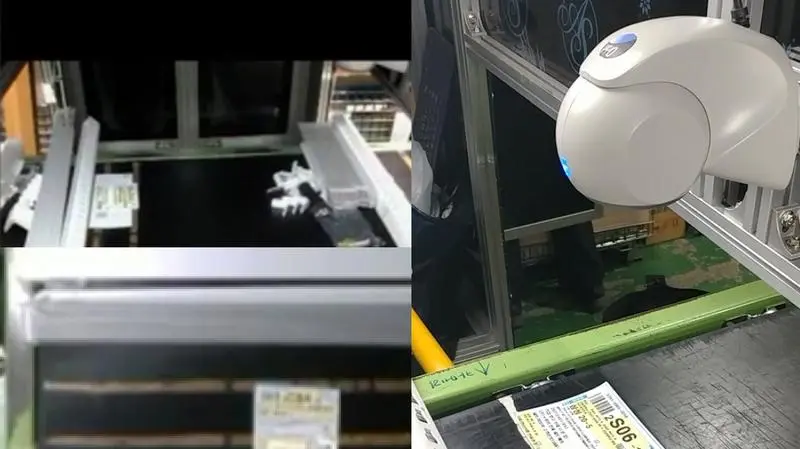
This application case features the Magenta Robotics FA VISION, a system designed for parts tending and inspection. Traditional production lines often suffer from high claim rates due to damaged, missing, or incorrectly shipped items, as well as significant delays between assembly and final taping/packaging.
FA VISION improves these inefficient systems by using AI to rapidly recognize the position and shape of objects, even measuring 3D coordinates and volume. This minimizes human error and optimizes the entire parts tending and inspection process.
Components
| Robot |
|
|---|
Workflow
| STEP 1. | Parts are fed into the system. |
|---|---|
| STEP 2. | Object recognition and position verification are performed. |
| STEP 3. | The robot executes parts tending (handling/loading). |
| STEP 4. | Final inspection is conducted. |
| STEP 5. | Workpieces are sorted and discharged. |
Features
Improved Work Productivity
Efficiency & Accuracy: Enhances overall operational efficiency and precision.
Flexible Production: Enables the construction of adaptable production lines.
Integrated Automation: Supports seamless integration with ERP systems for comprehensive Factory Automation (FA).
Optimized Motion Execution
Smart Pick-and-Place: Executes optimal movements based on sensed real-time information.
Irregular Part Handling: Capable of loading and unloading non-standard parts using suction or electromagnetic force.
Rapid Learning and Operation
High-Speed Recognition: Features rapid object detection and processing.
Intuitive Programming: Fast learning through a user-friendly GUI-based programming interface.
Remote Control: Supports real-time remote monitoring and control.
Superior Proprietary Technology
Proven Expertise: Backed by extensive on-site experience across various industries.
In-house Solution: Utilizes MAVIZ, a proprietary integrated control and simulation software.
Results
| Key Benefits | Rapid, accurate object recognition and 3D position/volume measurement.
Easy and fast robot teaching and deployment.
Highly efficient integrated parts tending and inspection system.
|
|---|---|
| Client Feedback | By simultaneously performing inspection and loading/unloading tasks for products of various shapes, we have significantly reduced defect rates and greatly improved overall productivity. |
Unauthorized copying or reproduction of any content on Marosol may violate the Unfair Competition Prevention Act and Copyright Act.
Recommended Solution

LG CNS Smart Logistics Equipment (Hybrid Wheel Sorter)
This application case features the LG CNS Hybrid Wheel Sorter, a smart logistics solution that enhances sorting accuracy and stability by improving the structural drawbacks of conventional circular roller wheel sorters through a belt-type application. It is an ideal solution for scenarios requiring the stable sorting of long items, sacks, and irregular-shaped cargo. The Belt-Type Wheel Sorter is a next-generation wheel sorter developed to overcome sorting errors caused by the narrow contact surfaces of traditional circular rollers. By replacing circular rollers with belt-type rollers, the contact area with the cargo is widened, significantly improving both sorting precision and stability. Additionally, its modular configuration ensures easy installation and maintenance. This system enables the construction of efficient logistics centers capable of handling high throughput by stably transporting and sorting diverse types of goods.

Gate Cutting and Vision Inspection for Injection Molding using Extraction Robots
This application is a solution that performs injection molding gate cutting and vision inspection using an extraction robot. In plastic injection automation, extraction robots do more than just retrieve parts; they handle post-processing tasks such as gate cutting and finishing. This solution goes beyond simple cutting by integrating vision inspection into the workflow.

SCHMALZ Layer Vacuum Gripping System (SPZ)
This application case features a solution for gripping and transferring workpieces using Schmalz's Layer Vacuum Gripping System (SPZ). The Schmalz SPZ is an optimized solution for wide-range palletizing tasks. It is ideally suited for transporting large workpieces, making it easy to implement in environments such as logistics warehouses. As an innovative gripper concept designed to support processes requiring high weight or high flow, it enables more stable and reliable palletizing.
Process layout
This application case features the Magenta Robotics FA VISION, a system designed for parts tending and inspection. Traditional production lines often suffer from high claim rates due to damaged, missing, or incorrectly shipped items, as well as significant delays between assembly and final taping/packaging.
FA VISION improves these inefficient systems by using AI to rapidly recognize the position and shape of objects, even measuring 3D coordinates and volume. This minimizes human error and optimizes the entire parts tending and inspection process.
Components
| Robot |
|
|---|
Workflow
| STEP 1. | Parts are fed into the system. |
|---|---|
| STEP 2. | Object recognition and position verification are performed. |
| STEP 3. | The robot executes parts tending (handling/loading). |
| STEP 4. | Final inspection is conducted. |
| STEP 5. | Workpieces are sorted and discharged. |
Features
Improved Work Productivity
Efficiency & Accuracy: Enhances overall operational efficiency and precision.
Flexible Production: Enables the construction of adaptable production lines.
Integrated Automation: Supports seamless integration with ERP systems for comprehensive Factory Automation (FA).
Optimized Motion Execution
Smart Pick-and-Place: Executes optimal movements based on sensed real-time information.
Irregular Part Handling: Capable of loading and unloading non-standard parts using suction or electromagnetic force.
Rapid Learning and Operation
High-Speed Recognition: Features rapid object detection and processing.
Intuitive Programming: Fast learning through a user-friendly GUI-based programming interface.
Remote Control: Supports real-time remote monitoring and control.
Superior Proprietary Technology
Proven Expertise: Backed by extensive on-site experience across various industries.
In-house Solution: Utilizes MAVIZ, a proprietary integrated control and simulation software.
Results
| Key Benefits | Rapid, accurate object recognition and 3D position/volume measurement.
Easy and fast robot teaching and deployment.
Highly efficient integrated parts tending and inspection system.
|
|---|---|
| Client Feedback | By simultaneously performing inspection and loading/unloading tasks for products of various shapes, we have significantly reduced defect rates and greatly improved overall productivity. |
Unauthorized copying or reproduction of any content on Marosol may violate the Unfair Competition Prevention Act and Copyright Act.
Recommended Solution
LG CNS Smart Logistics Equipment (Hybrid Wheel Sorter)
This application case features the LG CNS Hybrid Wheel Sorter, a smart logistics solution that enhances sorting accuracy and stability by improving the structural drawbacks of conventional circular roller wheel sorters through a belt-type application. It is an ideal solution for scenarios requiring the stable sorting of long items, sacks, and irregular-shaped cargo. The Belt-Type Wheel Sorter is a next-generation wheel sorter developed to overcome sorting errors caused by the narrow contact surfaces of traditional circular rollers. By replacing circular rollers with belt-type rollers, the contact area with the cargo is widened, significantly improving both sorting precision and stability. Additionally, its modular configuration ensures easy installation and maintenance. This system enables the construction of efficient logistics centers capable of handling high throughput by stably transporting and sorting diverse types of goods.
Gate Cutting and Vision Inspection for Injection Molding using Extraction Robots
This application is a solution that performs injection molding gate cutting and vision inspection using an extraction robot. In plastic injection automation, extraction robots do more than just retrieve parts; they handle post-processing tasks such as gate cutting and finishing. This solution goes beyond simple cutting by integrating vision inspection into the workflow.
SCHMALZ Layer Vacuum Gripping System (SPZ)
This application case features a solution for gripping and transferring workpieces using Schmalz's Layer Vacuum Gripping System (SPZ). The Schmalz SPZ is an optimized solution for wide-range palletizing tasks. It is ideally suited for transporting large workpieces, making it easy to implement in environments such as logistics warehouses. As an innovative gripper concept designed to support processes requiring high weight or high flow, it enables more stable and reliable palletizing.