

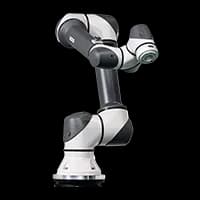



This machine tending solution automates the loading and unloading of parts by integrating three G-AiD small-precision (4-axis) machine tools with a Universal Robots UR10e.
By arranging multiple machine tools in a compact space, a single robot can manage the entire workflow, significantly boosting operational efficiency and productivity. G-AiD features an Automatic Tool Changer (ATC) and tool wear sensing, enabling efficient task management. Furthermore, its seamless data integration with external systems makes it an ideal candidate for Smart Factory government support projects, helping to reduce initial investment costs.
The project was implemented to resolve labor shortages in part machining, reduce personnel costs, and enable real-time quality monitoring and improvement through smart factory integration.
Components
| Robot |
|
|---|
Workflow
| STEP 1. | Infeed: Pick raw material from the infeed pallet. |
|---|---|
| STEP 2. | Loading (Stage 1): Load the raw material into the 1st G-AiD (MCT). |
| STEP 3. | Transfer: Pick the semi-finished part from the 1st MCT after primary machining. |
| STEP 4. | Loading (Stage 2): Load the semi-finished part into the 2nd G-AiD (MCT). |
| STEP 5. | Unloading: Pick the completed part from the 2nd MCT. |
| STEP 6. | Discharge: Place the finished part onto the discharge pallet. |
※ The content provided by Bigwave Robotics is protected under U.S. and Canadian copyright and intellectual property laws. Unauthorized reproduction, distribution, or use of this content is strictly prohibited.
Recommended Use Cases

Support Ring Machining Assistance for WIA Turning Center using Fanuc Robot
This machine tending automation solution utilizes a Fanuc M-710iC/70 robot mounted on a linear track to automate the machining of heavy support rings across six WIA Turning Centers (LV450). By employing a high-payload industrial robot and a linear track, the system can rapidly perform continuous operations for relatively large and heavy support rings without idle time. The previous manual process, where workers pushed carts to each machine, has been replaced by a centralized input system, significantly improving both logistics flow and space efficiency.

Press Machine Tending for Thin Plate Sheets using Yaskawa Robots
This automation solution utilizes YASKAWA robots equipped with vacuum grippers to handle thin plates, automating the workpiece feeding process and significantly enhancing the safety of press operations. Due to the nature of press processes—characterized by extremely short cycle times and high-risk environments—industrial accidents involving human operators are frequent. By employing robot automation, particularly with vacuum grippers which are far more effective at handling thin plates than manual labor, this solution simultaneously improves production throughput and workplace safety.

Powder Compaction Press Assistance using Doosan M1013
This automation solution utilizes the Doosan M1013 collaborative robot to automatically load and stack powder-compacted cutting tool components onto pallets. This system is characterized by its rapid teaching capabilities and high workplace safety. The powder compaction process traditionally generates significant amounts of dust, creating a hazardous environment for human workers. By implementing robot automation, idle time has been minimized to allow for continuous operation. Furthermore, a 100% inspection process has been integrated into the workflow, successfully reducing the overall defect rate.
This machine tending solution automates the loading and unloading of parts by integrating three G-AiD small-precision (4-axis) machine tools with a Universal Robots UR10e.
By arranging multiple machine tools in a compact space, a single robot can manage the entire workflow, significantly boosting operational efficiency and productivity. G-AiD features an Automatic Tool Changer (ATC) and tool wear sensing, enabling efficient task management. Furthermore, its seamless data integration with external systems makes it an ideal candidate for Smart Factory government support projects, helping to reduce initial investment costs.
The project was implemented to resolve labor shortages in part machining, reduce personnel costs, and enable real-time quality monitoring and improvement through smart factory integration.
Components
| Robot |
|
|---|
Workflow
| STEP 1. | Infeed: Pick raw material from the infeed pallet. |
|---|---|
| STEP 2. | Loading (Stage 1): Load the raw material into the 1st G-AiD (MCT). |
| STEP 3. | Transfer: Pick the semi-finished part from the 1st MCT after primary machining. |
| STEP 4. | Loading (Stage 2): Load the semi-finished part into the 2nd G-AiD (MCT). |
| STEP 5. | Unloading: Pick the completed part from the 2nd MCT. |
| STEP 6. | Discharge: Place the finished part onto the discharge pallet. |
※ The content provided by Bigwave Robotics is protected under U.S. and Canadian copyright and intellectual property laws. Unauthorized reproduction, distribution, or use of this content is strictly prohibited.