


Process layout
Process Overview
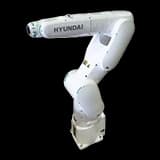
This palletizing automation solution uses the Hyundai Robotics HH050 and Mech-Mind 3D vision to detect mixed-size boxes, align them by size, and automatically stack them onto pallets. By leveraging a cost-effective 3D vision system, the cell can reliably palletize even when cartons of varying dimensions are mixed in the flow, ensuring stable operation.
Components
| Robot | Mech-Mind Mech-Eye Laser L (Industrial 3D camera) FOV: 1250 × 1460 @ 1.5 m; 2500 × 2890 @ 3 m Resolution: 2048 × 1536 (3 MP) Accuracy: 1.0 mm @ 2 m Scan time: 0.9–1.3 s Recommended scanning distance: 1.5–3 m Mech-Viz Intelligent Programming Environment: robot programming tool Hyundai Robotics HDR50-22 (HH050) Repeatability: ±0.06 mm |
|---|---|
| Peripherals | Tooling Vacuum gripper 3D Vision Mech-Eye Laser L (FOV: 1250 × 1460 @ 1.5 m; 2500 × 2890 @ 3 m, Resolution: 2048 × 1536 (3 MP), Accuracy: 1.0 mm @ 2 m, Scan time: 0.9–1.3 s, Recommended scanning distance: 1.5–3 m, Mech-Viz Intelligent Programming Environment: robot programming tool) Peripheral Equipment Robot base Vision mounting stand Box infeed stand Pallet fixing guide |
Workflow
| STEP 1. | Scan available pallet stacking space using 3D vision |
|---|---|
| STEP 2. | Pick each box and place it into the remaining pallet space based on its size |
| STEP 3. | Repeat until palletizing is complete |
Features
(Hyundai Robotics) Holds the #1 domestic market share with a strong sales and service network in Korea.
Since entering the domestic robot business in 1984, has secured a broad portfolio of solutions and product lineups.
Can deliver customer-tailored solutions through end-to-end execution across robot manufacturing, engineering, and installation.
Handles high payloads and a wide working envelope.
Payload: 50 kg; Reach: 2,239 mm
A single robot can handle most logistics box-handling tasks.
A reasonably priced 3D vision solution starting in the low KRW 20 million range.
Deep-learning-based 3D object recognition provides strong detection performance across a wide variety of objects.
Maintains reliable recognition even with strong reflections (e.g., from tape) or dark-colored products.
High capability to distinguish individual boxes even when cartons are tightly packed together.
Easy motion planning for collision avoidance and dense stacking.
Wide-area recognition supports palletizing tasks with stacking heights above 2 m.
Results
| Key Benefits | Reduced staffing requirements for box palletizing operations. |
|---|---|
| Client Feedback | In manual palletizing, operators had to repeatedly adjust and rework stacks to build tightly packed pallets with the robot cell, we were able to achieve satisfactory dense stacking as well. |
Unauthorized copying or reproduction of any content on Marosol may violate the Unfair Competition Prevention Act and Copyright Act.
Recommended Solution

Silicone Molded Part Palletizing using AIM AIVE System and Delta SCARA Robot
Silicone Molded Part Palletizing using AIM AIVE System and Delta SCARA Robot

AI Palletizing using Hyundai YS140 and Mech-Mind
This automation solution utilizes Mech-Mind 3D Vision and the Hyundai YS140 industrial robot to automatically sort and stack boxes onto pallets by size, as well as transfer them to conveyors. By employing two sets of highly cost-effective 3D vision sensors, the system can stably perform both palletizing and depalletizing tasks even when various product boxes are mixed together (Mixed-Case Palletizing). The project was implemented to improve worker health and safety by automating tasks known to cause musculoskeletal disorders.

Smartphone Sorting & Stacking using UR5 and Linear Track
This automated sorting and storage solution utilizes a Universal Robots UR5 collaborative robot mounted on a Linear Track (7th axis) to perform high-precision handling of smartphones. By integrating 2D Vision, the system identifies the type and position of items arriving via conveyor. The 6-axis articulated robot then uses an electric gripper to sort and stack these items into specific locations. Conversely, when a retrieval command is received, the robot can pick the required items from the storage rack and move them to the discharge position. The linear track allows the robot to cover a significantly wider workspace, making it ideal for comprehensive inbound/outbound inventory management.
Process layout
Process Overview
This palletizing automation solution uses the Hyundai Robotics HH050 and Mech-Mind 3D vision to detect mixed-size boxes, align them by size, and automatically stack them onto pallets. By leveraging a cost-effective 3D vision system, the cell can reliably palletize even when cartons of varying dimensions are mixed in the flow, ensuring stable operation.
Components
| Robot | Mech-Mind Mech-Eye Laser L (Industrial 3D camera) FOV: 1250 × 1460 @ 1.5 m; 2500 × 2890 @ 3 m Resolution: 2048 × 1536 (3 MP) Accuracy: 1.0 mm @ 2 m Scan time: 0.9–1.3 s Recommended scanning distance: 1.5–3 m Mech-Viz Intelligent Programming Environment: robot programming tool Hyundai Robotics HDR50-22 (HH050) Repeatability: ±0.06 mm |
|---|---|
| Peripherals | Tooling Vacuum gripper 3D Vision Mech-Eye Laser L (FOV: 1250 × 1460 @ 1.5 m; 2500 × 2890 @ 3 m, Resolution: 2048 × 1536 (3 MP), Accuracy: 1.0 mm @ 2 m, Scan time: 0.9–1.3 s, Recommended scanning distance: 1.5–3 m, Mech-Viz Intelligent Programming Environment: robot programming tool) Peripheral Equipment Robot base Vision mounting stand Box infeed stand Pallet fixing guide |
Workflow
| STEP 1. | Scan available pallet stacking space using 3D vision |
|---|---|
| STEP 2. | Pick each box and place it into the remaining pallet space based on its size |
| STEP 3. | Repeat until palletizing is complete |
Features
(Hyundai Robotics) Holds the #1 domestic market share with a strong sales and service network in Korea.
Since entering the domestic robot business in 1984, has secured a broad portfolio of solutions and product lineups.
Can deliver customer-tailored solutions through end-to-end execution across robot manufacturing, engineering, and installation.
Handles high payloads and a wide working envelope.
Payload: 50 kg; Reach: 2,239 mm
A single robot can handle most logistics box-handling tasks.
A reasonably priced 3D vision solution starting in the low KRW 20 million range.
Deep-learning-based 3D object recognition provides strong detection performance across a wide variety of objects.
Maintains reliable recognition even with strong reflections (e.g., from tape) or dark-colored products.
High capability to distinguish individual boxes even when cartons are tightly packed together.
Easy motion planning for collision avoidance and dense stacking.
Wide-area recognition supports palletizing tasks with stacking heights above 2 m.
Results
| Key Benefits | Reduced staffing requirements for box palletizing operations. |
|---|---|
| Client Feedback | In manual palletizing, operators had to repeatedly adjust and rework stacks to build tightly packed pallets with the robot cell, we were able to achieve satisfactory dense stacking as well. |
Unauthorized copying or reproduction of any content on Marosol may violate the Unfair Competition Prevention Act and Copyright Act.
Recommended Solution
Silicone Molded Part Palletizing using AIM AIVE System and Delta SCARA Robot
Silicone Molded Part Palletizing using AIM AIVE System and Delta SCARA Robot
AI Palletizing using Hyundai YS140 and Mech-Mind
This automation solution utilizes Mech-Mind 3D Vision and the Hyundai YS140 industrial robot to automatically sort and stack boxes onto pallets by size, as well as transfer them to conveyors. By employing two sets of highly cost-effective 3D vision sensors, the system can stably perform both palletizing and depalletizing tasks even when various product boxes are mixed together (Mixed-Case Palletizing). The project was implemented to improve worker health and safety by automating tasks known to cause musculoskeletal disorders.
Smartphone Sorting & Stacking using UR5 and Linear Track
This automated sorting and storage solution utilizes a Universal Robots UR5 collaborative robot mounted on a Linear Track (7th axis) to perform high-precision handling of smartphones. By integrating 2D Vision, the system identifies the type and position of items arriving via conveyor. The 6-axis articulated robot then uses an electric gripper to sort and stack these items into specific locations. Conversely, when a retrieval command is received, the robot can pick the required items from the storage rack and move them to the discharge position. The linear track allows the robot to cover a significantly wider workspace, making it ideal for comprehensive inbound/outbound inventory management.