

Process layout
Process Overview
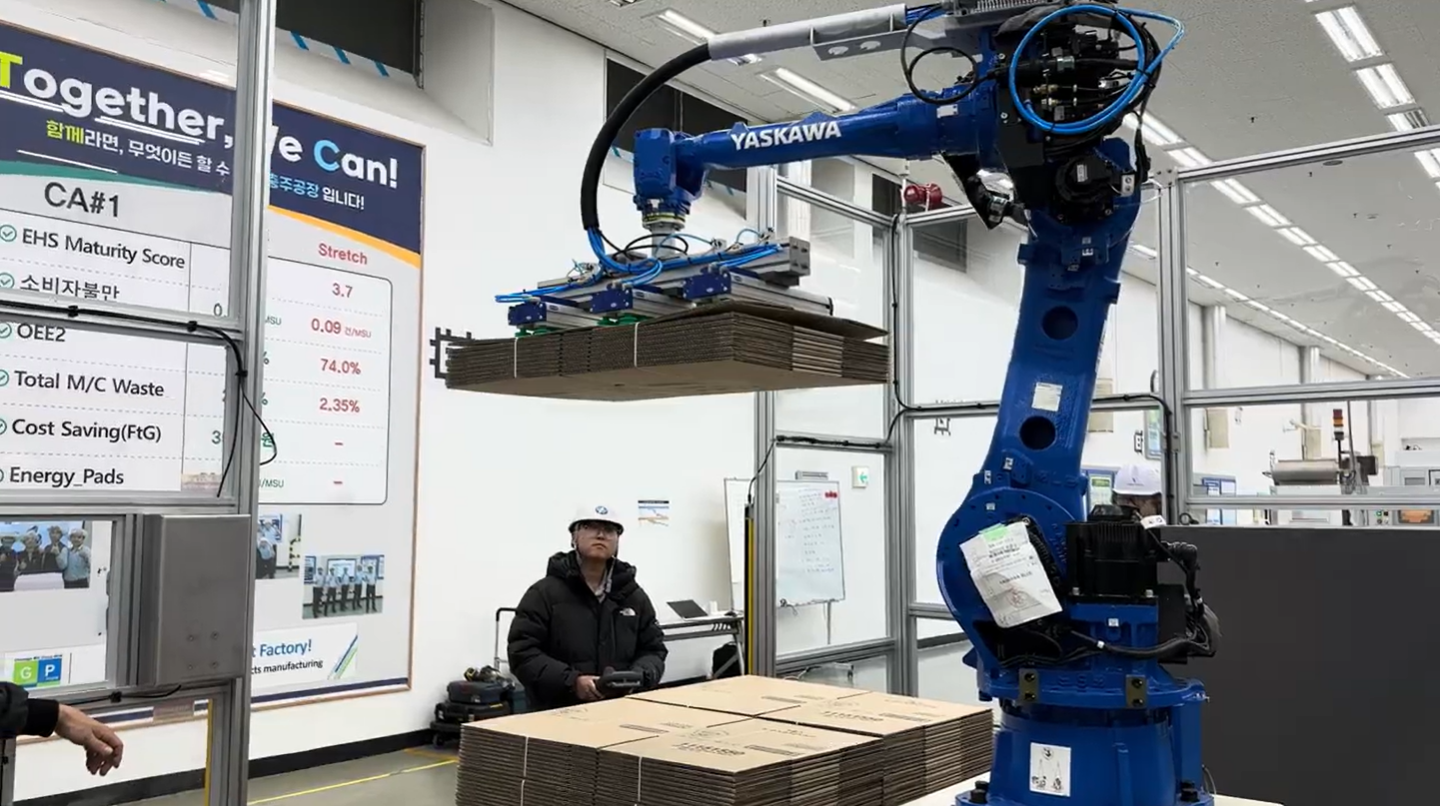
This deployment was implemented at Yuhan-Kimberly’s Chungju Plant, delivering an integrated solution that combines a Yaskawa industrial robot with a strapping-cut workbench to automate depalletizing + strap cutting.
The customer pursued a depalletizing system to reduce labor costs and operator fatigue, and showed strong interest in automating strap cutting and strap discharge to further maximize cost savings and operational efficiency.
The solution handles mixed carton sizes by aligning (squaring) cartons, cutting and removing straps, and then feeding cartons into the case packer. This improves throughput and consistency in both carton infeed and strap removal, while reducing physical strain on operators and enhancing workplace safety.
Project Background and Objectives
At Yuhan-Kimberly’s Chungju Plant, cartons arriving on pallets were previously broken down manually and then loaded one-by-one into the case packer. The work was highly repetitive, and manual strap removal using knives created a persistent risk of safety incidents.
The objective of this project was to minimize reliance on manual labor by automating the entire process—from depalletizing through case packer infeed—and to achieve lights-out (unmanned) operation for strap cutting. This enables improved operator safety, reduced fatigue and staffing burden on the floor, and more stable, repeatable plant operations.
Components
| Robot | Yaskawa GP50 Industrial Robot: A high-speed, high-precision 6-axis articulated robot optimized for palletizing/depalletizing operations. It can automatically pick, place, and transfer a wide range of products, making it well-suited for industrial automation. |
|---|---|
| Peripherals | Carton Aligner + Strap-Cutting Station: A workbench system that squares/aligns cartons of various sizes, then cuts and evacuates strapping. Safety Light Curtain + Perimeter Fence: Visually separates the operator zone from the robot cell. If an operator enters the depalletizing area, the system immediately stops motion to ensure safety. |
Workflow
| STEP 1. | An operator loads a pallet of stacked cartons into the designated loading position |
|---|---|
| STEP 2. | The operator selects the carton “recipe” on the HMI (OP panel) and starts the cycle |
| STEP 3. | The robot depalletizes bundled cartons per the selected recipe and transfers them to the alignment/strap-cutting station |
| STEP 4. | The station squares the bundle using servo drives and pneumatic cylinders |
| STEP 5. | The system cuts the straps while the cartons are securely clamped in position |
| STEP 6. | A hook mechanism captures and discharges the cut straps |
| STEP 7. | The station re-squares the bundle to prevent misalignment during cutting |
| STEP 8. | The robot feeds individual cartons to the case packer infeed one by one. |
Features
Key Features
Flexible handling across multiple carton sizes: Alignment and strap cutting can be performed regardless of carton size, supporting up to 27 carton size variants.
Flexible inbound conditions: Even if the number of strapped cartons on the pallet varies by load, the operator can simply enter the required conditions on the HMI (OP panel), and the robot can execute depalletizing accordingly.
Deployment Benefits
Higher productivity: Depalletizing and strap cutting are automated, increasing operation speed and reducing operator fatigue.
Lower operating cost: Process automation enables labor reduction and more efficient operations.
Improved safety: Safety light curtains, safety mats, and laser scanners help minimize accident and hazard risks during operation.
Results
| Key Benefits | This depalletizing and strap-cutting automation solution deployed at Yuhan-Kimberly’s Chungju Plant delivered meaningful improvements across productivity, safety, and workforce utilization. Previously, the process required 2–3 operators to manually break down palletized cartons and remove strapping after automation, the cell could be operated with a single operator primarily monitoring the system, resulting in a labor reduction effect of over 50%. |
|---|---|
| Client Feedback | The customer commented, “By deploying the depalletizing robot, not only was the operator’s physical workload reduced, but logistics efficiency also improved significantly. With the safety system well implemented, operators feel more secure and can stay focused on their work.” |
Unauthorized copying or reproduction of any content on Marosol may violate the Unfair Competition Prevention Act and Copyright Act.
Curious about the robots used?
Recommended Solution

Piece Picking using Yaskawa and Mech-Mind
This automation solution combines logistics and sorting automation by utilizing Mech-Mind 3D Vision and the Yaskawa GP8 robot to classify and transfer a diverse range of unstructured objects. By leveraging a highly cost-effective 3D vision system to recognize both the position and geometry of items, the robot can easily sort products even if their locations change or multiple types of objects are mixed together. This is the ideal solution for environments with diverse workpieces or for companies looking to automate manual tasks with minimal changes to their existing workspace. The project was implemented to automate order picking in fulfillment centers and eliminate the manual labor required for sorting individual packaged goods. Furthermore, it aims to achieve high-efficiency sorting for unstructured and mixed-SKU inventory. *Note: This content is based on a demo; actual deployment may require additional equipment based on specific customer requirements.

Product Sorting Automation using UR5 and Deep Learning
This next-generation sorting solution leverages 3D Vision, Deep Learning (Instance Segmentation), Reinforcement Learning, and Motion Planning (OMPL) to automate complex tasks such as product classification, assembly, and packing. By utilizing cost-effective 3D vision, the system recognizes the type and location of products and bins in real-time. This allows the robot to automatically compensate for shifts in the position of items or boxes without manual intervention. The integration of Motion Planning drastically reduces human teaching time, while Reinforcement Learning optimizes movements to minimize overall cycle times.

Smartphone Sorting & Stacking using UR5 and Linear Track
This automated sorting and storage solution utilizes a Universal Robots UR5 collaborative robot mounted on a Linear Track (7th axis) to perform high-precision handling of smartphones. By integrating 2D Vision, the system identifies the type and position of items arriving via conveyor. The 6-axis articulated robot then uses an electric gripper to sort and stack these items into specific locations. Conversely, when a retrieval command is received, the robot can pick the required items from the storage rack and move them to the discharge position. The linear track allows the robot to cover a significantly wider workspace, making it ideal for comprehensive inbound/outbound inventory management.