

Process layout
Process Overview
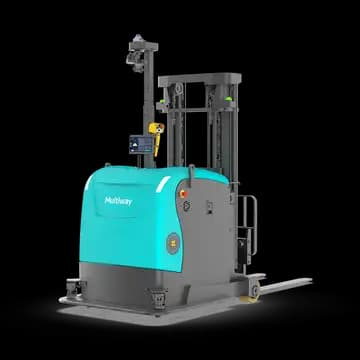
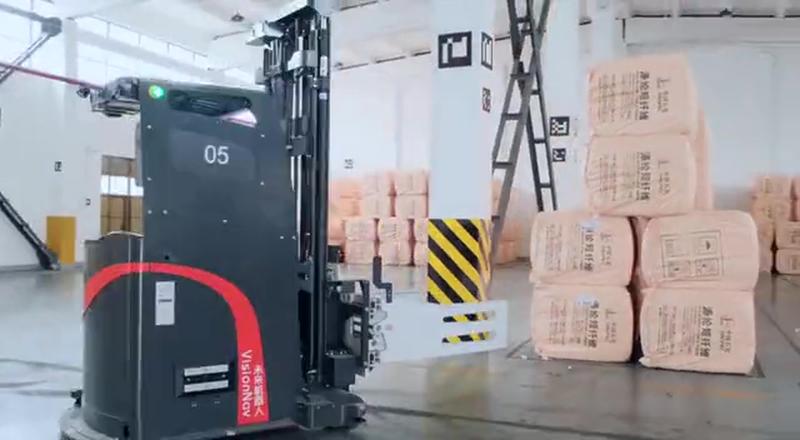
This case study showcases a logistics automation solution that uses VisionNav’s VNPA15 autonomous mobile robot (AMR) to automate the transport and loading/stacking of packaged products in indoor material-handling operations.
Built on robust safety functions, the solution minimizes changes to existing workflows while enabling unattended load/unload tasks, and provides effective monitoring and control of real-time operations.
Components
| Robot | VisionNav VNPA15 (Autonomous Counterbalanced Truck) Lifting height: 0–4,500 mm Max payload: 800 kg Min. stacking aisle width: 3,200 mm Dimensions (W×D×H): 2,790 × 1,185 × 2,110 mm Vehicle weight: 2,640 kg |
|---|
Workflow
| STEP 1. | Transport/stacking task dispatch |
|---|---|
| STEP 2. | Navigate to the pick location |
| STEP 3. | Pick from a two-level stacked load |
| STEP 4. | Navigate to the truck position and unload |
Features
High Performance and Safety
Using Visual SLAM, the system can achieve positioning accuracy of ±5 mm and navigation accuracy of ±10 mm.
Delivers high work efficiency with a maximum travel speed of 2 m/s and fast motion execution.
Even on complex routes, it can travel while avoiding obstacles at a speed comparable to a human operator’s working pace.
Ensures high safety through 5-level safety protection and a redundant control system.
Enables 24/7 continuous operation, increasing productivity.
Supports automatic charging based on remaining battery level and efficient task planning.
Recognizes variable truck positions to enable product loading onto trucks.
Supports alignment operations for multi-level stacking.
Minimized Deployment Time and Cost
With self-localization and path planning, it can reduce deployment time and cost by minimizing additional facility modifications.
Provides flexible 대응 to layout changes and work-location changes.
Performs obstacle avoidance via autonomous navigation functions.
Enables optimized operation and management of multiple units (100+ vehicles/equipment).
Results
| Key Benefits | Replaced 7 forklifts and 21 forklift operators with 10 VisionNav trucks (VNPA fleet). 63 pallets/hour, 24/7 operation (truck loading: 1,500 bags). |
|---|---|
| Client Feedback | With the VisionNav solution, we were able to perform stable two-level stacking and material transport operations, and also handle truck loading efficiently even when the truck docking position was not fixed. |
Unauthorized copying or reproduction of any content on Marosol may violate the Unfair Competition Prevention Act and Copyright Act.
Recommended Solution

Boston Dynamics Spot: The Autonomous Mobile Robot (Robot Dog)
This security and patrol automation solution utilizes Spot, the quadruped robot dog developed by Boston Dynamics. Spot is an agile, four-legged robot designed to be rugged and highly customizable. It is perfectly suited for unstructured environments, capable of climbing stairs and traversing rough, uneven terrain that traditional wheeled robots cannot access. By incorporating the Clearpath ROS Package for Spot, robotics researchers and developers can take full advantage of out-of-the-box ROS (Robot Operating System) functionality. This allows for accelerated development by leveraging widely available open-source libraries, tools, and the extensive global ROS community.

Logistics Robot 'KARRY' by DOGU
The autonomous logistics robot KARRY by DOGU KONGAN is a robotic solution designed for logistics centers, factories, and warehouses. It optimizes operations by either following a human worker to transport cargo or navigating autonomously to designated locations. The primary objective of this project was to automate heavy-load transport tasks to resolve the issue of cumulative worker fatigue. In this setup, human workers remain at fixed stations while the logistics transport process itself is fully automated. Featuring efficient and safe autonomous navigation, KARRY is easy to deploy in any logistics environment due to its intuitive user-recognition system and low barrier to entry.

Beverage Pallet Unwrapping Solution using Three Hyundai HS220 Robots
This industrial robot solution utilizes three Hyundai HS220 robots to automate the hazardous task of manually removing stretch wrap and straps from beverage pallets. Previously, this process posed a significant risk of safety accidents because workers had to use manual cutters on pallets with high stacking heights. Although the complexity of the task made automation difficult in the past, Hyundai Robotics' specialized solution has made it possible. Additionally, the system neatly manages residual waste, minimizing the need for operator intervention and management.
Process layout
Process Overview
This case study showcases a logistics automation solution that uses VisionNav’s VNPA15 autonomous mobile robot (AMR) to automate the transport and loading/stacking of packaged products in indoor material-handling operations.
Built on robust safety functions, the solution minimizes changes to existing workflows while enabling unattended load/unload tasks, and provides effective monitoring and control of real-time operations.
Components
| Robot | VisionNav VNPA15 (Autonomous Counterbalanced Truck) Lifting height: 0–4,500 mm Max payload: 800 kg Min. stacking aisle width: 3,200 mm Dimensions (W×D×H): 2,790 × 1,185 × 2,110 mm Vehicle weight: 2,640 kg |
|---|
Workflow
| STEP 1. | Transport/stacking task dispatch |
|---|---|
| STEP 2. | Navigate to the pick location |
| STEP 3. | Pick from a two-level stacked load |
| STEP 4. | Navigate to the truck position and unload |
Features
High Performance and Safety
Using Visual SLAM, the system can achieve positioning accuracy of ±5 mm and navigation accuracy of ±10 mm.
Delivers high work efficiency with a maximum travel speed of 2 m/s and fast motion execution.
Even on complex routes, it can travel while avoiding obstacles at a speed comparable to a human operator’s working pace.
Ensures high safety through 5-level safety protection and a redundant control system.
Enables 24/7 continuous operation, increasing productivity.
Supports automatic charging based on remaining battery level and efficient task planning.
Recognizes variable truck positions to enable product loading onto trucks.
Supports alignment operations for multi-level stacking.
Minimized Deployment Time and Cost
With self-localization and path planning, it can reduce deployment time and cost by minimizing additional facility modifications.
Provides flexible 대응 to layout changes and work-location changes.
Performs obstacle avoidance via autonomous navigation functions.
Enables optimized operation and management of multiple units (100+ vehicles/equipment).
Results
| Key Benefits | Replaced 7 forklifts and 21 forklift operators with 10 VisionNav trucks (VNPA fleet). 63 pallets/hour, 24/7 operation (truck loading: 1,500 bags). |
|---|---|
| Client Feedback | With the VisionNav solution, we were able to perform stable two-level stacking and material transport operations, and also handle truck loading efficiently even when the truck docking position was not fixed. |
Unauthorized copying or reproduction of any content on Marosol may violate the Unfair Competition Prevention Act and Copyright Act.
Recommended Solution
Boston Dynamics Spot: The Autonomous Mobile Robot (Robot Dog)
This security and patrol automation solution utilizes Spot, the quadruped robot dog developed by Boston Dynamics. Spot is an agile, four-legged robot designed to be rugged and highly customizable. It is perfectly suited for unstructured environments, capable of climbing stairs and traversing rough, uneven terrain that traditional wheeled robots cannot access. By incorporating the Clearpath ROS Package for Spot, robotics researchers and developers can take full advantage of out-of-the-box ROS (Robot Operating System) functionality. This allows for accelerated development by leveraging widely available open-source libraries, tools, and the extensive global ROS community.
Logistics Robot 'KARRY' by DOGU
The autonomous logistics robot KARRY by DOGU KONGAN is a robotic solution designed for logistics centers, factories, and warehouses. It optimizes operations by either following a human worker to transport cargo or navigating autonomously to designated locations. The primary objective of this project was to automate heavy-load transport tasks to resolve the issue of cumulative worker fatigue. In this setup, human workers remain at fixed stations while the logistics transport process itself is fully automated. Featuring efficient and safe autonomous navigation, KARRY is easy to deploy in any logistics environment due to its intuitive user-recognition system and low barrier to entry.
Beverage Pallet Unwrapping Solution using Three Hyundai HS220 Robots
This industrial robot solution utilizes three Hyundai HS220 robots to automate the hazardous task of manually removing stretch wrap and straps from beverage pallets. Previously, this process posed a significant risk of safety accidents because workers had to use manual cutters on pallets with high stacking heights. Although the complexity of the task made automation difficult in the past, Hyundai Robotics' specialized solution has made it possible. Additionally, the system neatly manages residual waste, minimizing the need for operator intervention and management.