

Process layout
Process Overview
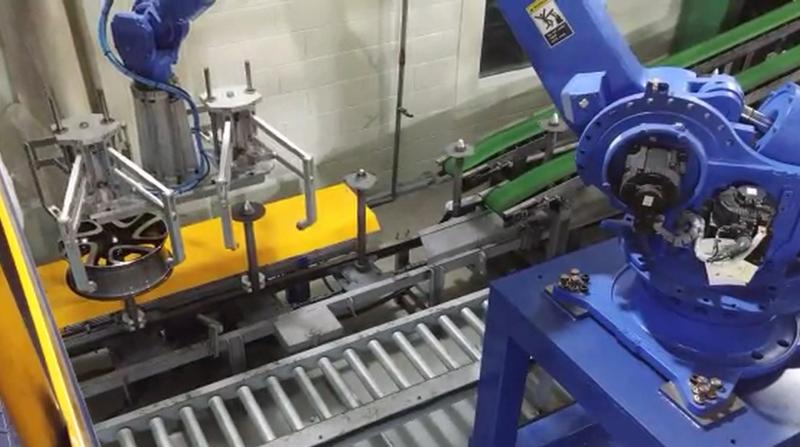
This solution automates high-payload automotive wheel handling using a Yaskawa GP250 robot.
Since automotive wheels are heavy workpieces (over 8 kg) that are difficult and physically demanding for operators to handle, robot automation enables handling up to two wheels at once, improving productivity and operator satisfaction.
Components
| Robot |
|
|---|---|
| Peripherals |
|
Workflow
| STEP 1. | Workpiece infeed and transfer |
|---|---|
| STEP 2. | Position sensing and tracking |
| STEP 3. | Workpiece pick-up |
| STEP 4. | Outfeed conveyor tracking |
| STEP 5. | Workpiece unloading |
Features
Improves both work environment and productivity
Prevents operator musculoskeletal disorders by automating high-payload (over 8 kg) handling
Reduces cycle time by handling two workpieces simultaneously
Enables continuous operation by performing both infeed and outfeed conveyor transfer while parts remain in motion
Supports optimal design and pre-validation based on process conditions
Supports custom tool design and fabrication optimized for process conditions and performance
Enables tool and layout design for simultaneous handling of two workpieces
Minimizes errors caused by positional deviation by clamping the conveyor jig lower section
Results
| Key Benefits | Higher productivity through reduced cycle time Prevention of operator musculoskeletal disorders |
|---|---|
| Client Feedback | This process was physically demanding due to high-payload product handling. With automation, operators were reassigned to other processes, improving work efficiency and productivity. |
Unauthorized copying or reproduction of any content on Marosol may violate the Unfair Competition Prevention Act and Copyright Act.
Recommended Solution

Automotive Parts Roll Forming & Deburring Automation with Kawasaki and ABB Robots
Process Overview This solution uses a total of four robots—one KAWASAKI ZX165U, two ABB IRB 2600 units, and one ABB IRB 6700—to transfer automotive parts after roll forming and perform deburring operations. By transferring parts to the next process in sync with the continuous forming cycle time, it reduces operation time and maximizes productivity.

EV Cooling Fin Manufacturing Automation with 4 Hyundai Robots and a Cartesian Robot
Process Overview This solution is a manufacturing automation system for producing EV cooling fins using four Hyundai Robotics HH010L robots and a cartesian robot. By automating the entire continuous workflow in-line, including raw material cutting, press forming, and appearance inspection, productivity has increased and product quality has been significantly improved through 100% inspection.

Automotive Hood Polishing with UR10 and OnRobot Sander
Process Overview This application performs uniform polishing on the 3D surface of an automotive hood by utilizing a Universal Robots UR10, an OnRobot HEX force/torque sensor, and an OnRobot Sander. With the combination of the OnRobot force/torque sensor and the sander, polishing can be performed while applying consistent force to match 3D curved surfaces.
Process layout
Process Overview
This solution automates high-payload automotive wheel handling using a Yaskawa GP250 robot.
Since automotive wheels are heavy workpieces (over 8 kg) that are difficult and physically demanding for operators to handle, robot automation enables handling up to two wheels at once, improving productivity and operator satisfaction.
Components
| Robot |
|
|---|---|
| Peripherals |
|
Workflow
| STEP 1. | Workpiece infeed and transfer |
|---|---|
| STEP 2. | Position sensing and tracking |
| STEP 3. | Workpiece pick-up |
| STEP 4. | Outfeed conveyor tracking |
| STEP 5. | Workpiece unloading |
Features
Improves both work environment and productivity
Prevents operator musculoskeletal disorders by automating high-payload (over 8 kg) handling
Reduces cycle time by handling two workpieces simultaneously
Enables continuous operation by performing both infeed and outfeed conveyor transfer while parts remain in motion
Supports optimal design and pre-validation based on process conditions
Supports custom tool design and fabrication optimized for process conditions and performance
Enables tool and layout design for simultaneous handling of two workpieces
Minimizes errors caused by positional deviation by clamping the conveyor jig lower section
Results
| Key Benefits | Higher productivity through reduced cycle time Prevention of operator musculoskeletal disorders |
|---|---|
| Client Feedback | This process was physically demanding due to high-payload product handling. With automation, operators were reassigned to other processes, improving work efficiency and productivity. |
Unauthorized copying or reproduction of any content on Marosol may violate the Unfair Competition Prevention Act and Copyright Act.
Recommended Solution
Automotive Parts Roll Forming & Deburring Automation with Kawasaki and ABB Robots
Process Overview This solution uses a total of four robots—one KAWASAKI ZX165U, two ABB IRB 2600 units, and one ABB IRB 6700—to transfer automotive parts after roll forming and perform deburring operations. By transferring parts to the next process in sync with the continuous forming cycle time, it reduces operation time and maximizes productivity.
EV Cooling Fin Manufacturing Automation with 4 Hyundai Robots and a Cartesian Robot
Process Overview This solution is a manufacturing automation system for producing EV cooling fins using four Hyundai Robotics HH010L robots and a cartesian robot. By automating the entire continuous workflow in-line, including raw material cutting, press forming, and appearance inspection, productivity has increased and product quality has been significantly improved through 100% inspection.
Automotive Hood Polishing with UR10 and OnRobot Sander
Process Overview This application performs uniform polishing on the 3D surface of an automotive hood by utilizing a Universal Robots UR10, an OnRobot HEX force/torque sensor, and an OnRobot Sander. With the combination of the OnRobot force/torque sensor and the sander, polishing can be performed while applying consistent force to match 3D curved surfaces.