



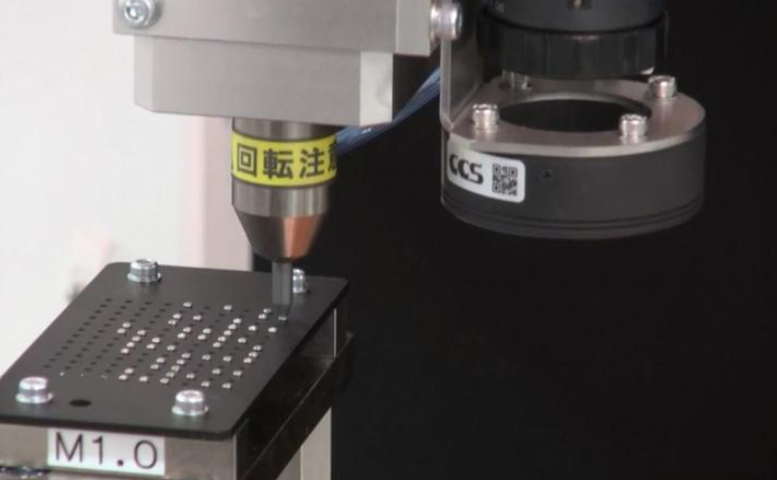
Process layout
Process Overview
This small-parts assembly automation solution uses an Epson N6 robot and an FT (Force-Torque) sensor to automate the assembly process for small M1 bolts.
For M1-class bolts, even minor positional deviations can easily lead to assembly failure, and if the bolt is not assembled with the proper force, it may result in part damage or misassembly. By combining Epson’s N6 robot with an FT sensor, this solution minimizes positioning errors and monitors force during operation to ensure stable assembly performance.
This solution is optimized for achieving both precise assembly and minimized takt time in limited space.
This project was implemented to automate the assembly process of micro bolts.
Components
| Robot |
|
|---|---|
| Peripherals |
|
Workflow
| STEP 1. | Pick a bolt from the bolt rack (vacuum suction) |
|---|---|
| STEP 2. | Move to the assembly position and perform bolting |
| STEP 3. | Detect insertion force to confirm bolting success |
| STEP 4. | Move to the next bolting position after fastening is completed to the target torque |
Features
Enables precise micro bolt assembly operations
Performs accurate fastening based on target torque by applying an FT sensor capable of detecting 0.1 N / 0.003 Nm
Enables precision bolting for M1-size bolts by applying high repeatability
Prevents bolt damage through precise force sensing
Enables stable assembly even with part shape variation by applying controlled force
Ensures high-precision assembly without misalignment even in pre-assembly processes
Enables compact installation
Minimizes required floor space through ceiling-mounted robot cell design
Minimizes operator footprint through folding-arm structure
Minimizes takt time through high-speed, high-efficiency motion
Enables high-speed operation with a maximum joint speed of 537.8 deg/s
Shortens cycle time by enabling shortest-path movements even in confined space through folding-arm structure
Provides assurance through quality warranty coverage
Provides 1-year warranty service support
Results
| Key Benefits | Reduced bolt assembly defects (missing assembly and torque defects)
Reduced labor input for bolt assembly operations |
|---|---|
| Client Feedback | For micro bolts under M2, automation was difficult due to assembly tolerances, but through Dream’s solution, automation was successfully implemented. |
Unauthorized copying or reproduction of any content on Marosol may violate the Unfair Competition Prevention Act and Copyright Act.
Recommended Solution
%20%EC%9E%90%EB%8F%99%EC%B0%A8%20%EB%B6%80%ED%92%88%20%EA%B0%80%EA%B3%B5.jpg&w=3840&q=75)
Parts Machining Automation Using Three Yaskawa Robots for Six Doosan Turning Centers
Process Overview This machine tending automation solution performs continuous machining processes by integrating three Yaskawa robots with six Doosan machine tools. In the first machining process, one robot operates two machine tools. Once the first machining is completed and the workpiece is transferred to the downstream process, the other two robots interface with four machine tools to perform the second machining process. This configuration enables high productivity through continuous machining of a single product.

Automotive Rubber Packing Assembly Automation with a Cartesian Robot and EPSON C4
Process Overview This solution assembles rubber packings onto automotive electronic components using an Epson C4 robot. By combining a cartesian robot and an industrial robot to correct the picking orientation, rubber packing assembly can be performed quickly and consistently.

Automotive Parts Machine Tending Support for WIA Turning Center using Doosan Collaborative Robot
Process Overview This machine tending automation solution uses the Doosan collaborative robot M1013 and a WIA turning center to automate the loading and unloading of automotive parts for machining processes. In conventional processes, operators had to continuously wait in front of the equipment and manually load parts one by one. By allowing the robot to handle loading and unloading tasks for two machine tools, operators can manage and operate more equipment simultaneously.
Process layout
Process Overview
This small-parts assembly automation solution uses an Epson N6 robot and an FT (Force-Torque) sensor to automate the assembly process for small M1 bolts.
For M1-class bolts, even minor positional deviations can easily lead to assembly failure, and if the bolt is not assembled with the proper force, it may result in part damage or misassembly. By combining Epson’s N6 robot with an FT sensor, this solution minimizes positioning errors and monitors force during operation to ensure stable assembly performance.
This solution is optimized for achieving both precise assembly and minimized takt time in limited space.
This project was implemented to automate the assembly process of micro bolts.
Components
| Robot |
|
|---|---|
| Peripherals |
|
Workflow
| STEP 1. | Pick a bolt from the bolt rack (vacuum suction) |
|---|---|
| STEP 2. | Move to the assembly position and perform bolting |
| STEP 3. | Detect insertion force to confirm bolting success |
| STEP 4. | Move to the next bolting position after fastening is completed to the target torque |
Features
Enables precise micro bolt assembly operations
Performs accurate fastening based on target torque by applying an FT sensor capable of detecting 0.1 N / 0.003 Nm
Enables precision bolting for M1-size bolts by applying high repeatability
Prevents bolt damage through precise force sensing
Enables stable assembly even with part shape variation by applying controlled force
Ensures high-precision assembly without misalignment even in pre-assembly processes
Enables compact installation
Minimizes required floor space through ceiling-mounted robot cell design
Minimizes operator footprint through folding-arm structure
Minimizes takt time through high-speed, high-efficiency motion
Enables high-speed operation with a maximum joint speed of 537.8 deg/s
Shortens cycle time by enabling shortest-path movements even in confined space through folding-arm structure
Provides assurance through quality warranty coverage
Provides 1-year warranty service support
Results
| Key Benefits | Reduced bolt assembly defects (missing assembly and torque defects)
Reduced labor input for bolt assembly operations |
|---|---|
| Client Feedback | For micro bolts under M2, automation was difficult due to assembly tolerances, but through Dream’s solution, automation was successfully implemented. |
Unauthorized copying or reproduction of any content on Marosol may violate the Unfair Competition Prevention Act and Copyright Act.
Recommended Solution
Parts Machining Automation Using Three Yaskawa Robots for Six Doosan Turning Centers
Process Overview This machine tending automation solution performs continuous machining processes by integrating three Yaskawa robots with six Doosan machine tools. In the first machining process, one robot operates two machine tools. Once the first machining is completed and the workpiece is transferred to the downstream process, the other two robots interface with four machine tools to perform the second machining process. This configuration enables high productivity through continuous machining of a single product.
Automotive Rubber Packing Assembly Automation with a Cartesian Robot and EPSON C4
Process Overview This solution assembles rubber packings onto automotive electronic components using an Epson C4 robot. By combining a cartesian robot and an industrial robot to correct the picking orientation, rubber packing assembly can be performed quickly and consistently.
Automotive Parts Machine Tending Support for WIA Turning Center using Doosan Collaborative Robot
Process Overview This machine tending automation solution uses the Doosan collaborative robot M1013 and a WIA turning center to automate the loading and unloading of automotive parts for machining processes. In conventional processes, operators had to continuously wait in front of the equipment and manually load parts one by one. By allowing the robot to handle loading and unloading tasks for two machine tools, operators can manage and operate more equipment simultaneously.