




![[업계 최저가] 현대로보틱스 HDR160L-30(HS160L) (Pay load : 160kg Reach : 3,036mm)](/_next/image?url=https%3A%2F%2Fd1fchzsdhim61l.cloudfront.net%2FStore%2Fthumbnail%2F267%2F9b0e71b1-5478-4785-a828-64cfc1ef99d9%2FHS160L_right_pers(1).png&w=256&q=75)
![[업계 최저가] 현대로보틱스 HDR8-14(UA008) (Pay load : 8kg Reach : 1,430mm)](/_next/image?url=https%3A%2F%2Fd1fchzsdhim61l.cloudfront.net%2FStore%2Fthumbnail%2FhyhT0kn69GXvWFQaFbDA%2Fae0d5b6d-316d-49bb-9ffa-de57271adeaa%2F1742530782071-.png&w=256&q=75)
Process layout
[Process Overview]
This implementation case is an automated mixed-flow box classification and stacking solution that combines Hyundai Robotics' industrial robots, drive axes, and in-house designed robot grippers to apply an AI-based remote operation and control system for automotive parts (latching locking devices).
Daedong Door introduced this automation system to prevent worker safety accidents by improving simple repetitive tasks and abnormal working postures, and to enhance the efficiency of inventory organization and FIFO management through pallet-based standardization.
[Project Background and Objective]
The existing palletizing and shipping processes have been operated as repetitive, heavy-duty tasks relying on a large workforce, resulting in structural limitations such as reduced productivity, worker safety issues, and increased labor costs. Furthermore, with the transition to a multi-product, small-batch production system and stricter delivery demands from clients, it was difficult to respond flexibly using the existing methods.
Accordingly, the main objective of this project has been set to secure both productivity and quality simultaneously through the establishment of robot-based standardized processes, rather than simply expanding facilities, and to achieve improved working environments and maximized operational efficiency.
Components
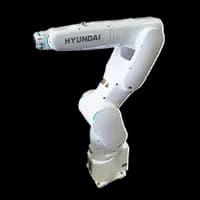
| Robot | We automated the mixed-flow box Classification and palletizing processes by applying Hyundai Robotics' HS160L (Pay load: 160kg, Reach: 3,036mm) and UA008 (Pay load: 8kg, Reach: 1,430mm) industrial robots. The system is designed to expand the working range by integrating with the drive axes and to accommodate a wide variety of products. |
|---|---|
| Peripherals | SOLlink Industrial: Monitors robot and equipment status in real time through the system and manages production flows in an integrated manner. Omni-sensor: It detects the surrounding environment of the facility and improves system operational stability and usability by flexibly implementing industry-specific functions such as inter-floor connectivity, fire and fall detection, and remote control. |
Workflow
| STEP 1. | [Product Transfer] Products are lowered from the upper-level logistics area via a vertical lifter and transferred to the barcode scanner robot via a conveyor |
|---|---|
| STEP 2. | [Box Sorting] Once the product reaches the stopper, the robot scans the barcode and automatically assigns a palletizing zone. (Items with successful recognition move to the OK conveyor for palletizing, while recognition failures are diverted to the NG conveyor |
| STEP 3. | [Box Alignment] Sorted boxes are aligned along the X and Y axes using an aligner at each work zone |
| STEP 4. | [Box Pickup] Industrial robots move along a linear axis to pick up boxes based on barcode information (part number, box specifications, and quantity) |
| STEP 5. | [Palletizing] The picked boxes are automatically stacked onto designated pallet stages (10 stages in total) |
| STEP 6. | [Pallet Discharge] Once a pallet is loaded with the preset quantity, an operator removes it using a manual cart |
| STEP 7. | [Pallet Replenishment] Empty pallet stages are replenished with new pallets stored in the pallet magazine |
Features
Compatible with various openings: Based on a modular production system, customized palletizing for various items is possible by utilizing 25 types of boxes.
Production process automation and monitoring: By monitoring robots and work status in real time, rapid response to process anomalies is possible, and efficient management of the entire production flow is enabled.
Results
| Key Benefits | Increased work efficiency
By introducing robots, we reduced the workforce for the palletizing process (2 people each for day and night shifts) and redeployed them to the shipping process, thereby improving operational efficiency.
Improvement of working environment and safety
It reduced repetitive and heavy lifting tasks, alleviating the burden on the musculoskeletal system and lowering the risk of Industry accidents.
Improvement of inventory and quality management
We improved the problem of missing inventory by reducing the error rate, and enhanced inventory management efficiency and loading quality through pallet standardization.
Improved productivity and on-time delivery capabilities
Through palletizing automation, we standardized work speeds and increased throughput, thereby shortening shipping lead times and ensuring on-time delivery. |
|---|---|
| Client Feedback | Daedong Door said, “Through the automation of robotic palletizing, the working environment has improved and production efficiency has significantly increased. In addition, overall operational stability has been ensured as process management and problem response have become easier through a real-time monitoring system based on SOLlink Industrial.” |
Unauthorized copying or reproduction of any content on Marosol may violate the Unfair Competition Prevention Act and Copyright Act.
Recommended Solution

Shrink-Fit Tool Exchange Automation using Doosan M1013
This machine tending automation solution utilizes the Doosan M1013 collaborative robot to automate the hazardous task of exchanging tools in shrink-fit chucks. In industrial settings, shrink-fit chucks are used to enhance machining precision and create compact tool assemblies. However, because the process involves repeated cycles of rapid heating and cooling, operators were previously exposed to high risks of safety accidents, such as thermal burns. By implementing Doosan's collaborative robot, the risk of safety accidents has been eliminated, and productivity has increased through continuous, uninterrupted operation.

Press Machine Tending for Thin Plate Sheets using Yaskawa Robots
This automation solution utilizes YASKAWA robots equipped with vacuum grippers to handle thin plates, automating the workpiece feeding process and significantly enhancing the safety of press operations. Due to the nature of press processes—characterized by extremely short cycle times and high-risk environments—industrial accidents involving human operators are frequent. By employing robot automation, particularly with vacuum grippers which are far more effective at handling thin plates than manual labor, this solution simultaneously improves production throughput and workplace safety.

Cognex AI Vision: 4-Model Review 👀 Can This 3D AI Vision Read 255 Barcodes at Once?
Introducing four AI Vision solutions showcased by Cognex at the 2026 AW (Aircraft Automation Show). From simultaneous reading of 255 barcodes and 15-minute installation to deep learning cargo classification , check them out now if you are interested in Vision automation for logistics and manufacturing sites.
Process layout
[Process Overview]
This implementation case is an automated mixed-flow box classification and stacking solution that combines Hyundai Robotics' industrial robots, drive axes, and in-house designed robot grippers to apply an AI-based remote operation and control system for automotive parts (latching locking devices).
Daedong Door introduced this automation system to prevent worker safety accidents by improving simple repetitive tasks and abnormal working postures, and to enhance the efficiency of inventory organization and FIFO management through pallet-based standardization.
[Project Background and Objective]
The existing palletizing and shipping processes have been operated as repetitive, heavy-duty tasks relying on a large workforce, resulting in structural limitations such as reduced productivity, worker safety issues, and increased labor costs. Furthermore, with the transition to a multi-product, small-batch production system and stricter delivery demands from clients, it was difficult to respond flexibly using the existing methods.
Accordingly, the main objective of this project has been set to secure both productivity and quality simultaneously through the establishment of robot-based standardized processes, rather than simply expanding facilities, and to achieve improved working environments and maximized operational efficiency.
Components
| Robot | We automated the mixed-flow box Classification and palletizing processes by applying Hyundai Robotics' HS160L (Pay load: 160kg, Reach: 3,036mm) and UA008 (Pay load: 8kg, Reach: 1,430mm) industrial robots. The system is designed to expand the working range by integrating with the drive axes and to accommodate a wide variety of products. |
|---|---|
| Peripherals | SOLlink Industrial: Monitors robot and equipment status in real time through the system and manages production flows in an integrated manner. Omni-sensor: It detects the surrounding environment of the facility and improves system operational stability and usability by flexibly implementing industry-specific functions such as inter-floor connectivity, fire and fall detection, and remote control. |
Workflow
| STEP 1. | [Product Transfer] Products are lowered from the upper-level logistics area via a vertical lifter and transferred to the barcode scanner robot via a conveyor |
|---|---|
| STEP 2. | [Box Sorting] Once the product reaches the stopper, the robot scans the barcode and automatically assigns a palletizing zone. (Items with successful recognition move to the OK conveyor for palletizing, while recognition failures are diverted to the NG conveyor |
| STEP 3. | [Box Alignment] Sorted boxes are aligned along the X and Y axes using an aligner at each work zone |
| STEP 4. | [Box Pickup] Industrial robots move along a linear axis to pick up boxes based on barcode information (part number, box specifications, and quantity) |
| STEP 5. | [Palletizing] The picked boxes are automatically stacked onto designated pallet stages (10 stages in total) |
| STEP 6. | [Pallet Discharge] Once a pallet is loaded with the preset quantity, an operator removes it using a manual cart |
| STEP 7. | [Pallet Replenishment] Empty pallet stages are replenished with new pallets stored in the pallet magazine |
Features
Compatible with various openings: Based on a modular production system, customized palletizing for various items is possible by utilizing 25 types of boxes.
Production process automation and monitoring: By monitoring robots and work status in real time, rapid response to process anomalies is possible, and efficient management of the entire production flow is enabled.
Results
| Key Benefits | Increased work efficiency
By introducing robots, we reduced the workforce for the palletizing process (2 people each for day and night shifts) and redeployed them to the shipping process, thereby improving operational efficiency.
Improvement of working environment and safety
It reduced repetitive and heavy lifting tasks, alleviating the burden on the musculoskeletal system and lowering the risk of Industry accidents.
Improvement of inventory and quality management
We improved the problem of missing inventory by reducing the error rate, and enhanced inventory management efficiency and loading quality through pallet standardization.
Improved productivity and on-time delivery capabilities
Through palletizing automation, we standardized work speeds and increased throughput, thereby shortening shipping lead times and ensuring on-time delivery. |
|---|---|
| Client Feedback | Daedong Door said, “Through the automation of robotic palletizing, the working environment has improved and production efficiency has significantly increased. In addition, overall operational stability has been ensured as process management and problem response have become easier through a real-time monitoring system based on SOLlink Industrial.” |
Unauthorized copying or reproduction of any content on Marosol may violate the Unfair Competition Prevention Act and Copyright Act.
Recommended Solution
Shrink-Fit Tool Exchange Automation using Doosan M1013
This machine tending automation solution utilizes the Doosan M1013 collaborative robot to automate the hazardous task of exchanging tools in shrink-fit chucks. In industrial settings, shrink-fit chucks are used to enhance machining precision and create compact tool assemblies. However, because the process involves repeated cycles of rapid heating and cooling, operators were previously exposed to high risks of safety accidents, such as thermal burns. By implementing Doosan's collaborative robot, the risk of safety accidents has been eliminated, and productivity has increased through continuous, uninterrupted operation.
Press Machine Tending for Thin Plate Sheets using Yaskawa Robots
This automation solution utilizes YASKAWA robots equipped with vacuum grippers to handle thin plates, automating the workpiece feeding process and significantly enhancing the safety of press operations. Due to the nature of press processes—characterized by extremely short cycle times and high-risk environments—industrial accidents involving human operators are frequent. By employing robot automation, particularly with vacuum grippers which are far more effective at handling thin plates than manual labor, this solution simultaneously improves production throughput and workplace safety.
Cognex AI Vision: 4-Model Review 👀 Can This 3D AI Vision Read 255 Barcodes at Once?
Introducing four AI Vision solutions showcased by Cognex at the 2026 AW (Aircraft Automation Show). From simultaneous reading of 255 barcodes and 15-minute installation to deep learning cargo classification , check them out now if you are interested in Vision automation for logistics and manufacturing sites.