



Process layout
Process Overview
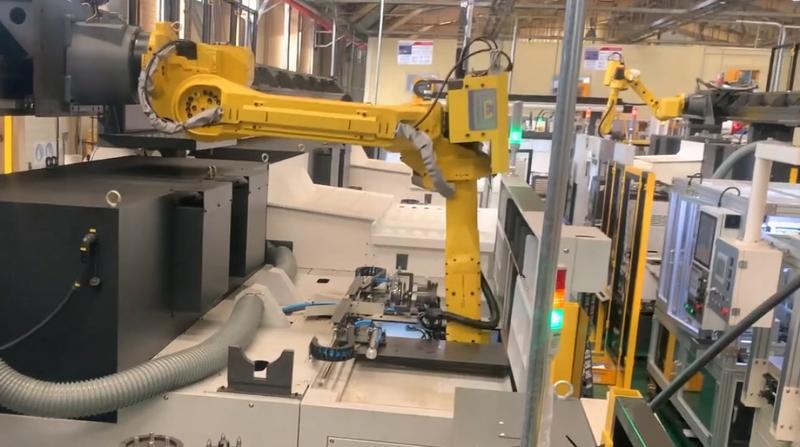
This solution uses the FANUC M-20iA/35M robot installed on an upper linear track mounted above Doosan turning machines (TW2600M) to machine differential cases for automotive applications.
By installing the robot together with a linear track on top of the machine tool, the system enables efficient floor space utilization and automates continuous processes in a single integrated workflow, significantly improving automation efficiency.
Since the front side of the machine tool remains open, smooth access is available for tool change and machine maintenance operations.
In addition, it helps prevent musculoskeletal disorders for operators by automating the loading and unloading of heavy machined parts.
Components
| Robot |
|
|---|---|
| Peripherals |
|
Workflow
| STEP 1. | Pick workpiece from the lift feeder (OP10) |
|---|---|
| STEP 2. | Load into turning center and perform machining |
| STEP 3. | Perform part alignment for completed parts |
| STEP 4. | Place onto 1st machining completed jig |
| STEP 5. | Transfer to OP20 using inter-process gantry robot |
| STEP 6. | Load into turning center for 2nd machining (OP20) |
| STEP 7. | Load finished part into air blowing unit |
| STEP 8. | Transfer to discharge jig using outfeed gantry robot |
Features
Improved Productivity and Operational Efficiency
Minimizes cycle time using a high-speed, high-precision industrial robot
Uses one robot to handle three machine tools, minimizing idle time by matching machining takt time
Enables optimized layout configuration based on the number of machining machines
Minimizes management points and enables continuous production by applying infeed/outfeed conveyors
Prevents musculoskeletal disorders caused by heavy material handling
Maximized Space Utilization Through an Optimized Layout
Minimizes floor space usage and maximizes space efficiency by mounting the robot above the machine tool
Ensures accessibility for maintenance by keeping the front side of the machine tool open
Results
| Key Benefits | Minimization of loading labor
Improved productivity by reducing idle waiting time |
|---|---|
| Client Feedback | Since the workpieces were heavy and required continuous fast handling, it was difficult for operators to keep up. By adopting robot handling, the process became easier and operators were relieved from heavy-load tasks, resulting in higher satisfaction. |
Unauthorized copying or reproduction of any content on Marosol may violate the Unfair Competition Prevention Act and Copyright Act.
Recommended Solution

Automotive Hood Polishing with UR10 and OnRobot Sander
Process Overview This application performs uniform polishing on the 3D surface of an automotive hood by utilizing a Universal Robots UR10, an OnRobot HEX force/torque sensor, and an OnRobot Sander. With the combination of the OnRobot force/torque sensor and the sander, polishing can be performed while applying consistent force to match 3D curved surfaces.

EV Cooling Fin Manufacturing Automation with 4 Hyundai Robots and a Cartesian Robot
Process Overview This solution is a manufacturing automation system for producing EV cooling fins using four Hyundai Robotics HH010L robots and a cartesian robot. By automating the entire continuous workflow in-line, including raw material cutting, press forming, and appearance inspection, productivity has increased and product quality has been significantly improved through 100% inspection.

Parts Machine Tending Automation using ABB IRB 2600
Process Overview This machine tending automation solution uses the ABB IRB 2600 robot with Hyundai WIA Turning Center 160LA to automate the process of loading and unloading automotive parts. The system completes the first machining process using two turning centers, then transfers the semi-finished parts to the other turning center for the second machining process, and finally moves them to the discharge conveyor. This configuration is designed to minimize idle time by matching the work cycle time and maximizing productivity. The solution was implemented to increase productivity through 24/7 operation, reduce the required loading labor, and minimize idle waiting time between processes.
Process layout
Process Overview
This solution uses the FANUC M-20iA/35M robot installed on an upper linear track mounted above Doosan turning machines (TW2600M) to machine differential cases for automotive applications.
By installing the robot together with a linear track on top of the machine tool, the system enables efficient floor space utilization and automates continuous processes in a single integrated workflow, significantly improving automation efficiency.
Since the front side of the machine tool remains open, smooth access is available for tool change and machine maintenance operations.
In addition, it helps prevent musculoskeletal disorders for operators by automating the loading and unloading of heavy machined parts.
Components
| Robot |
|
|---|---|
| Peripherals |
|
Workflow
| STEP 1. | Pick workpiece from the lift feeder (OP10) |
|---|---|
| STEP 2. | Load into turning center and perform machining |
| STEP 3. | Perform part alignment for completed parts |
| STEP 4. | Place onto 1st machining completed jig |
| STEP 5. | Transfer to OP20 using inter-process gantry robot |
| STEP 6. | Load into turning center for 2nd machining (OP20) |
| STEP 7. | Load finished part into air blowing unit |
| STEP 8. | Transfer to discharge jig using outfeed gantry robot |
Features
Improved Productivity and Operational Efficiency
Minimizes cycle time using a high-speed, high-precision industrial robot
Uses one robot to handle three machine tools, minimizing idle time by matching machining takt time
Enables optimized layout configuration based on the number of machining machines
Minimizes management points and enables continuous production by applying infeed/outfeed conveyors
Prevents musculoskeletal disorders caused by heavy material handling
Maximized Space Utilization Through an Optimized Layout
Minimizes floor space usage and maximizes space efficiency by mounting the robot above the machine tool
Ensures accessibility for maintenance by keeping the front side of the machine tool open
Results
| Key Benefits | Minimization of loading labor
Improved productivity by reducing idle waiting time |
|---|---|
| Client Feedback | Since the workpieces were heavy and required continuous fast handling, it was difficult for operators to keep up. By adopting robot handling, the process became easier and operators were relieved from heavy-load tasks, resulting in higher satisfaction. |
Unauthorized copying or reproduction of any content on Marosol may violate the Unfair Competition Prevention Act and Copyright Act.
Recommended Solution
Automotive Hood Polishing with UR10 and OnRobot Sander
Process Overview This application performs uniform polishing on the 3D surface of an automotive hood by utilizing a Universal Robots UR10, an OnRobot HEX force/torque sensor, and an OnRobot Sander. With the combination of the OnRobot force/torque sensor and the sander, polishing can be performed while applying consistent force to match 3D curved surfaces.
EV Cooling Fin Manufacturing Automation with 4 Hyundai Robots and a Cartesian Robot
Process Overview This solution is a manufacturing automation system for producing EV cooling fins using four Hyundai Robotics HH010L robots and a cartesian robot. By automating the entire continuous workflow in-line, including raw material cutting, press forming, and appearance inspection, productivity has increased and product quality has been significantly improved through 100% inspection.
Parts Machine Tending Automation using ABB IRB 2600
Process Overview This machine tending automation solution uses the ABB IRB 2600 robot with Hyundai WIA Turning Center 160LA to automate the process of loading and unloading automotive parts. The system completes the first machining process using two turning centers, then transfers the semi-finished parts to the other turning center for the second machining process, and finally moves them to the discharge conveyor. This configuration is designed to minimize idle time by matching the work cycle time and maximizing productivity. The solution was implemented to increase productivity through 24/7 operation, reduce the required loading labor, and minimize idle waiting time between processes.