



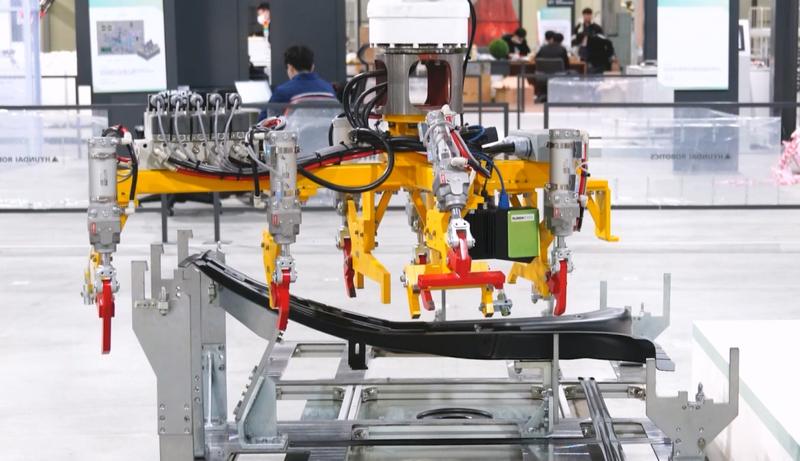
Process layout
Process Overview
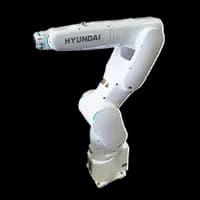
This bin picking automation solution uses Hyundai HS210E and Pickit 3D vision inspection to automate bin picking for automotive body frames. Using a gripper, the robot can pick various product shapes and transfer multiple required parts at once.
Even for various product shapes, 3D vision enables accurate recognition and picking, overcoming the limitations of conventional robot automation that only repeated fixed tasks under restricted conditions. With this solution, flexible execution across diverse process conditions is possible.
Components
| Robot |
|
|---|---|
| Peripherals |
|
Workflow
| STEP 1. | Recognize discharge jig and AMR position via 3D vision |
|---|---|
| STEP 2. | Detect workpiece position |
| STEP 3. | Adjust gripper based on workpiece |
| STEP 4. | Pick workpiece |
| STEP 5. | Load onto discharge jig |
| STEP 6. | Perform next workpiece picking |
Features
Hyundai Robotics holds the No.1 market share in Korea with an extensive sales and service network
Since entering the domestic robot market in 1984, Hyundai Robotics has built a wide portfolio of solutions and lineups
Provides customized solutions by performing end-to-end execution including robot production, engineering, and installation
High-Payload and Wide Working Envelope
Payload: 210 kg, working range: 2,666 mm
Handles 4 different product types by applying a multi-purpose gripper
Easy 3D Vision Teaching
Strong 3D object recognition performance across various object types
Easy task changeover after teaching for different operations
Supports bin picking for unstructured and non-ordered products
Results
| Key Benefits | Reduced manpower required for material loading in process logistics |
|---|---|
| Client Feedback | In many cases, performing robot automation required pre-alignment work in upstream processes, which often made layouts more complex or increased additional costs. Also, there were many limitations in handling various workpieces. With Hyundai Robotics’ solution, we were able to minimize upstream process changes and execute automation. |
Unauthorized copying or reproduction of any content on Marosol may violate the Unfair Competition Prevention Act and Copyright Act.
Recommended Solution

Automotive Lever Switch Testing with EPSON C4L and a Force Sensor
Process Overview This solution performs automotive lever switch operation testing using an Epson C4L robot and a force sensor. By applying a constant force, it repeatedly tests whether the lever switch operates normally, and the measured data can be used to improve final product quality.

AI Vision + Industrial Robot for 2D Picking Automation 🦾 (CTR 2D Picking System Case)
Process Overview A robot vision picking system using robots and AI vision for industrial pick-and-place operations. A smart conveyor provides flexible part feeding, while AI-based vision inspects parts and captures key information such as position. This enables fast and accurate robot-integrated pick-and-place automation. Company Introduction Company name: CTR Robotics Established: April 2, 2012 Location: 21, 333beon-gil, Gwahangsan-dong, Gangseo-gu, Busan, Korea Competitiveness Total solution capabilities for automation equipment manufacturing Extensive experience and skilled workforce in custom system design, control, and installation Robotics automation solutions aligned with leading industry trends Mass-production deployment experience for intelligent equipment using robot vision Advanced development capabilities and standardization expertise through PoC projects In-house R&D team dedicated to advanced technology development

Automotive Harness Component Assembly with a Vibratory Feeder and EPSON C4L
Process Overview This solution assembles automotive harness components using a vibratory feeder combined with an Epson C4L robot and a vision system. Bulk-fed parts are separated by the vibratory feeder, and the separated parts are located through vision for picking. By quickly separating, detecting, and picking parts in line with production speed, productivity can be improved.
Process layout
Process Overview
This bin picking automation solution uses Hyundai HS210E and Pickit 3D vision inspection to automate bin picking for automotive body frames. Using a gripper, the robot can pick various product shapes and transfer multiple required parts at once.
Even for various product shapes, 3D vision enables accurate recognition and picking, overcoming the limitations of conventional robot automation that only repeated fixed tasks under restricted conditions. With this solution, flexible execution across diverse process conditions is possible.
Components
| Robot |
|
|---|---|
| Peripherals |
|
Workflow
| STEP 1. | Recognize discharge jig and AMR position via 3D vision |
|---|---|
| STEP 2. | Detect workpiece position |
| STEP 3. | Adjust gripper based on workpiece |
| STEP 4. | Pick workpiece |
| STEP 5. | Load onto discharge jig |
| STEP 6. | Perform next workpiece picking |
Features
Hyundai Robotics holds the No.1 market share in Korea with an extensive sales and service network
Since entering the domestic robot market in 1984, Hyundai Robotics has built a wide portfolio of solutions and lineups
Provides customized solutions by performing end-to-end execution including robot production, engineering, and installation
High-Payload and Wide Working Envelope
Payload: 210 kg, working range: 2,666 mm
Handles 4 different product types by applying a multi-purpose gripper
Easy 3D Vision Teaching
Strong 3D object recognition performance across various object types
Easy task changeover after teaching for different operations
Supports bin picking for unstructured and non-ordered products
Results
| Key Benefits | Reduced manpower required for material loading in process logistics |
|---|---|
| Client Feedback | In many cases, performing robot automation required pre-alignment work in upstream processes, which often made layouts more complex or increased additional costs. Also, there were many limitations in handling various workpieces. With Hyundai Robotics’ solution, we were able to minimize upstream process changes and execute automation. |
Unauthorized copying or reproduction of any content on Marosol may violate the Unfair Competition Prevention Act and Copyright Act.
Recommended Solution
Automotive Lever Switch Testing with EPSON C4L and a Force Sensor
Process Overview This solution performs automotive lever switch operation testing using an Epson C4L robot and a force sensor. By applying a constant force, it repeatedly tests whether the lever switch operates normally, and the measured data can be used to improve final product quality.
AI Vision + Industrial Robot for 2D Picking Automation 🦾 (CTR 2D Picking System Case)
Process Overview A robot vision picking system using robots and AI vision for industrial pick-and-place operations. A smart conveyor provides flexible part feeding, while AI-based vision inspects parts and captures key information such as position. This enables fast and accurate robot-integrated pick-and-place automation. Company Introduction Company name: CTR Robotics Established: April 2, 2012 Location: 21, 333beon-gil, Gwahangsan-dong, Gangseo-gu, Busan, Korea Competitiveness Total solution capabilities for automation equipment manufacturing Extensive experience and skilled workforce in custom system design, control, and installation Robotics automation solutions aligned with leading industry trends Mass-production deployment experience for intelligent equipment using robot vision Advanced development capabilities and standardization expertise through PoC projects In-house R&D team dedicated to advanced technology development
Automotive Harness Component Assembly with a Vibratory Feeder and EPSON C4L
Process Overview This solution assembles automotive harness components using a vibratory feeder combined with an Epson C4L robot and a vision system. Bulk-fed parts are separated by the vibratory feeder, and the separated parts are located through vision for picking. By quickly separating, detecting, and picking parts in line with production speed, productivity can be improved.