


Process layout
Process Overview
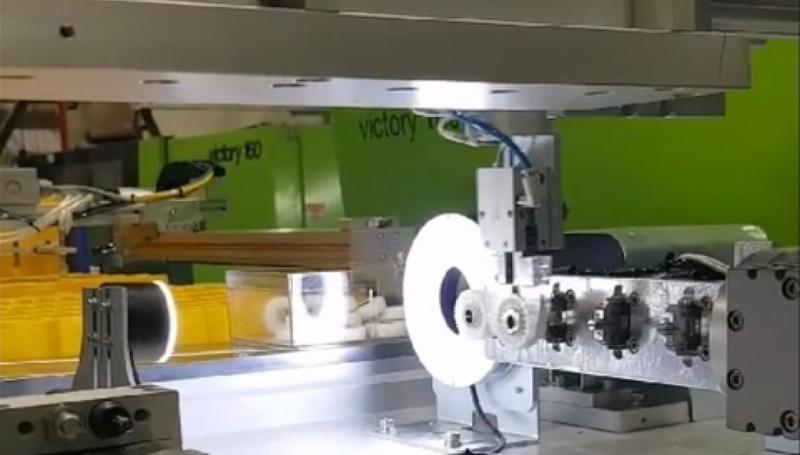
This assembly automation solution uses a YUSHIN take-out robot (SCⅡ 150) to perform insert molding, placing a nut into the mold and overmolding it with plastic, followed by automated inspection. By automating both the insert-loading operation and the downstream inspection process, the system minimizes quality-control touchpoints while improving overall productivity.
Components
| Robot | Injection molding take-out robot YUSHIN SCⅡ-150D (for insert loading) 5-axis Cartesian robot + 90° tilting arm Payload: 5 kg Repeatability: ±0.1 mm Stroke (robot specs): Travel 1,500 mm / Vertical 850 mm / Fore–aft 468 mm End-of-arm tooling (EOAT) / Tools Pneumatic grippers: 8 units (Insert loading 4 / Part take-out 4) 3-axis Cartesian robot for vision inspection (including a rotary tool Pneumatic grippers: 3 units (Vision inspection 1 / Orientation-change jig loading 2) |
|---|---|
| Peripherals | Insert injection molding equipment (optional / separate) Bowl feeder (BOWL FEEDER) Nut loading cylinder Finished-part transfer unit (post-insert) Insert orientation-change jig Vision inspection system |
Workflow
| STEP 1. | Feed and singulate nut blanks via the bowl feeder |
|---|---|
| STEP 2. | Pick four nut blanks |
| STEP 3. | Load them into the insert-molding station |
| STEP 4. | Take out the insert-molded parts and load them onto the finished-part transfer unit |
| STEP 5. | Move the parts to the orientation-change jig |
| STEP 6. | Pick parts one-by-one for vision inspection |
| STEP 7. | Sort and discharge into trays based on inspection results |
Features
Improved Production Efficiency and Quality
Continuous, low-idle operation improves overall production efficiency.
Total inspection minimizes defect rates.
Fewer control points reduce the number of operators required.
Cost-Effective Performance with a Dedicated Take-Out Robot
A dedicated take-out robot enables a compact installation and overhead handling.
Optimized motion profiles support high-speed cycle operation.
Compared to articulated robots, this tailored solution minimizes upfront investment cost.
Results
| Key Benefits | Improved productivity, Minimized staffing by reducing control/management points |
|---|---|
| Client Feedback | Because machining cycle time was short, continuous operation was required by deploying Seojeong’s solution, we increased production speed and were able to perform 100% inspection, which also improved product quality. |
Unauthorized copying or reproduction of any content on Marosol may violate the Unfair Competition Prevention Act and Copyright Act.
Recommended Solution

Silicone Molded Part Palletizing using AIM AIVE System and Delta SCARA Robot
Silicone Molded Part Palletizing using AIM AIVE System and Delta SCARA Robot

Steel Plate Press Assistance using Dual Yaskawa Robots
This automation solution utilizes two YASKAWA robots to assist in steel plate press operations. By automating the machine tending process, the system secures high operational stability and safety. Due to the nature of press processes—characterized by extremely short cycle times and high-risk environments—industrial accidents involving human operators are frequent. In this specific solution, the robots hold the workpieces during the pressing operation itself. By having two robots perform continuous, synchronized cross-work, the cycle time is minimized to just 2 seconds per unit, maximizing overall productivity.

Cognex AI Vision: 4-Model Review 👀 Can This 3D AI Vision Read 255 Barcodes at Once?
Introducing four AI Vision solutions showcased by Cognex at the 2026 AW (Aircraft Automation Show). From simultaneous reading of 255 barcodes and 15-minute installation to deep learning cargo classification , check them out now if you are interested in Vision automation for logistics and manufacturing sites.
Process layout
Process Overview
This assembly automation solution uses a YUSHIN take-out robot (SCⅡ 150) to perform insert molding, placing a nut into the mold and overmolding it with plastic, followed by automated inspection. By automating both the insert-loading operation and the downstream inspection process, the system minimizes quality-control touchpoints while improving overall productivity.
Components
| Robot | Injection molding take-out robot YUSHIN SCⅡ-150D (for insert loading) 5-axis Cartesian robot + 90° tilting arm Payload: 5 kg Repeatability: ±0.1 mm Stroke (robot specs): Travel 1,500 mm / Vertical 850 mm / Fore–aft 468 mm End-of-arm tooling (EOAT) / Tools Pneumatic grippers: 8 units (Insert loading 4 / Part take-out 4) 3-axis Cartesian robot for vision inspection (including a rotary tool Pneumatic grippers: 3 units (Vision inspection 1 / Orientation-change jig loading 2) |
|---|---|
| Peripherals | Insert injection molding equipment (optional / separate) Bowl feeder (BOWL FEEDER) Nut loading cylinder Finished-part transfer unit (post-insert) Insert orientation-change jig Vision inspection system |
Workflow
| STEP 1. | Feed and singulate nut blanks via the bowl feeder |
|---|---|
| STEP 2. | Pick four nut blanks |
| STEP 3. | Load them into the insert-molding station |
| STEP 4. | Take out the insert-molded parts and load them onto the finished-part transfer unit |
| STEP 5. | Move the parts to the orientation-change jig |
| STEP 6. | Pick parts one-by-one for vision inspection |
| STEP 7. | Sort and discharge into trays based on inspection results |
Features
Improved Production Efficiency and Quality
Continuous, low-idle operation improves overall production efficiency.
Total inspection minimizes defect rates.
Fewer control points reduce the number of operators required.
Cost-Effective Performance with a Dedicated Take-Out Robot
A dedicated take-out robot enables a compact installation and overhead handling.
Optimized motion profiles support high-speed cycle operation.
Compared to articulated robots, this tailored solution minimizes upfront investment cost.
Results
| Key Benefits | Improved productivity, Minimized staffing by reducing control/management points |
|---|---|
| Client Feedback | Because machining cycle time was short, continuous operation was required by deploying Seojeong’s solution, we increased production speed and were able to perform 100% inspection, which also improved product quality. |
Unauthorized copying or reproduction of any content on Marosol may violate the Unfair Competition Prevention Act and Copyright Act.
Recommended Solution
Silicone Molded Part Palletizing using AIM AIVE System and Delta SCARA Robot
Silicone Molded Part Palletizing using AIM AIVE System and Delta SCARA Robot
Steel Plate Press Assistance using Dual Yaskawa Robots
This automation solution utilizes two YASKAWA robots to assist in steel plate press operations. By automating the machine tending process, the system secures high operational stability and safety. Due to the nature of press processes—characterized by extremely short cycle times and high-risk environments—industrial accidents involving human operators are frequent. In this specific solution, the robots hold the workpieces during the pressing operation itself. By having two robots perform continuous, synchronized cross-work, the cycle time is minimized to just 2 seconds per unit, maximizing overall productivity.
Cognex AI Vision: 4-Model Review 👀 Can This 3D AI Vision Read 255 Barcodes at Once?
Introducing four AI Vision solutions showcased by Cognex at the 2026 AW (Aircraft Automation Show). From simultaneous reading of 255 barcodes and 15-minute installation to deep learning cargo classification , check them out now if you are interested in Vision automation for logistics and manufacturing sites.