

Process layout
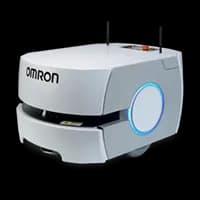
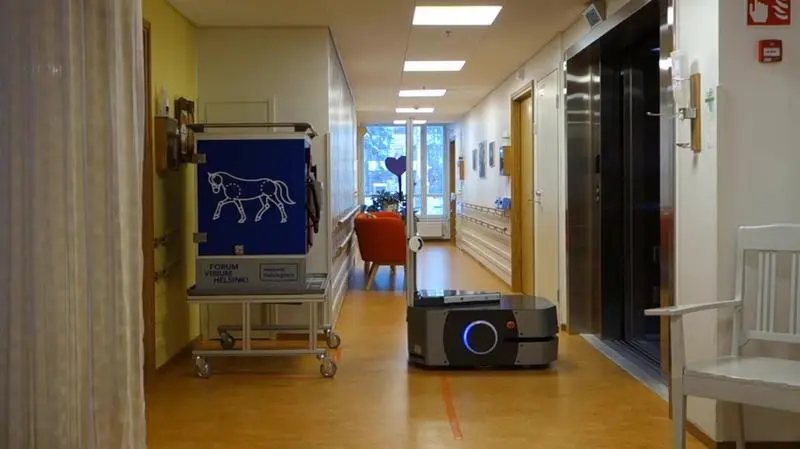
This solution implements cart towing and cross-floor transport using OMRON's LD-250.
The OMRON LD-250 is an Autonomous Mobile Robot (AMR) that maps its environment and navigates along optimal paths, adapting to real-time changes on-site. While the LD-250 has a direct payload of 250kg, it can move even heavier loads when configured for towing. Its ability to interface with elevators allows for a much broader scope of automated cart transport across multiple floors of a building.
Components
| Robot |
|
|---|
Workflow
| STEP 1. | Robot job inquiry is generated by the ACS and transmitted to the EM via communication. |
|---|---|
| STEP 2. | Robot job allocation, path planning, and flow control are continuously managed by the EM. |
| STEP 3. | LD-250 receives the operational signal. |
| STEP 4. | Moves to the cart loading/hitching location. |
| STEP 5. | Hitches the cart securely. |
| STEP 6. | Interfaces with the elevator system. |
| STEP 7. | Moves between floors via the elevator. |
| STEP 8. | Drops off the cart at the designated location. |
| STEP 9. | Re-interfaces with the elevator system. |
| STEP 10. | Takes the elevator to the next destination or base. |
| STEP 11. | Repeats the previous steps. |
Features
Robots replacing humans in strenuous and hazardous delivery tasks
Saves time by having robots handle material transport instead of people.
Enhances safety by removing humans from high-risk tasks and preventing injuries.
Capable of continuously transporting heavy loads up to 250kg (or more via towing) without fatigue.
A solution adaptable to diverse environments
Compact design allows the robot to navigate even in tight spaces.
Managed by a fleet control system to ensure robots drive along optimal paths.
Front-facing sensors enable automatic avoidance when people approach.
Battery management system ensures zero interruptions in production.
Infrastructure-free autonomous driving allows for easy changes to routes and multi-floor destinations without auxiliary devices.
Logistics with increased productivity and reduced delivery errors
Decreases delivery errors by transporting goods to precise locations only.
Enables continuous, tireless production around the clock.
Results
| Key Benefits | Increased productivity and reduced delivery errors.
Prevention of safety accidents and savings in transport time.
Cost savings through the reduction of manual labor input.
|
|---|---|
| Client Feedback | Thanks to the efficient fleet management system and elevator integration, we can move carts between floors much more conveniently |
Unauthorized copying or reproduction of any content on Marosol may violate the Unfair Competition Prevention Act and Copyright Act.
Recommended Solution

Seaweed Roasting Automation Solution using RB3-1200 Collaborative Robot
This application case features an automated seaweed (Gim) roasting solution utilizing the RB3-1200 collaborative robot. The system is designed to maintain consistent taste through high stability and uniform heating times while significantly boosting productivity. It features an icon-based GUI that allows users to customize the interface according to their needs, providing easy maintenance, a high level of security, and intuitive programming functions. The system is compatible with all devices running Android OS (smartphones and tablets) as well as Windows OS environments. Project Background & Objectives Ensuring Convenience and Safety: Protecting workers from high-heat environments. Implementation of Uniform Cooking Recipes: Maintaining consistent product quality. Addressing Labor Shortages: Automating repetitive manual roasting tasks.

AMR Logistics Robots Introduced to Manufacturing Factory ✨ Logistics Automation that Quickly Resolves Even 1 Ton of Waste Derbris (2 KUKA KMP 1500P Logistics Robots)
Process Overview This case study demonstrates the installation of a KUKA KMP 1500P logistics robot at Bigwave Robotics (Marosol) to transport rollers and scrap debris within the space manufacturing facility. The KMP 1500P autonomously handles up to 1 ton of scrap debris over a 1.2 km distance and automatically transports heavy-duty roller modules weighing up to 1 ton. Furthermore, sensors embedded in the KMP 1500P enabled the development of an unmanned system capable of safely transporting heavy-duty materials. Project Background and Purpose Automated unmanned transport using autonomous robots Robots perform simple, repetitive tasks Safe operation of heavy-duty products using various sensors Remote control and monitoring using SOLlink

Omron AMR Logistics Robot Implements Logistics Automation by Carrying 300kg Rolltainers
Project Overview This implementation case features a solution utilizing Omron AMR Logistics robots to automatically transport rolltainers weighing over 300kg. Previously, workers had to manually move heavy rolltainers, leading to a high risk of musculoskeletal disorders and potential safety issues during the bulk loading of irregular goods. Through this solution, the AMR automatically recognizes the rolltainers and moves them to designated locations via safe autonomous driving, establishing a work environment that significantly reduces worker burden and increases efficiency. Project Background & Objectives In logistics sites, the repetitive task of moving rolltainers weighing over 300kg placed a significant physical strain on workers, leading to frequent musculoskeletal disorders. Additionally, manually moving various products, including irregular items, resulted in decreased safety and efficiency. The objective of this project is to protect worker health and maximize operational efficiency by automating rolltainer transport with AMRs. Through this, the goal is to enhance overall logistics safety, reduce worker fatigue, and maximize productivity and efficiency in the long term.
Process layout
This solution implements cart towing and cross-floor transport using OMRON's LD-250.
The OMRON LD-250 is an Autonomous Mobile Robot (AMR) that maps its environment and navigates along optimal paths, adapting to real-time changes on-site. While the LD-250 has a direct payload of 250kg, it can move even heavier loads when configured for towing. Its ability to interface with elevators allows for a much broader scope of automated cart transport across multiple floors of a building.
Components
| Robot |
|
|---|
Workflow
| STEP 1. | Robot job inquiry is generated by the ACS and transmitted to the EM via communication. |
|---|---|
| STEP 2. | Robot job allocation, path planning, and flow control are continuously managed by the EM. |
| STEP 3. | LD-250 receives the operational signal. |
| STEP 4. | Moves to the cart loading/hitching location. |
| STEP 5. | Hitches the cart securely. |
| STEP 6. | Interfaces with the elevator system. |
| STEP 7. | Moves between floors via the elevator. |
| STEP 8. | Drops off the cart at the designated location. |
| STEP 9. | Re-interfaces with the elevator system. |
| STEP 10. | Takes the elevator to the next destination or base. |
| STEP 11. | Repeats the previous steps. |
Features
Robots replacing humans in strenuous and hazardous delivery tasks
Saves time by having robots handle material transport instead of people.
Enhances safety by removing humans from high-risk tasks and preventing injuries.
Capable of continuously transporting heavy loads up to 250kg (or more via towing) without fatigue.
A solution adaptable to diverse environments
Compact design allows the robot to navigate even in tight spaces.
Managed by a fleet control system to ensure robots drive along optimal paths.
Front-facing sensors enable automatic avoidance when people approach.
Battery management system ensures zero interruptions in production.
Infrastructure-free autonomous driving allows for easy changes to routes and multi-floor destinations without auxiliary devices.
Logistics with increased productivity and reduced delivery errors
Decreases delivery errors by transporting goods to precise locations only.
Enables continuous, tireless production around the clock.
Results
| Key Benefits | Increased productivity and reduced delivery errors.
Prevention of safety accidents and savings in transport time.
Cost savings through the reduction of manual labor input.
|
|---|---|
| Client Feedback | Thanks to the efficient fleet management system and elevator integration, we can move carts between floors much more conveniently |
Unauthorized copying or reproduction of any content on Marosol may violate the Unfair Competition Prevention Act and Copyright Act.
Recommended Solution
Seaweed Roasting Automation Solution using RB3-1200 Collaborative Robot
This application case features an automated seaweed (Gim) roasting solution utilizing the RB3-1200 collaborative robot. The system is designed to maintain consistent taste through high stability and uniform heating times while significantly boosting productivity. It features an icon-based GUI that allows users to customize the interface according to their needs, providing easy maintenance, a high level of security, and intuitive programming functions. The system is compatible with all devices running Android OS (smartphones and tablets) as well as Windows OS environments. Project Background & Objectives Ensuring Convenience and Safety: Protecting workers from high-heat environments. Implementation of Uniform Cooking Recipes: Maintaining consistent product quality. Addressing Labor Shortages: Automating repetitive manual roasting tasks.
AMR Logistics Robots Introduced to Manufacturing Factory ✨ Logistics Automation that Quickly Resolves Even 1 Ton of Waste Derbris (2 KUKA KMP 1500P Logistics Robots)
Process Overview This case study demonstrates the installation of a KUKA KMP 1500P logistics robot at Bigwave Robotics (Marosol) to transport rollers and scrap debris within the space manufacturing facility. The KMP 1500P autonomously handles up to 1 ton of scrap debris over a 1.2 km distance and automatically transports heavy-duty roller modules weighing up to 1 ton. Furthermore, sensors embedded in the KMP 1500P enabled the development of an unmanned system capable of safely transporting heavy-duty materials. Project Background and Purpose Automated unmanned transport using autonomous robots Robots perform simple, repetitive tasks Safe operation of heavy-duty products using various sensors Remote control and monitoring using SOLlink
Omron AMR Logistics Robot Implements Logistics Automation by Carrying 300kg Rolltainers
Project Overview This implementation case features a solution utilizing Omron AMR Logistics robots to automatically transport rolltainers weighing over 300kg. Previously, workers had to manually move heavy rolltainers, leading to a high risk of musculoskeletal disorders and potential safety issues during the bulk loading of irregular goods. Through this solution, the AMR automatically recognizes the rolltainers and moves them to designated locations via safe autonomous driving, establishing a work environment that significantly reduces worker burden and increases efficiency. Project Background & Objectives In logistics sites, the repetitive task of moving rolltainers weighing over 300kg placed a significant physical strain on workers, leading to frequent musculoskeletal disorders. Additionally, manually moving various products, including irregular items, resulted in decreased safety and efficiency. The objective of this project is to protect worker health and maximize operational efficiency by automating rolltainer transport with AMRs. Through this, the goal is to enhance overall logistics safety, reduce worker fatigue, and maximize productivity and efficiency in the long term.