




Process layout
Process Overview
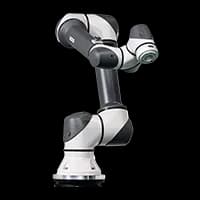
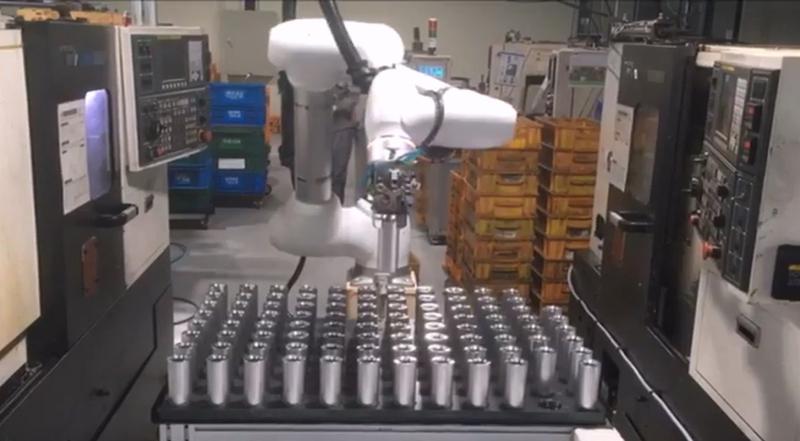
This machine tending automation solution uses the Doosan collaborative robot M1013 and a WIA turning center to automate the loading and unloading of automotive parts for machining processes.
In conventional processes, operators had to continuously wait in front of the equipment and manually load parts one by one. By allowing the robot to handle loading and unloading tasks for two machine tools, operators can manage and operate more equipment simultaneously.
Components
| Robot |
|
|---|---|
| Peripherals |
|
Workflow
| STEP 1. | Pick raw material from the pallet |
|---|---|
| STEP 2. | Load into the turning center |
| STEP 3. | Perform machining |
| STEP 4. | Pick the finished part and load it back onto the original pallet position |
| STEP 5. | Alternate operation between both turning centers |
Features
Maximized Flexibility Through Human-Robot Collaboration
Performs continuous operation for difficult or hazardous tasks
Improves efficiency by allowing operators to manage the upstream and downstream workflow
Easy Task Teaching
Enables direct teaching by manually guiding the robot arm
Enables compliance control using torque sensors to perform close-contact operations on the chuck
Enables additional teaching within 10 minutes even when the model changes
Enhanced Work Safety
Torque sensors with 0.2 Nm resolution are mounted on 6 axes, enabling operation stop even with minor collisions in the front direction
Applies compliance control logic that responds smoothly to external force during picking and loading, minimizing impact
Compact Installation
Minimizes required space by applying a compact collaborative robot
Results
| Key Benefits | Increased work efficiency by enabling additional tasks for existing operators |
|---|---|
| Client Feedback | Operators had efficiency loss due to constant waiting. With the robot handling machining response tasks and operators only performing periodic pallet replacement, overall work efficiency improved. |
Unauthorized copying or reproduction of any content on Marosol may violate the Unfair Competition Prevention Act and Copyright Act.
Recommended Solution

Lamp Assembly Automation using Yaskawa GP12 and Robostar RPA80-4B
Process Overview This assembly automation solution automates automotive lamp assembly and inspection processes using Yaskawa GP12 and Robostar RPA80-4B robots. By utilizing two Yaskawa (vertical articulated) robots and two Robostar (horizontal articulated, SCARA) robots, the entire process is divided based on takt time, enabling continuous operations to be completed within a short cycle time. In addition, the solution performs inspection processes and QR code labeling after assembly, achieving end-to-end process automation and minimizing defect rates.

Wheel Machining Support Automation with ABB IRB 6640
Process Overview This solution automates machine tending for machining high-payload automotive wheels using an ABB IRB 6640 robot. Since automotive wheels are heavy workpieces (over 8 kg) that are difficult and physically demanding for operators to handle, robot automation supports two machining centers at the same time, improving productivity and operator satisfaction.

Automotive Parts Protective Film Application and Inspection using DENSO Robot
Process Overview This inspection automation solution uses the DENSO VM60B1 robot to automate quality inspection and protective film application for automotive parts by performing taping and inspection processes through robotic wrapping. By switching between three tools, the system performs gate cutting, protective film application, and inspection in a single integrated workflow, minimizing management points and improving overall productivity.
Process layout
Process Overview
This machine tending automation solution uses the Doosan collaborative robot M1013 and a WIA turning center to automate the loading and unloading of automotive parts for machining processes.
In conventional processes, operators had to continuously wait in front of the equipment and manually load parts one by one. By allowing the robot to handle loading and unloading tasks for two machine tools, operators can manage and operate more equipment simultaneously.
Components
| Robot |
|
|---|---|
| Peripherals |
|
Workflow
| STEP 1. | Pick raw material from the pallet |
|---|---|
| STEP 2. | Load into the turning center |
| STEP 3. | Perform machining |
| STEP 4. | Pick the finished part and load it back onto the original pallet position |
| STEP 5. | Alternate operation between both turning centers |
Features
Maximized Flexibility Through Human-Robot Collaboration
Performs continuous operation for difficult or hazardous tasks
Improves efficiency by allowing operators to manage the upstream and downstream workflow
Easy Task Teaching
Enables direct teaching by manually guiding the robot arm
Enables compliance control using torque sensors to perform close-contact operations on the chuck
Enables additional teaching within 10 minutes even when the model changes
Enhanced Work Safety
Torque sensors with 0.2 Nm resolution are mounted on 6 axes, enabling operation stop even with minor collisions in the front direction
Applies compliance control logic that responds smoothly to external force during picking and loading, minimizing impact
Compact Installation
Minimizes required space by applying a compact collaborative robot
Results
| Key Benefits | Increased work efficiency by enabling additional tasks for existing operators |
|---|---|
| Client Feedback | Operators had efficiency loss due to constant waiting. With the robot handling machining response tasks and operators only performing periodic pallet replacement, overall work efficiency improved. |
Unauthorized copying or reproduction of any content on Marosol may violate the Unfair Competition Prevention Act and Copyright Act.
Recommended Solution
Lamp Assembly Automation using Yaskawa GP12 and Robostar RPA80-4B
Process Overview This assembly automation solution automates automotive lamp assembly and inspection processes using Yaskawa GP12 and Robostar RPA80-4B robots. By utilizing two Yaskawa (vertical articulated) robots and two Robostar (horizontal articulated, SCARA) robots, the entire process is divided based on takt time, enabling continuous operations to be completed within a short cycle time. In addition, the solution performs inspection processes and QR code labeling after assembly, achieving end-to-end process automation and minimizing defect rates.
Wheel Machining Support Automation with ABB IRB 6640
Process Overview This solution automates machine tending for machining high-payload automotive wheels using an ABB IRB 6640 robot. Since automotive wheels are heavy workpieces (over 8 kg) that are difficult and physically demanding for operators to handle, robot automation supports two machining centers at the same time, improving productivity and operator satisfaction.
Automotive Parts Protective Film Application and Inspection using DENSO Robot
Process Overview This inspection automation solution uses the DENSO VM60B1 robot to automate quality inspection and protective film application for automotive parts by performing taping and inspection processes through robotic wrapping. By switching between three tools, the system performs gate cutting, protective film application, and inspection in a single integrated workflow, minimizing management points and improving overall productivity.