



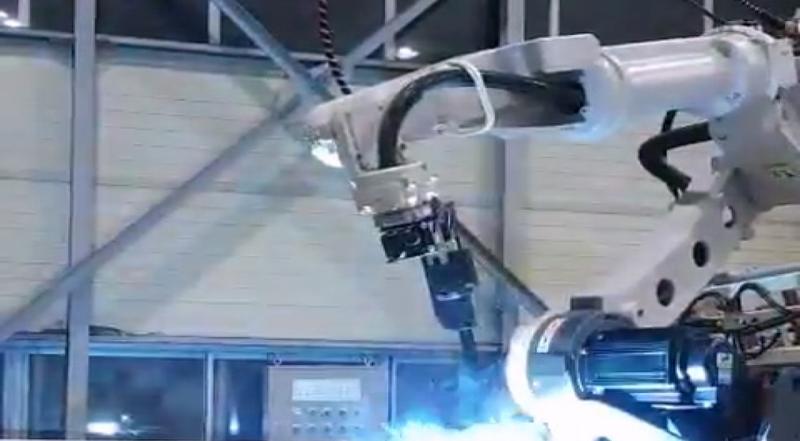
Process layout
Process Overview
This welding automation solution uses the Panasonic automatic welding system (TM-2000) combined with a positioner to perform underside welding on automotive cargo beds weighing over 1 ton. A robot travel axis (linear track) is applied to cover a wide working envelope.
By applying the Panasonic automatic welding system, the solution enables both high welding speed and high welding quality for arc welding automation.
In addition, the welding machine, robot, and positioner are configured as an integrated package, enabling fast installation and tuning.
Components
| Robot |
|
|---|---|
| Peripherals |
|
Workflow
| STEP 1. | Fix the weld target workpiece on the jig |
|---|---|
| STEP 2. | Click the work instruction button |
| STEP 3. | Perform arc welding |
| STEP 4. | Click the work instruction button to change the fixing position (positioner rotation) |
| STEP 5. | Perform subsequent arc welding |
Features
High Work Efficiency and Quality
Assigns tasks requiring consistent quality and skill to the robot, while operators focus on loading and unloading, improving both efficiency and quality
Minimizes cycle time through high-speed welding execution
Reduces cycle time by applying logic and teaching strategies for corner-cutting and fitting motions at welding start and end
Enables automatic re-ignition logic in case of arc ignition failure to minimize downtime due to errors
Secures a wide working range and flexible welding postures by utilizing a positioner
Performs full welding coverage on large structures using a single robot
Enables easy welding in hard-to-reach positions that are difficult for operators
Secures high welding quality and reduces post-weld rework costs
Applies spatter reduction technology
Applies heat input reduction technology
Enables automatic compensation for uneven surfaces by detecting the distance between the welding torch and the workpiece
Enables gap correction using contact sensors
Ensures uniform welding quality by applying arc sensors with automatic compensation during welding
Easy Setup and Monitoring
Provides simple installation and monitoring functions
Enables fast installation and tuning
Eliminates the need for separate interface work by using an integrated welding system package
Enables fast parameter setup and easy tuning using WELD NAVIGATION
Secures various welding postures by linking with an external positioner
Shortens installation time by performing synchronized motion with other robots
Enables easy monitoring and record management of welding process data
Results
| Key Benefits | Improved welding quality
Increased productivity comparable to skilled operators |
|---|---|
| Client Feedback | For welding operations, it has become difficult to hire qualified workers, and even when training foreign labor, it still takes time to reach a skilled level. Through welding automation, we were able to perform consistent-quality welding and significantly improve productivity. |
Unauthorized copying or reproduction of any content on Marosol may violate the Unfair Competition Prevention Act and Copyright Act.
Recommended Solution

Automotive Parts Roll Forming & Deburring Automation with Kawasaki and ABB Robots
Process Overview This solution uses a total of four robots—one KAWASAKI ZX165U, two ABB IRB 2600 units, and one ABB IRB 6700—to transfer automotive parts after roll forming and perform deburring operations. By transferring parts to the next process in sync with the continuous forming cycle time, it reduces operation time and maximizes productivity.

Automated Spot Welding for Aluminum Oil Pans using NACHI SRA210
Process Overview This welding robot solution automates spot welding for aluminum oil pan products using the NACHI SRA210 robot, enabling high-speed welding performance and excellent space utilization. By applying a dedicated spot-welding robot, the SRA210 supports a compact installation footprint and delivers fast, accurate welding operations.

Engine Parts Deburring Automation using FANUC Robot
Process Overview This deburring automation solution uses the FANUC M-10iA/12 robot to automate manual deburring operations for engine parts. By applying Youngchang Robotech's solution with a deburring tool that can maintain appropriate force according to input conditions, the system enables precise and consistent deburring quality. Configured as a single automation cell, the solution is easy to install and operate, and it also supports deburring at multiple angles even for complex-shaped parts.
Process layout
Process Overview
This welding automation solution uses the Panasonic automatic welding system (TM-2000) combined with a positioner to perform underside welding on automotive cargo beds weighing over 1 ton. A robot travel axis (linear track) is applied to cover a wide working envelope.
By applying the Panasonic automatic welding system, the solution enables both high welding speed and high welding quality for arc welding automation.
In addition, the welding machine, robot, and positioner are configured as an integrated package, enabling fast installation and tuning.
Components
| Robot |
|
|---|---|
| Peripherals |
|
Workflow
| STEP 1. | Fix the weld target workpiece on the jig |
|---|---|
| STEP 2. | Click the work instruction button |
| STEP 3. | Perform arc welding |
| STEP 4. | Click the work instruction button to change the fixing position (positioner rotation) |
| STEP 5. | Perform subsequent arc welding |
Features
High Work Efficiency and Quality
Assigns tasks requiring consistent quality and skill to the robot, while operators focus on loading and unloading, improving both efficiency and quality
Minimizes cycle time through high-speed welding execution
Reduces cycle time by applying logic and teaching strategies for corner-cutting and fitting motions at welding start and end
Enables automatic re-ignition logic in case of arc ignition failure to minimize downtime due to errors
Secures a wide working range and flexible welding postures by utilizing a positioner
Performs full welding coverage on large structures using a single robot
Enables easy welding in hard-to-reach positions that are difficult for operators
Secures high welding quality and reduces post-weld rework costs
Applies spatter reduction technology
Applies heat input reduction technology
Enables automatic compensation for uneven surfaces by detecting the distance between the welding torch and the workpiece
Enables gap correction using contact sensors
Ensures uniform welding quality by applying arc sensors with automatic compensation during welding
Easy Setup and Monitoring
Provides simple installation and monitoring functions
Enables fast installation and tuning
Eliminates the need for separate interface work by using an integrated welding system package
Enables fast parameter setup and easy tuning using WELD NAVIGATION
Secures various welding postures by linking with an external positioner
Shortens installation time by performing synchronized motion with other robots
Enables easy monitoring and record management of welding process data
Results
| Key Benefits | Improved welding quality
Increased productivity comparable to skilled operators |
|---|---|
| Client Feedback | For welding operations, it has become difficult to hire qualified workers, and even when training foreign labor, it still takes time to reach a skilled level. Through welding automation, we were able to perform consistent-quality welding and significantly improve productivity. |
Unauthorized copying or reproduction of any content on Marosol may violate the Unfair Competition Prevention Act and Copyright Act.
Recommended Solution
Automotive Parts Roll Forming & Deburring Automation with Kawasaki and ABB Robots
Process Overview This solution uses a total of four robots—one KAWASAKI ZX165U, two ABB IRB 2600 units, and one ABB IRB 6700—to transfer automotive parts after roll forming and perform deburring operations. By transferring parts to the next process in sync with the continuous forming cycle time, it reduces operation time and maximizes productivity.
Automated Spot Welding for Aluminum Oil Pans using NACHI SRA210
Process Overview This welding robot solution automates spot welding for aluminum oil pan products using the NACHI SRA210 robot, enabling high-speed welding performance and excellent space utilization. By applying a dedicated spot-welding robot, the SRA210 supports a compact installation footprint and delivers fast, accurate welding operations.
Engine Parts Deburring Automation using FANUC Robot
Process Overview This deburring automation solution uses the FANUC M-10iA/12 robot to automate manual deburring operations for engine parts. By applying Youngchang Robotech's solution with a deburring tool that can maintain appropriate force according to input conditions, the system enables precise and consistent deburring quality. Configured as a single automation cell, the solution is easy to install and operate, and it also supports deburring at multiple angles even for complex-shaped parts.