




Process layout
Process Overview
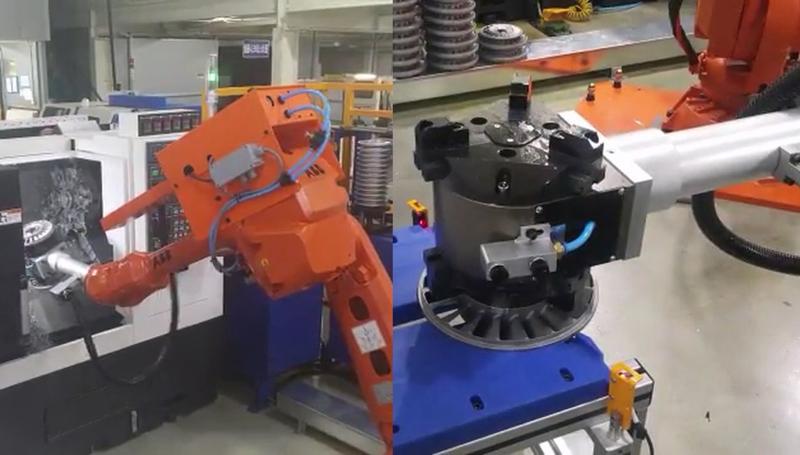
This machine tending automation solution uses the ABB IRB 2600 robot with Hyundai WIA Turning Center 160LA to automate the process of loading and unloading automotive parts.
The system completes the first machining process using two turning centers, then transfers the semi-finished parts to the other turning center for the second machining process, and finally moves them to the discharge conveyor. This configuration is designed to minimize idle time by matching the work cycle time and maximizing productivity.
The solution was implemented to increase productivity through 24/7 operation, reduce the required loading labor, and minimize idle waiting time between processes.
Components
| Robot |
|
|---|---|
| Peripherals |
|
Workflow
| STEP 1. | 1st machining loading |
|---|---|
| STEP 2. | 1st machining completed |
| STEP 3. | Air blowing for 1st machining |
| STEP 4. | Picking 1st machined part |
| STEP 5. | Orientation change |
| STEP 6. | Air blowing for 2nd machined part |
| STEP 7. | Picking 2nd machined part |
| STEP 8. | Load 1st machined part |
| STEP 9. | Orientation change for 2nd machined part |
| STEP 10. | Discharge to conveyor |
Features
Improved Productivity and Operational Efficiency
Minimizes cycle time by leveraging a high-speed, high-precision industrial robot
Uses one robot to handle three machine tools, reducing idle time by synchronizing with machining takt time
Automates loading and unloading to reduce management points and enable continuous production
High Durability and Strong Protection Rating
Applies an IP67 protection rating suitable for harsh cutting and machining environments
Ensures stable operation by adopting an ABB industrial robot with high durability and reliability
Results
| Key Benefits | Minimization of loading labor
Improved productivity by reducing idle waiting time |
|---|---|
| Client Feedback | By minimizing loading labor and reducing idle time, we were able to increase productivity. |
Unauthorized copying or reproduction of any content on Marosol may violate the Unfair Competition Prevention Act and Copyright Act.
Recommended Solution

Automotive Parts Grease Dispensing Automation with EPSON C4
Process Overview This solution applies grease to automotive switch boxes using an Epson C4 robot. With a high-precision industrial robot, grease dispensing can be performed according to the product geometry, reducing overall cycle time.

Automated Workpiece Loading & Unloading System for Automotive Parts Machining Lines
Process Overview This solution enables automatic loading of workpieces into machining equipment, including irregular, non-standard workpieces generated from hot forging, by using a specially designed gripping tool in the automotive parts machining load/unload process. Developed through the company's in-house R&D, this automation system uses a custom-made gripper to automatically load hot-forged workpieces, even those with inconsistent shapes, into the machining area.

Successfully Automated the Samlak Heat Treatment Loading Process!🙌 We Even Built a Perfect Jig Design (ft. Hyundai Robotics Industrial Robot)
Process Overview This project involved the introduction of automated loading/unloading to ensure uniform heat treatment of the carrier mid-planet , a key component of automotive transmissions. The client implemented automation to address several issues arising from the previously manual process, particularly the increased defect rate and inefficiencies caused by worker s. Hyundai Robotics' HH050 six-axis industrial robot was utilized for this purpose, automating various tasks such as product stacking, pin insertion, and tray placement , ensuring high productivity and stability. Warranty Period 1 Year Performance Year 2024 Project Duration 3 Months
Process layout
Process Overview
This machine tending automation solution uses the ABB IRB 2600 robot with Hyundai WIA Turning Center 160LA to automate the process of loading and unloading automotive parts.
The system completes the first machining process using two turning centers, then transfers the semi-finished parts to the other turning center for the second machining process, and finally moves them to the discharge conveyor. This configuration is designed to minimize idle time by matching the work cycle time and maximizing productivity.
The solution was implemented to increase productivity through 24/7 operation, reduce the required loading labor, and minimize idle waiting time between processes.
Components
| Robot |
|
|---|---|
| Peripherals |
|
Workflow
| STEP 1. | 1st machining loading |
|---|---|
| STEP 2. | 1st machining completed |
| STEP 3. | Air blowing for 1st machining |
| STEP 4. | Picking 1st machined part |
| STEP 5. | Orientation change |
| STEP 6. | Air blowing for 2nd machined part |
| STEP 7. | Picking 2nd machined part |
| STEP 8. | Load 1st machined part |
| STEP 9. | Orientation change for 2nd machined part |
| STEP 10. | Discharge to conveyor |
Features
Improved Productivity and Operational Efficiency
Minimizes cycle time by leveraging a high-speed, high-precision industrial robot
Uses one robot to handle three machine tools, reducing idle time by synchronizing with machining takt time
Automates loading and unloading to reduce management points and enable continuous production
High Durability and Strong Protection Rating
Applies an IP67 protection rating suitable for harsh cutting and machining environments
Ensures stable operation by adopting an ABB industrial robot with high durability and reliability
Results
| Key Benefits | Minimization of loading labor
Improved productivity by reducing idle waiting time |
|---|---|
| Client Feedback | By minimizing loading labor and reducing idle time, we were able to increase productivity. |
Unauthorized copying or reproduction of any content on Marosol may violate the Unfair Competition Prevention Act and Copyright Act.
Recommended Solution
Automotive Parts Grease Dispensing Automation with EPSON C4
Process Overview This solution applies grease to automotive switch boxes using an Epson C4 robot. With a high-precision industrial robot, grease dispensing can be performed according to the product geometry, reducing overall cycle time.
Automated Workpiece Loading & Unloading System for Automotive Parts Machining Lines
Process Overview This solution enables automatic loading of workpieces into machining equipment, including irregular, non-standard workpieces generated from hot forging, by using a specially designed gripping tool in the automotive parts machining load/unload process. Developed through the company's in-house R&D, this automation system uses a custom-made gripper to automatically load hot-forged workpieces, even those with inconsistent shapes, into the machining area.
Successfully Automated the Samlak Heat Treatment Loading Process!🙌 We Even Built a Perfect Jig Design (ft. Hyundai Robotics Industrial Robot)
Process Overview This project involved the introduction of automated loading/unloading to ensure uniform heat treatment of the carrier mid-planet , a key component of automotive transmissions. The client implemented automation to address several issues arising from the previously manual process, particularly the increased defect rate and inefficiencies caused by worker s. Hyundai Robotics' HH050 six-axis industrial robot was utilized for this purpose, automating various tasks such as product stacking, pin insertion, and tray placement , ensuring high productivity and stability. Warranty Period 1 Year Performance Year 2024 Project Duration 3 Months