






Process layout
Process Overview
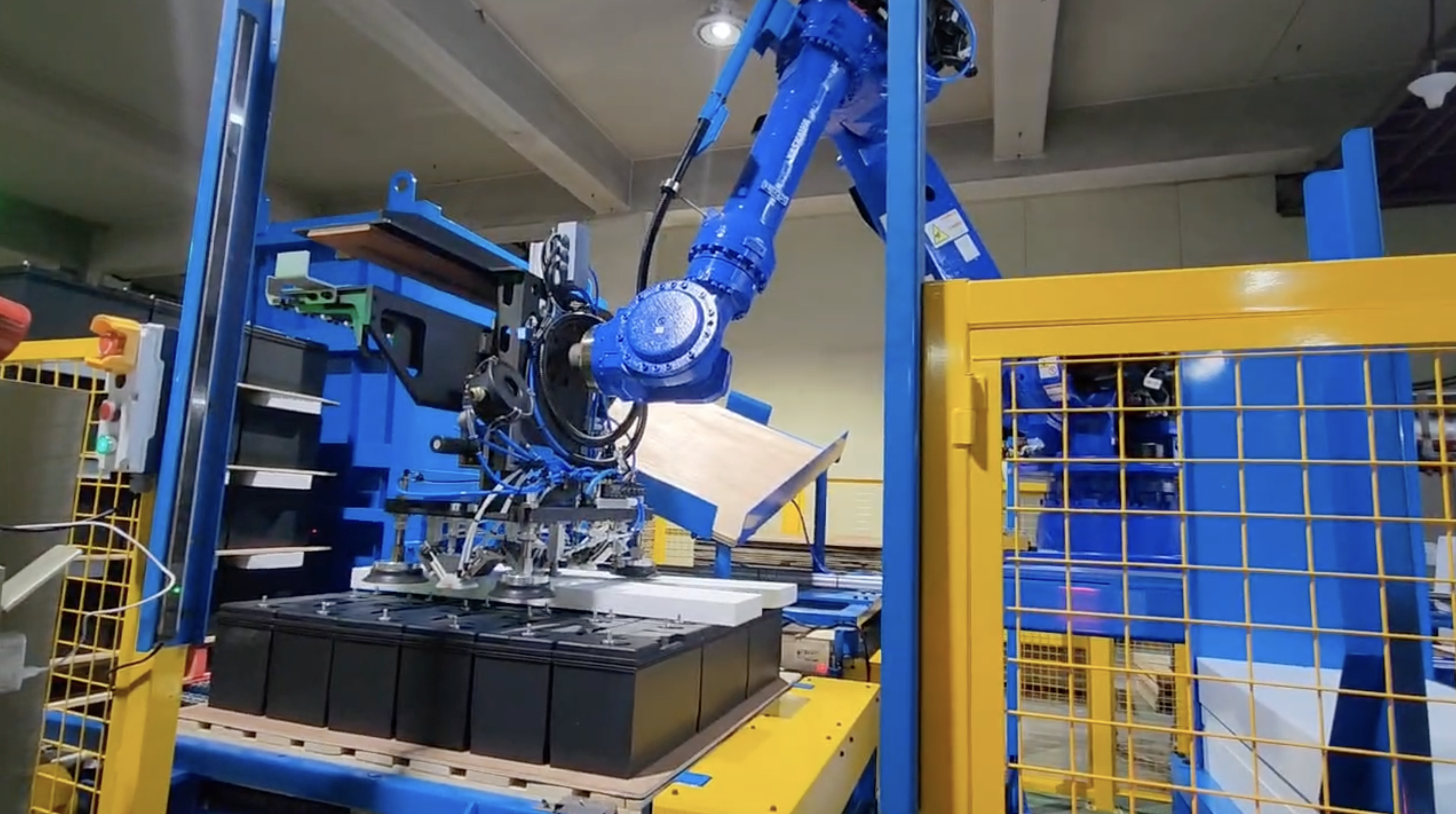
Hankook & Company’s palletizing solution prioritizes higher output and reduced labor requirements. After removing the existing line that was built around a single palletizer, the operation was split into two lines and reconfigured with two palletizers to secure production capacity (CAPA). In addition, manual placement of styrofoam and slip sheets was automated to reduce operator intervention—enabling one operator to manage both lines.
Project Background and Objectives
Background
The previous workflow had an imbalance between line production capacity (CAPA) and palletizing capacity (CAPA), requiring operators to manually support styrofoam and slip-sheet placement to maintain output. This structure forced continuous loading of slip sheets (approx. 7 kg each), causing significant operator fatigue. Also, the line had to wait until manual slip-sheet loading was completed, leading to large fluctuations in the logistics cycle time.
Key issues
Palletizing quality instability and speed loss caused by manual operations
Reduced productivity, increased operator fatigue, and skilled-labor dependency issues
Objectives
Improve production efficiency by minimizing repetitive manual tasks through upgraded robot automation
Ensure quality consistency by reducing manual intervention
Improve the work environment by reducing operator fatigue and strengthening safety
Components
| Robot | YASKAWA industrial robot GP250 |
|---|---|
| Peripherals | Battery infeed conveyor Sorter Battery bundle alignment conveyor Dedicated gripper Pallet conveyor Pallet supply unit Diverter conveyor Slip-sheet alignment station Styrofoam supply magazine |
Workflow
| STEP 1. | On the HMI, select the battery model and enter the required quantity. |
|---|---|
| STEP 2. | Batteries fed from the infeed line are aligned on the conveyor to the required count and queued for palletizing. |
| STEP 3. | The load is transferred and fixed in position at the palletizing station. |
| STEP 4. | Based on the recipe total layer count, slip sheets are aligned accordingly. |
| STEP 5. | The 6-axis robot grips the battery bundle. |
| STEP 6. | The robot automatically loads the bundle onto the pallet. |
Features
Higher Productivity
Line production capacity (CAPA) improved by 30% through parallel operation.
Buffering for pallets, styrofoam, and slip sheets enables continuous production capability.
Quality Consistency
Standardized palletizing for defined battery and pattern specifications ensures consistent pallet quality.
Anti-drop prevention design helps reduce defects.
Improved Work Environment
Automation within the operator’s work zone reduces fatigue and injury risk.
Helps prevent musculoskeletal disorders caused by repetitive tasks.
Reduced Operating Cost
Instead of one operator running one palletizer, one operator can run two palletizers, reducing operating cost relative to output increase.
Prompt Project Completion
Using prior references and simulation, the line removal, installation, and stabilization were completed within 5 days of line downtime.
Results
| Client Feedback | The customer stated, “After Marosol set up the palletizing line, material flow became smoother than before, and operator satisfaction increased due to a significant reduction in manual work. Despite the short installation schedule and initial concerns about a new vendor, the team completed line removal, installation, and ramp-up within just five days without a single drop incident. We validated more than 40 SKUs, stabilized quickly without impacting production output, and even our management team praised the results. In addition, Marosol’s engineers responded immediately to on-site variables through direct support, making deployment very smooth and resulting in high field satisfaction. |
|---|
Unauthorized copying or reproduction of any content on Marosol may violate the Unfair Competition Prevention Act and Copyright Act.
Recommended Solution

Silicone Molded Part Palletizing using AIM AIVE System and Delta SCARA Robot
Silicone Molded Part Palletizing using AIM AIVE System and Delta SCARA Robot

Smart Machine Tool Assistant "G-AiD" using Collaborative Robots
This machine tending solution automates the loading and unloading of parts by integrating three G-AiD small-precision (4-axis) machine tools with a Universal Robots UR10e. By arranging multiple machine tools in a compact space, a single robot can manage the entire workflow, significantly boosting operational efficiency and productivity. G-AiD features an Automatic Tool Changer (ATC) and tool wear sensing, enabling efficient task management. Furthermore, its seamless data integration with external systems makes it an ideal candidate for Smart Factory government support projects, helping to reduce initial investment costs. The project was implemented to resolve labor shortages in part machining, reduce personnel costs, and enable real-time quality monitoring and improvement through smart factory integration.

Cognex AI Vision: 4-Model Review 👀 Can This 3D AI Vision Read 255 Barcodes at Once?
Introducing four AI Vision solutions showcased by Cognex at the 2026 AW (Aircraft Automation Show). From simultaneous reading of 255 barcodes and 15-minute installation to deep learning cargo classification , check them out now if you are interested in Vision automation for logistics and manufacturing sites.
Process layout
Process Overview
Hankook & Company’s palletizing solution prioritizes higher output and reduced labor requirements. After removing the existing line that was built around a single palletizer, the operation was split into two lines and reconfigured with two palletizers to secure production capacity (CAPA). In addition, manual placement of styrofoam and slip sheets was automated to reduce operator intervention—enabling one operator to manage both lines.
Project Background and Objectives
Background
The previous workflow had an imbalance between line production capacity (CAPA) and palletizing capacity (CAPA), requiring operators to manually support styrofoam and slip-sheet placement to maintain output. This structure forced continuous loading of slip sheets (approx. 7 kg each), causing significant operator fatigue. Also, the line had to wait until manual slip-sheet loading was completed, leading to large fluctuations in the logistics cycle time.
Key issues
Palletizing quality instability and speed loss caused by manual operations
Reduced productivity, increased operator fatigue, and skilled-labor dependency issues
Objectives
Improve production efficiency by minimizing repetitive manual tasks through upgraded robot automation
Ensure quality consistency by reducing manual intervention
Improve the work environment by reducing operator fatigue and strengthening safety
Components
| Robot | YASKAWA industrial robot GP250 |
|---|---|
| Peripherals | Battery infeed conveyor Sorter Battery bundle alignment conveyor Dedicated gripper Pallet conveyor Pallet supply unit Diverter conveyor Slip-sheet alignment station Styrofoam supply magazine |
Workflow
| STEP 1. | On the HMI, select the battery model and enter the required quantity. |
|---|---|
| STEP 2. | Batteries fed from the infeed line are aligned on the conveyor to the required count and queued for palletizing. |
| STEP 3. | The load is transferred and fixed in position at the palletizing station. |
| STEP 4. | Based on the recipe total layer count, slip sheets are aligned accordingly. |
| STEP 5. | The 6-axis robot grips the battery bundle. |
| STEP 6. | The robot automatically loads the bundle onto the pallet. |
Features
Higher Productivity
Line production capacity (CAPA) improved by 30% through parallel operation.
Buffering for pallets, styrofoam, and slip sheets enables continuous production capability.
Quality Consistency
Standardized palletizing for defined battery and pattern specifications ensures consistent pallet quality.
Anti-drop prevention design helps reduce defects.
Improved Work Environment
Automation within the operator’s work zone reduces fatigue and injury risk.
Helps prevent musculoskeletal disorders caused by repetitive tasks.
Reduced Operating Cost
Instead of one operator running one palletizer, one operator can run two palletizers, reducing operating cost relative to output increase.
Prompt Project Completion
Using prior references and simulation, the line removal, installation, and stabilization were completed within 5 days of line downtime.
Results
| Client Feedback | The customer stated, “After Marosol set up the palletizing line, material flow became smoother than before, and operator satisfaction increased due to a significant reduction in manual work. Despite the short installation schedule and initial concerns about a new vendor, the team completed line removal, installation, and ramp-up within just five days without a single drop incident. We validated more than 40 SKUs, stabilized quickly without impacting production output, and even our management team praised the results. In addition, Marosol’s engineers responded immediately to on-site variables through direct support, making deployment very smooth and resulting in high field satisfaction. |
|---|
Unauthorized copying or reproduction of any content on Marosol may violate the Unfair Competition Prevention Act and Copyright Act.
Recommended Solution
Silicone Molded Part Palletizing using AIM AIVE System and Delta SCARA Robot
Silicone Molded Part Palletizing using AIM AIVE System and Delta SCARA Robot
Smart Machine Tool Assistant "G-AiD" using Collaborative Robots
This machine tending solution automates the loading and unloading of parts by integrating three G-AiD small-precision (4-axis) machine tools with a Universal Robots UR10e. By arranging multiple machine tools in a compact space, a single robot can manage the entire workflow, significantly boosting operational efficiency and productivity. G-AiD features an Automatic Tool Changer (ATC) and tool wear sensing, enabling efficient task management. Furthermore, its seamless data integration with external systems makes it an ideal candidate for Smart Factory government support projects, helping to reduce initial investment costs. The project was implemented to resolve labor shortages in part machining, reduce personnel costs, and enable real-time quality monitoring and improvement through smart factory integration.
Cognex AI Vision: 4-Model Review 👀 Can This 3D AI Vision Read 255 Barcodes at Once?
Introducing four AI Vision solutions showcased by Cognex at the 2026 AW (Aircraft Automation Show). From simultaneous reading of 255 barcodes and 15-minute installation to deep learning cargo classification , check them out now if you are interested in Vision automation for logistics and manufacturing sites.