



Adding ‘AI Capabilities’ to Robots: SOLlink AOD Advanced Sensor
2 min read0270
SOLlink AOD (Add-on Device):
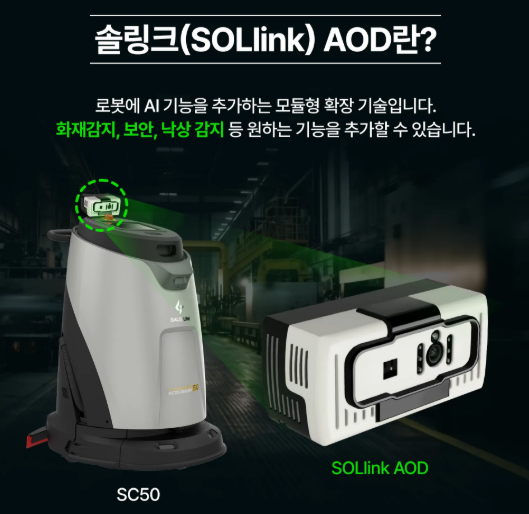
Modular expansion technology that adds 'AI capabilities' to robots
💡 We'll tell you all this in 5 minutes!
Is AOD really necessary?
AOD Implementation Cases: How to Utilize Cleaning Robot, Guide, and Logistics
Features of robots equipped with AOD
The Special Reason for Marosol AOD Solution
Your robot is reborn.
Existing robots operated only within the functional range defined at the time of shipment. Cleaning robots only perform cleaning, and guidance robots only perform guidance. To expand functions, it was necessary to change hardware or perform complex custom development, and the cost and time involved acted as a burden.
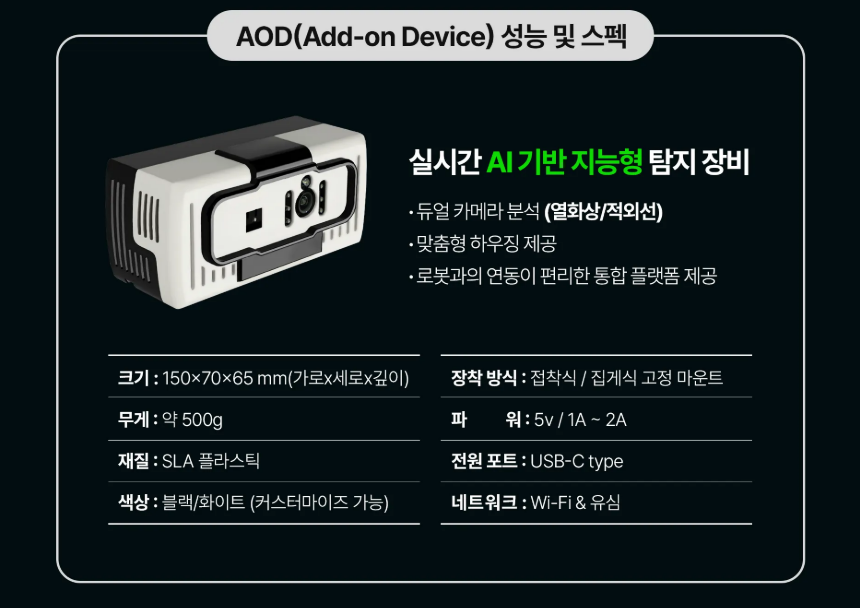
SOLlink AOD was designed in a way that fundamentally changes this structural limit. Instead of changing the robot itself, an AI-based Add-on Device is combined with the exterior of the robot, allowing for the step-by-step expansion of recognition, analysis, and judgment system integration functions while maintaining the inherent functions of the existing robot.
In other words, it has become possible to 'upgrade' a robot already on-site into a multi-functional AI robot without introducing a new one.
Cost-Effective: Drastically reduce costs by utilizing existing robots without introducing expensive new robots.
Development-Free: Designed to be applicable to the field immediately without complex integration development processes.
How far can the role of a robot be expanded with SOLlink AOD? – Interview with Marosol Robot Expert
Q1. From what problem did the SOLlink AOD (Add-on Device) solution start?
AOD is a solution that started from the question: “While the robot is working, who will be responsible for the safety and abnormal situations of the site?” Looking at actual fields, various robots such as cleaning, guidance, and logistics robots are already moving through spaces, but most robots were structured to perform only set tasks and could not recognize or judge surrounding situations.
However, accidents always occur during times when people are absent or at moments out of sight. AOD was developed to fill this gap. AOD is a modular solution attached to the top of an existing robot to add camera, thermal imaging, and AI recognition functions, designed so the robot can function as a subject that observes the site and detects abnormal situations beyond being a simple 'moving equipment.'
Q2. Is AOD a technology applied only to specific robots, such as cleaning robots?
That is not the case. Rather, the greatest strength of AOD lies in its versatility, regardless of the type of robot. AOD is not a device designed on the premise of specific tasks like 'cleaning function' or 'guidance function,' but an AI expansion module applicable to any robot that moves through space.
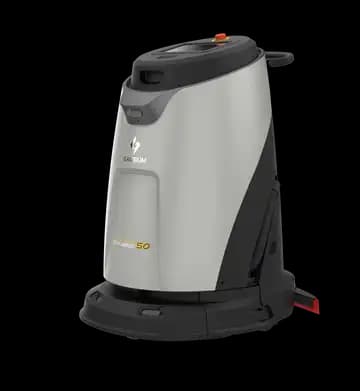
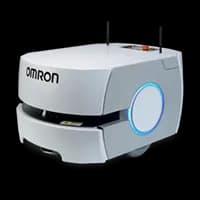
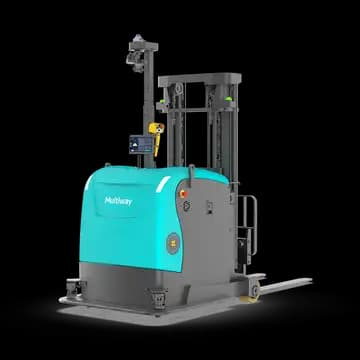
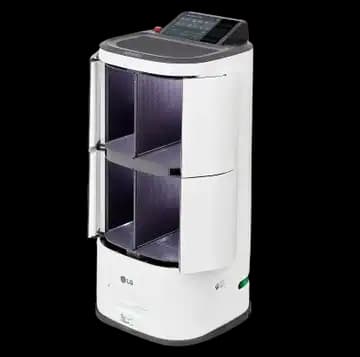
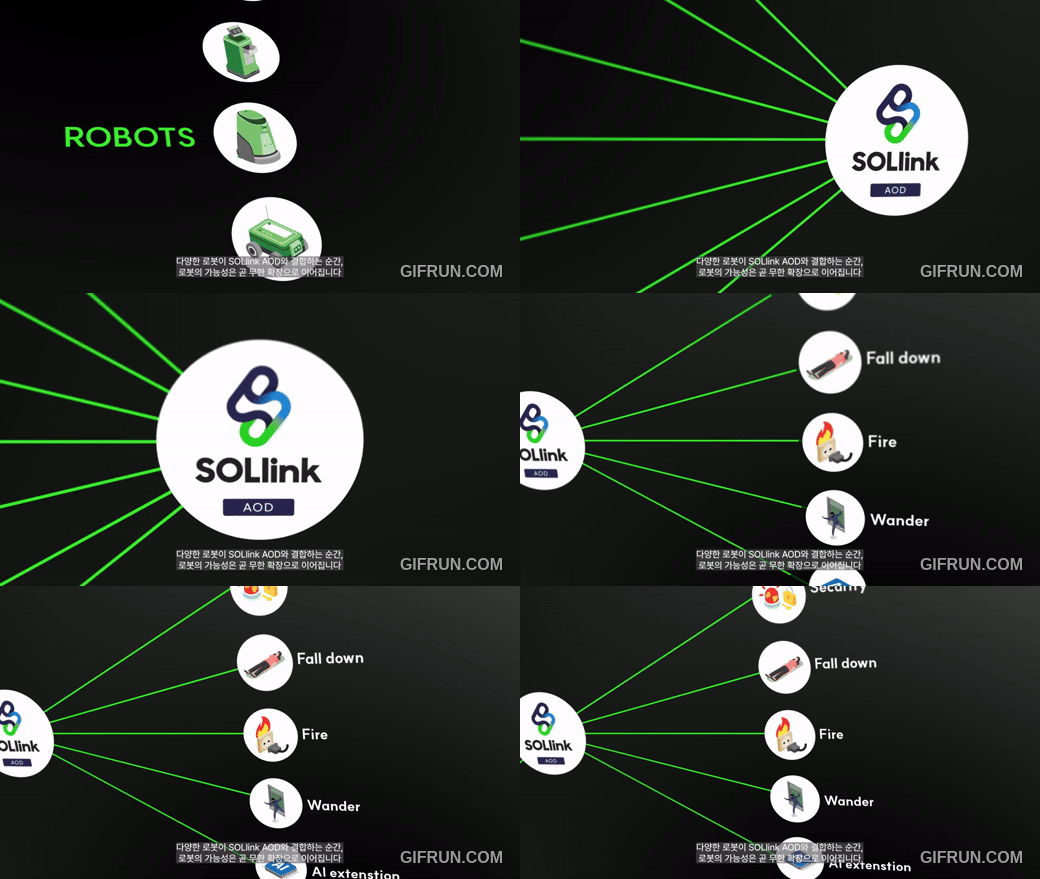
Currently, representative robot types applicable include cleaning robots, guidance robots, logistics robots (AMR), and unmanned forklifts (AGV). These robots have one thing in common: they are all capable of autonomous driving and move while circulating the site for a certain period. AOD utilizes this 'mobility' to make the robot a moving detection sensor and a subject of patrol.
Actually, cleaning robots with AOD applied are designed to perform site monitoring simultaneously with cleaning tasks.
👉 If you are interested in Cleaning Robot robot products equipped with AOD, (Relevant link) Please check the details through.
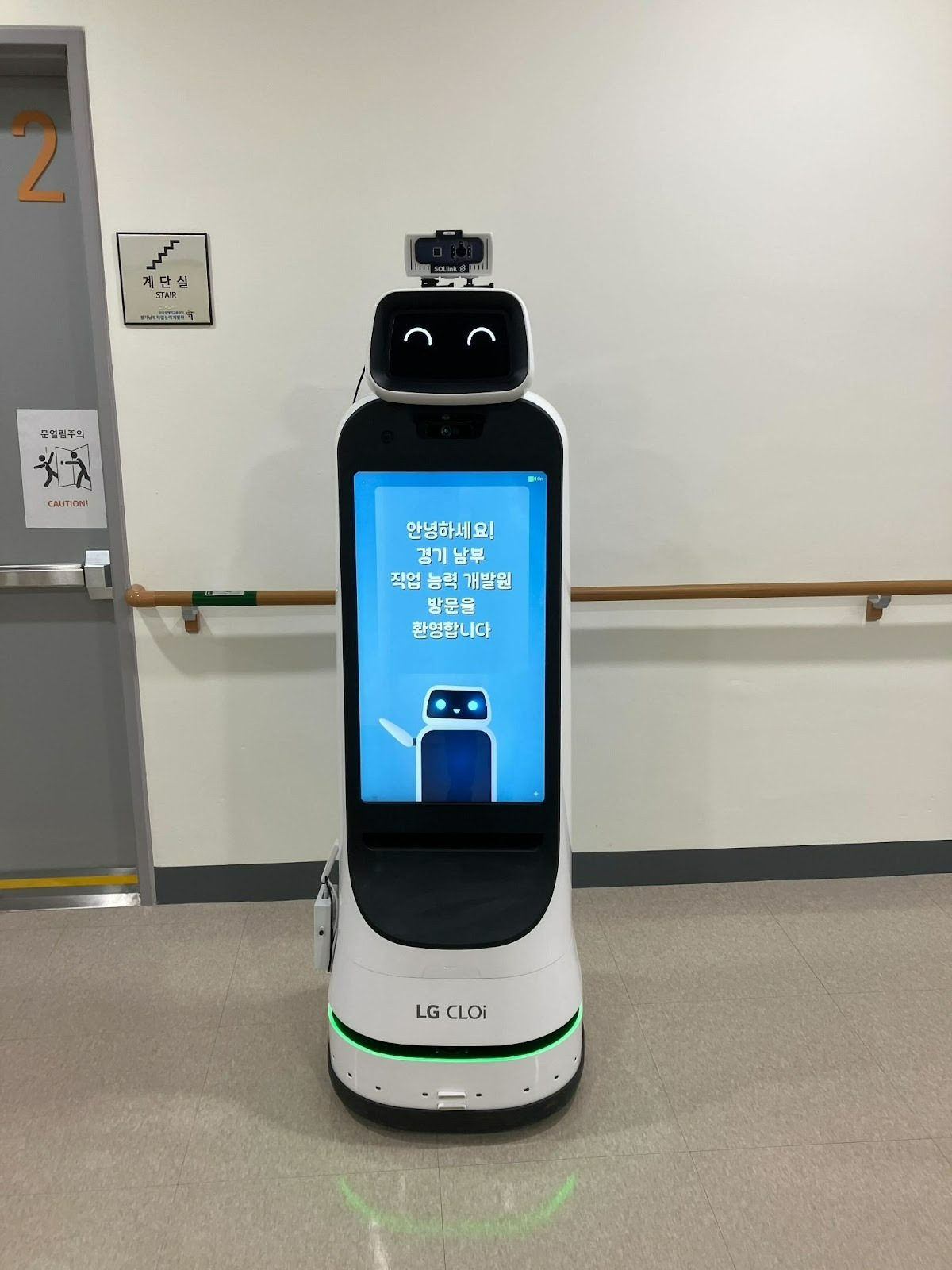 A view of the AOD attached to Chloe, the Guide robot at the Korea Employment Agency for the Disabled.
Q3. Specifically, how does the role of the robot change when AOD is installed?
A robot equipped with AOD recognizes and analyzes the surrounding environment continuously while performing cleaning or guidance as before. It operates in a structure that judges a situation as abnormal when specific conditions are met and immediately notifies the manager.
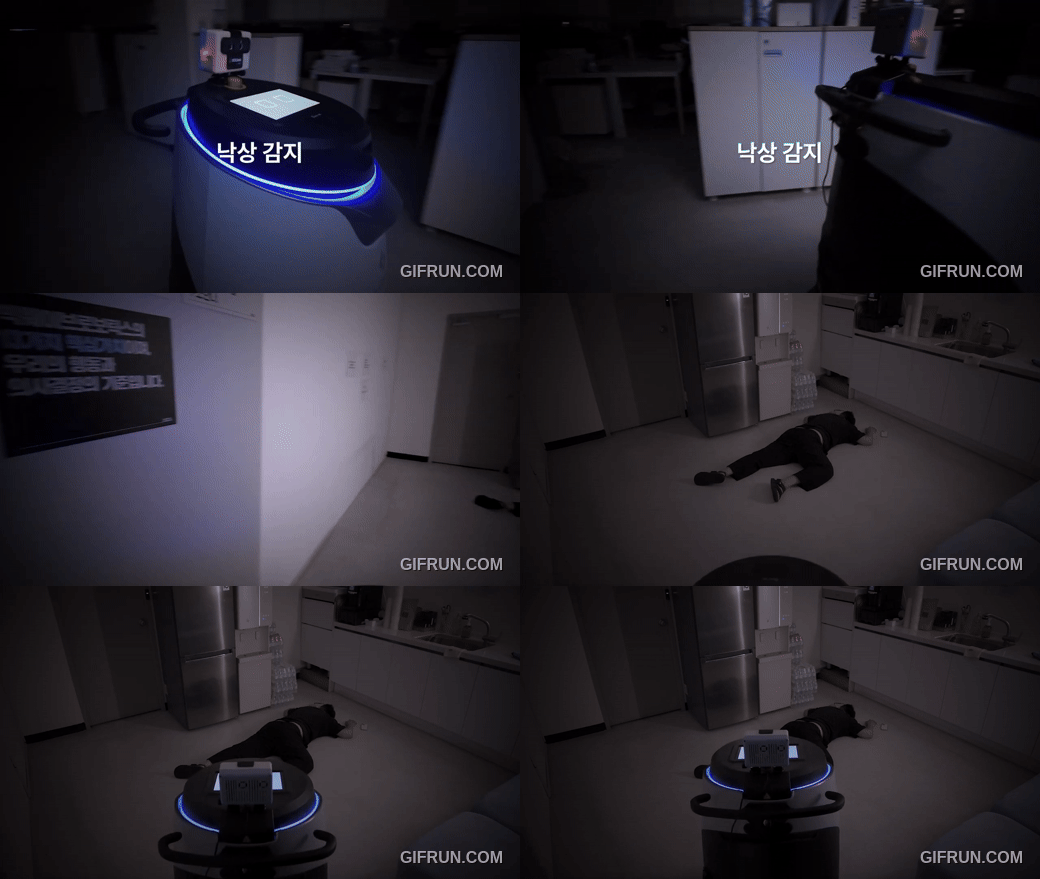
Currently, three functions have been verified as the most realistic and effective scenarios through video planning and actual field application: Fall Detection, Loitering Detection, and Fire Detection. These three are not simple technical demonstrations but were designed around situations that have a high frequency of occurrence in actual fields and where initial response is critical.
Examples of key detection features of SOLlink AOD
Q4. How is fall detection actually performed?
Fall detection is not at the level of simply recognizing that “a person is lying on the floor.” AOD continuously analyzes human movement patterns to distinguish between normal walking flows and abnormal actions.
For example, if a person walking suddenly loses balance and falls quickly to the floor, or if there is no movement for more than a certain period afterwards, AOD judges this as a situation with a high possibility of a fall. At this time, a “Fall Detected” message is displayed on the robot’s point-of-view screen, and the robot's location, fall point, and real-time video information are transmitted together to the SOLlink control screen.
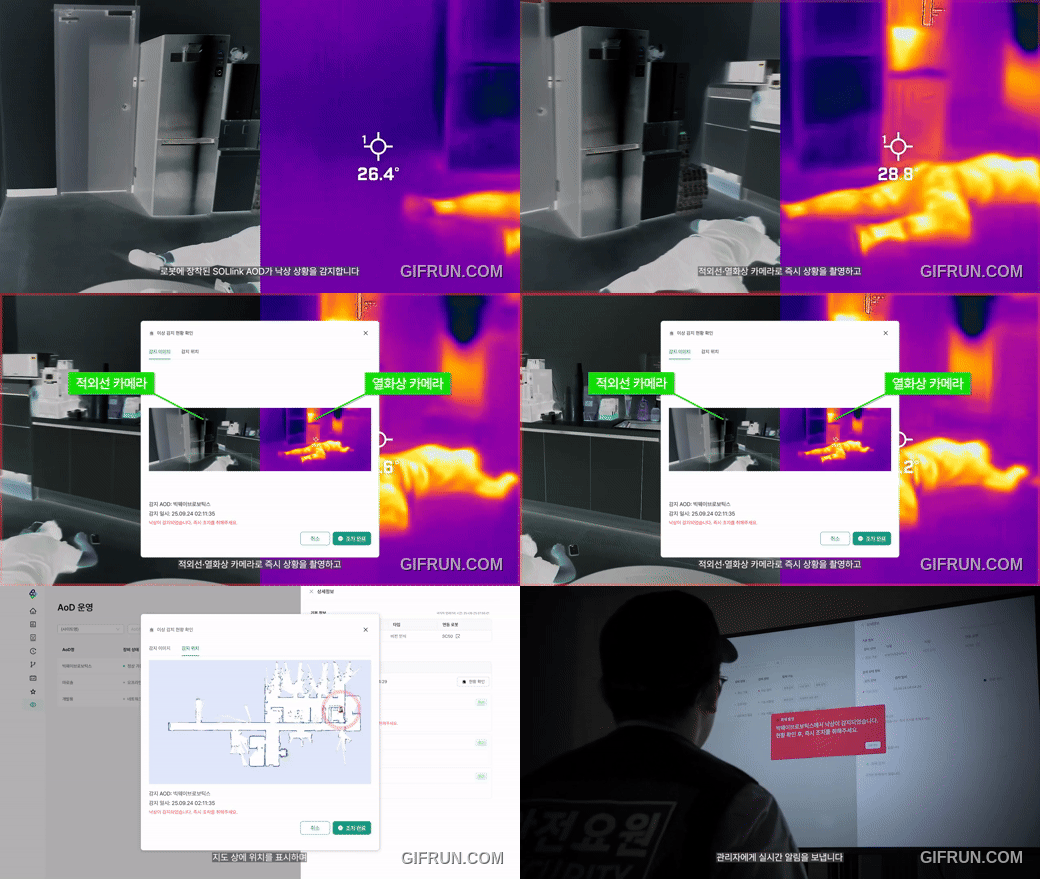
The important point is that the robot does not handle the situation on its own. The role of AOD is to provide information so that the manager can make a quick and accurate judgment.
Actually, fall detection scenarios for the disabled using AOD are in operation for guidance and cleaning robots introduced to the Korea Employment Agency for Persons with Disabilities, performing the role of supplementing safety dead zones in environments where regular personnel are scarce.
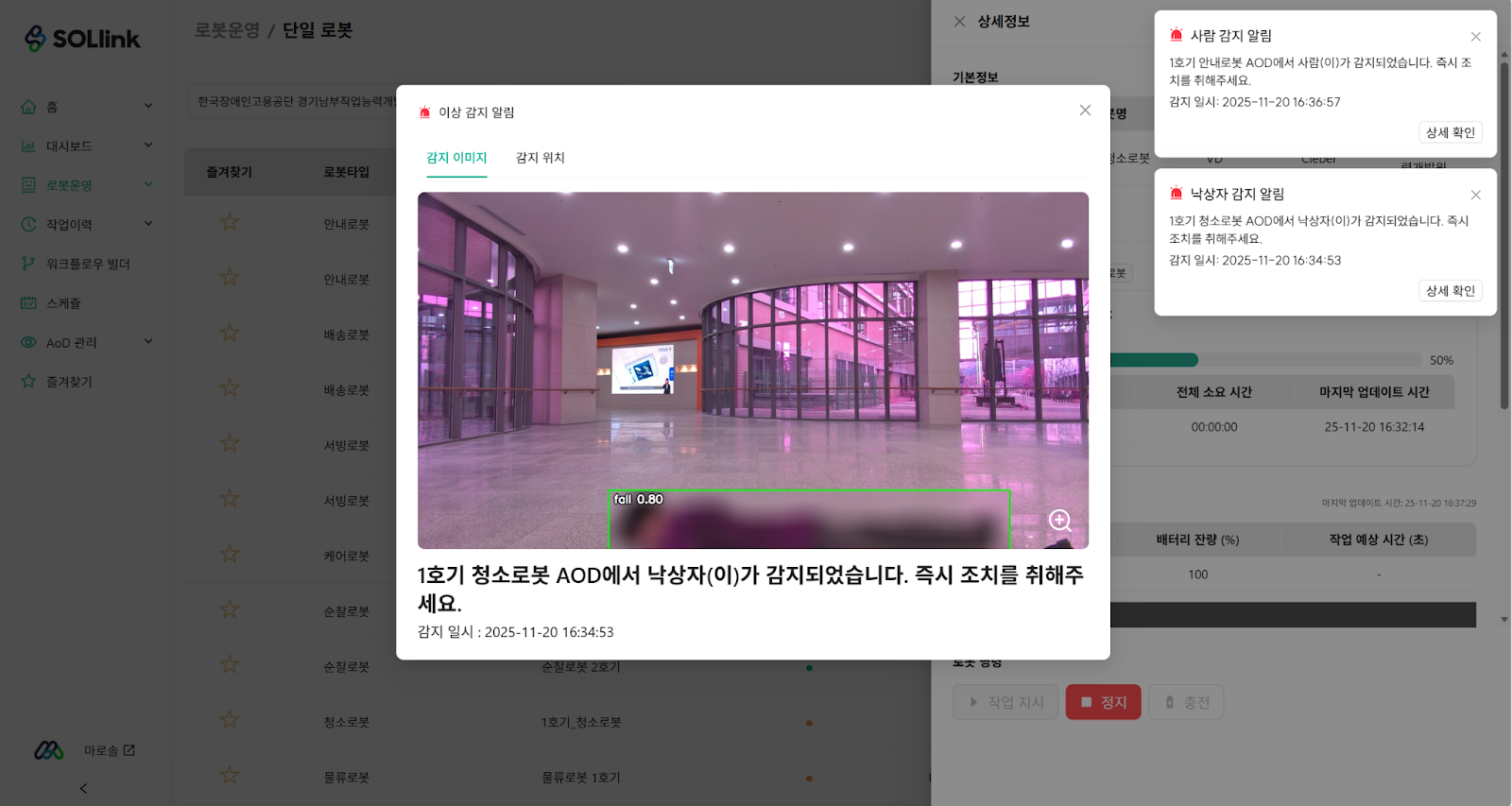 A view of the SOLlink screen where the AOD attached to a Cleaning Robot robot at the Korea Employment Agency for the Disabled detected a fall.
Q5. What are the differences between loitering detection and existing CCTV?
Existing CCTV is basically close to a 'recording device.' While it is useful for checking video after an incident occurs, there are limits to recognizing and intervening in risky behavior in advance.
On the other hand, AOD analyzes the context and pattern of behavior, not just the simple presence of a person. It recognizes it as a loitering situation by comprehensively judging whether a person moves back and forth in a specific area repeatedly, stays abnormally long in a restricted area, or if the behavior is awkward relative to the time of day.
Information detected in this way is immediately delivered to the manager, and the manager can choose responses such as dispatching to the site, operating warning lights/sirens, or providing warning guidance depending on the situation. In other words, AOD can be seen not as a 'watching device' like CCTV, but as a system that detects behavior with the potential to develop into a danger early.
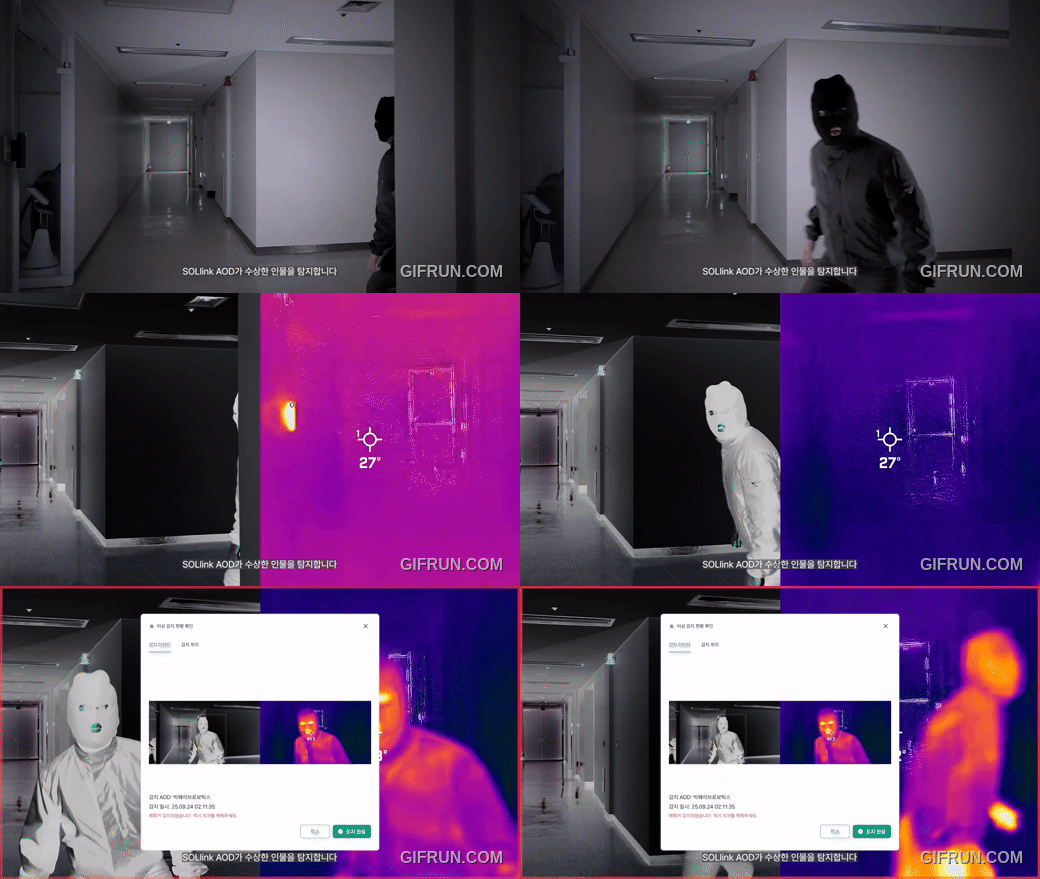
Q6. On what principle does fire detection work?
Fire detection is mainly performed based on thermal imaging. Even in the early stages when smoke or flames are not clearly visible, if an abnormal heat source occurs, AOD recognizes it as a danger signal.
On the robot's POV screen, the heat source is visually highlighted, and a “Fire Detected” warning message is output together. This information is immediately delivered to the control system, helping the manager check the situation with real-time video and execute emergency response processes.
The most important thing in fire response is how quickly it is recognized before rapid suppression. AOD is a solution that makes it possible to utilize robots in this very early recognition stage.
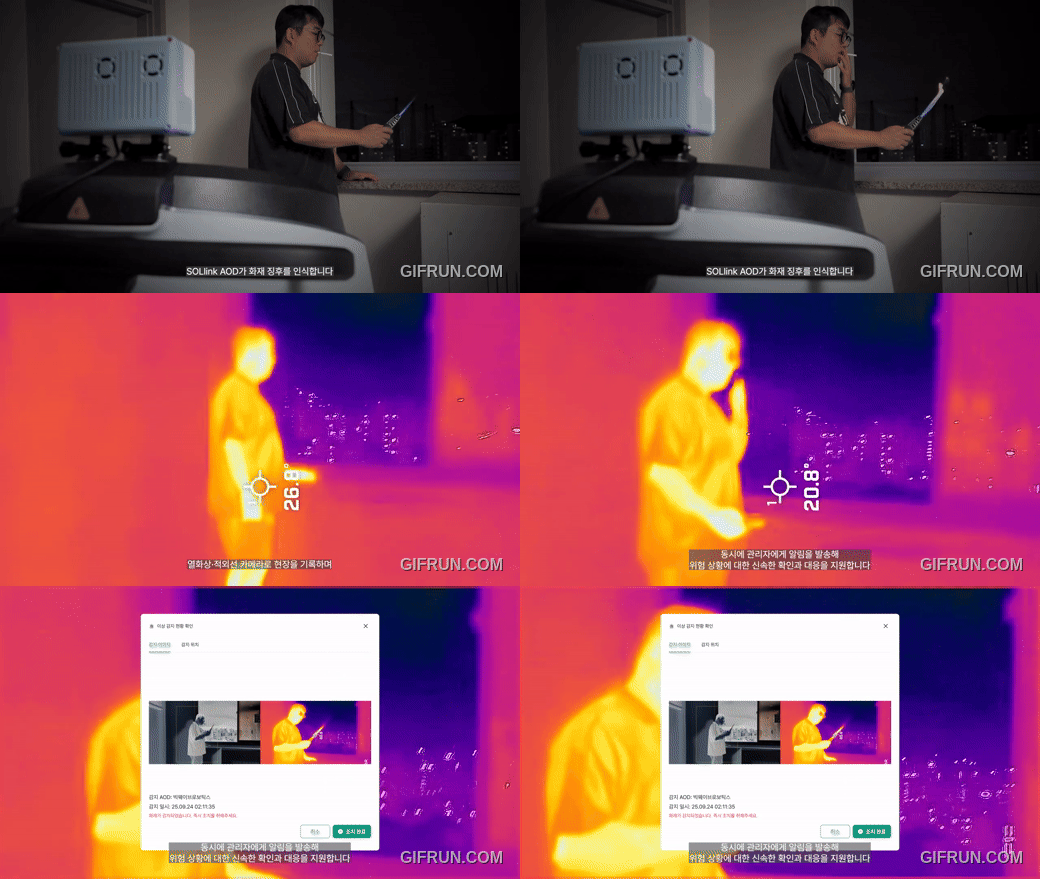
Q7. What are the advantages when applied to guidance or logistics robots?
Guidance or logistics robots often have more points of contact with users than cleaning robots or have a high proportion of nighttime operation. In such environments, the effect of AOD is even more apparent.
In the case of guidance robots, if they were previously used only for route guidance or information provision, they can now even perform the role of assisting user safety in welfare facilities or public institutions through AOD.
In the case of logistics robots or unmanned forklifts, they contribute to raising the level of safety management during personnel vacancy periods by detecting risk factors that may occur during nighttime logistics work.

Q9. Finally, to which companies and how would you like to recommend AOD?
AOD is not a type of solution purchased separately and attached to existing robots. It is a solution designed together as an additional function option for customers newly introducing cleaning, guidance, and logistics robots through Marosol.
In other words, it is not a structure where a robot is decided first and then AOD is placed on top; rather, the decision on whether to apply AOD is made while pondering together
“what role this robot should take on at our site”
during the stage of considering the first robot introduction. Thanks to this approach, AOD is a solution that can be sufficiently applied not only to service spaces such as commercial facilities, logistics centers, and welfare facilities, but also to construction sites.
Specifically, construction sites have many nighttime operations and unmanned periods, and the open structure makes it easy for safety dead zones to occur. At this time, robots with AOD can observe the status of work areas, abnormal situations, and risk factors at all times while moving through the site, so they can be expected to play a role in supplementing the limits of fixed CCTVs or limited safety personnel.
Therefore, AOD can be seen as a suitable solution especially for:
Companies considering the introduction of new robots
Spaces with a high proportion of operation during nighttime/unmanned hours
Sites where it is realistically difficult to expand safety/security personnel
Marosol designs together starting from the robot selection stage, including which robot is suitable, whether the environment needs AOD, and which scenario among fall, loitering, and fire is actually needed. As a result, the robot can be introduced as a partner that takes responsibility for the site together, not simply as 'equipment that does work.'
“If you are introducing a robot and are curious about how far it can be utilized,” Marosol will design it together from that first step.
Robots no longer stay as equipment that only performs set tasks. If AOD is designed together with cleaning, guidance, and logistics robots newly introduced through Marosol, the robot can be expanded into a partner responsible for not only work efficiency but also the safety and security of the site.
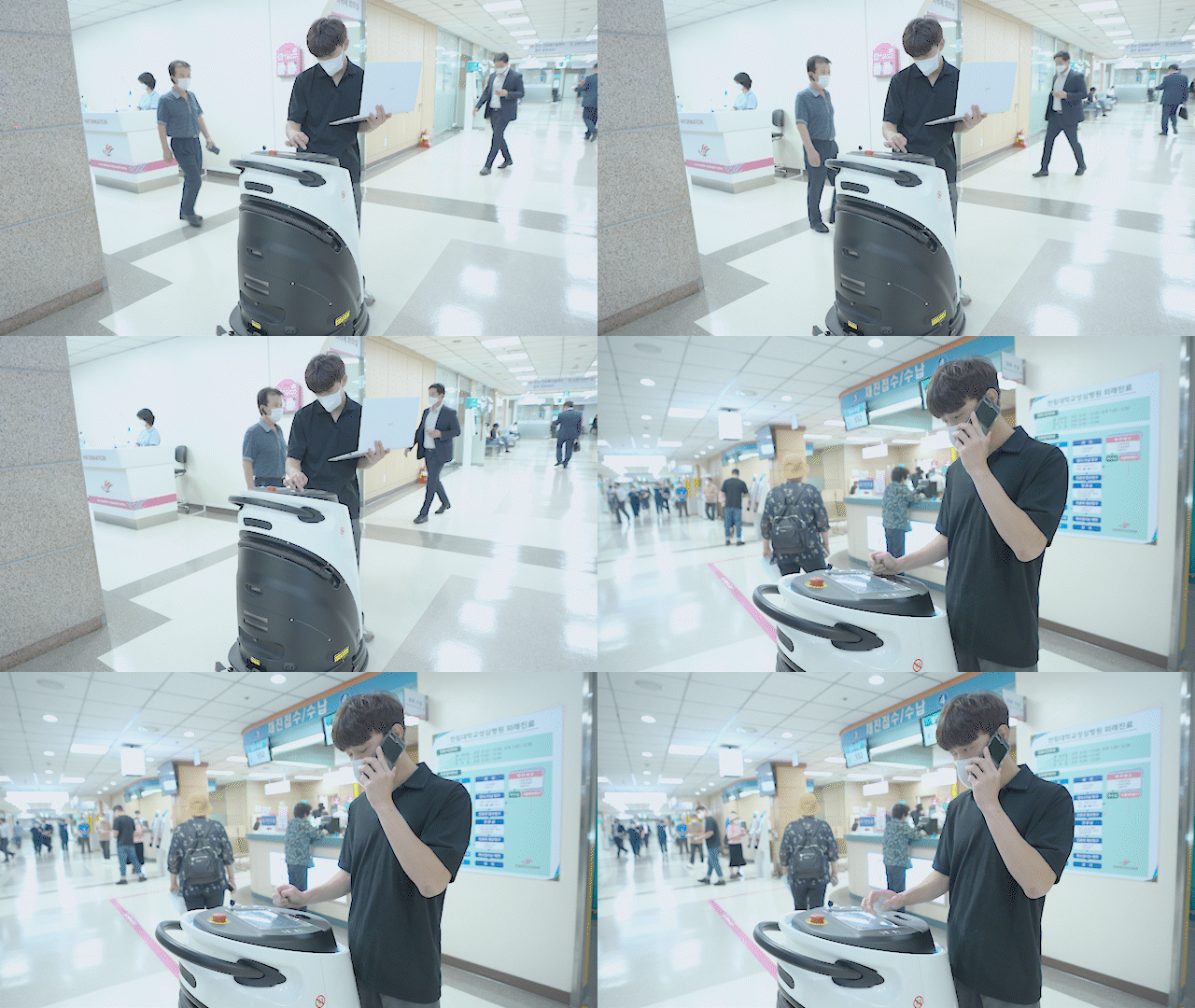
Marosol robot expert installing an industrial Cleaning Robot robot inside Hallym University Sacred Heart Hospital
Marosol does not stop at simply selling robots but is comprehensively designing everything from AOD application to operation scenarios by analyzing the purpose of robot introduction and the site environment together.
We are responsible for and support the entire process from robot selection → installation → control integration → actual operation so that automation works properly on-site.
If you are considering robot introduction or are worried about “how far a robot can be utilized at our site,” click the banner below to comfortably inquire with Marosol. 👇👇👇
We will consult right now on the possibility of utilizing Robot + AOD suitable for your space.

Readers also liked the following posts


Price Negotiation Available Now!
Additional discounts may be available depending on your needs.