

70% Reduction in Quality Costs through Loading/Unloading Automation 🙏 (ft. Hyundai Robotics Industrial Robot)
0 min read0299
💡 Learn these in 5 minutes!
Reasons for requesting loading/unloading automation
Features / differentiation of this automation
Loading/unloading automation work sequence
Reasons for using the Hyundai Robotics industrial robot HH050
How to succeed 100% in loading/unloading automation
Hello! This is Marosol, the No.1 robot automation platform.🙌 Today, we would like to introduce an automation project conducted in the third quarter of 2024.
This automation project was applied to the stacking process of carrier mid-planet products, which are important parts of automobile transmissions. We designed it so that loading/unloading operations and heat treatment operations are performed automatically using industrial robots and jigs.
We are going to have a brief interview with Marosol's engineer Han Ji-seop, who successfully led this automation.🎤
Automation applied to Samrak Heat Treatment, a company specializing in heat treatment for automobile parts
Q1. Hello, Ji-seop! First, I'd like to know the background of this project. Why did the customer request automation?
Engineer Han Ji-seop: Yes, this project was to solve problems occurring in the customer's manual process. Previously, workers were manually performing the process of stacking carrier mid-planet products and placing them on heat treatment jigs. As a result, work errors became frequent and the product defect rate continued to increase. In addition, as worker fatigue accumulated in the high-intensity manual process, efficiency began to drop. They said they requested automation to solve this.
Workers moving products manually before automation
Q2. You requested automation to reduce defect rates and for worker safety. What are the features of this project?
Engineer Han Ji-seop: The biggest feature of this automation project is that we secured a customized layout tailored to the customer's needs. It's not just simple process automation; we fully automated the entire pin insertion and stacking operation, enabling stable production of 720 products per hour. While it was difficult to expect consistent product quality when processing manually, the big advantage is that uniform product quality can be maintained after the introduction of this loading/unloading automation.
Q3. You secured a customer-tailored layout with Marosol's unique know-how. Then, is there anything that differentiates this project compared to other similar projects?
Engineer Han Ji-seop: Another differentiation point of this project is that we created a system that can flexibly respond to model changes.
To explain easily, if the customer wants to change the automation to fit a new product in the future, they can easily change the automation line without additional costs. We can say we gave a differentiation point in that it is a solution that can increase scalability in the future by applying a simple model change mechanism.
Source: Marosol Technical Proposal
Q4. Thank you for the explanation. How was the work sequence for this loading/unloading automation configured?
Engineer Han Ji-seop: The work is largely divided into four stages.
1. Product Input Part: First, a worker manually places 20 mid-planets onto a loading jig. We also designed the jig according to the customer's working environment. The jigs are placed on an 8-division index table, allowing up to 160 products to be prepared.
*Jig: A frame or device that helps fix or align objects during work *Index Table: A table that helps perform work in various positions by rotating the product while work is in progress
Stage 1: Product Input Part
2. Pin Insertion Part: Supply and align stacking pins through a parts feeder. Instead of a person having to align parts one by one, the parts feeder aligns them and sends them to the required position. This process is carried out by accurately inserting pins into the mid-planet using a single-axis robot and an air chuck.
*Parts Feeder: A device that automatically supplies small parts *Air Chuck: A tool that can grip or release objects using air pressure *Single-axis Robot: A robot that moves along a single axis
Stage 2: Pin Insertion Part
3. Stacking Part: This is the stage of precision stacking the mid-planets with pins inserted. At this time, using a Servo type control system, it stacks while adjusting the exact position according to the thickness of the mid-planet. Furthermore, a 2-set work method is applied so that work on another set can be done without delay even while the stacked product is being discharged. Because of this, bottleneck phenomena do not occur, and work proceeds smoothly.
*Bottleneck Phenomenon: A situation where a specific stage in production or work flow is delayed or slower than other stages, reducing the efficiency of the entire process
Stage 3: Stacking Part
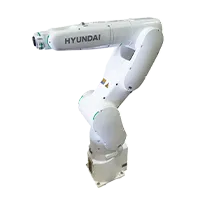
4. Tray Placement Part: Finally, using the HH050, a 6-axis industrial robot, the completed stacked products are placed onto a heat treatment tray. After completing the work by stacking 9 sets of products in two layers on one tray, the tray is discharged using a hoist. This completes one work cycle.
*Hoist: A mechanical device used to lift or lower heavy objects
Stage 4: Tray Placement Part
Q5. Various devices and robots were used for precise automation. Is there a special reason why you used the Hyundai Robotics industrial robot HH050 among many industrial robots?
Engineer Han Ji-seop: Yes, there were several reasons for choosing Hyundai Robotics' industrial robot HH050. First of all, as a 6-axis robot, it can perform complex movements and work from various angles, so it was optimized for the precision stacking work required in this project. In particular, its flexibility to accurately place products on trays and move quickly and efficiently in limited spaces was a big advantage.
In addition, the HH050 can stably respond to high-load work, so it could be used without problems even when handling heavy products. Its durability is also excellent, and it is efficient in terms of maintenance, which was a decisive reason as it could guarantee the long-term operational stability that the customer wanted.
If you visit the Marosol website, you can check welding automation, palletizing automation, and assembly automation using the Hyundai Robotics industrial robot HH050. If you want to check more diverse introduction cases, please click the thumbnails below. 👇👇
Click the image to check the video of the introduction case! Click the image to check the video of the introduction case!
Q6. What are the expected effects through this automation?
Engineer Han Ji-seop: The biggest effect of automation is labor efficiency. Work that previously required 3 to 4 workers can now be operated sufficiently with just 1 person. Through this, ROI (Return on Investment) can also be secured quickly. In addition, as the consistency of product quality improved significantly, the defect rate decreased and productivity improved greatly.
Q7. How are you planning system maintenance and management?
Engineer Han Ji-seop: System maintenance is primarily responded to through SoLlink, a heterogeneous/multi-robot integrated control system solution. If a problem occurs that cannot be solved by remote support, we solve the problem through prompt A/S dispatch. We guarantee that customers can operate the automation system stably by providing free A/S for one year after introduction.
Robot utilization data available in Sollink
Q8. How is Marosol building various manufacturing automations, including loading/unloading automation?
Engineer Han Ji-seop: Marosol provides customized automation solutions tailored to various manufacturing processes, not just loading/unloading automation. To this end, we first thoroughly analyze the customer's production needs and process characteristics. We design solutions that meet the technical requirements for the process by selecting the optimal equipment such as robots, control systems, and sensors according to each manufacturing process.
In particular, loading/unloading automation is an important part of maximizing accuracy and efficiency in repetitive tasks, and Marosol enables precise and consistent work by introducing industrial robots and advanced automation equipment to solve this. We also provide systems that can automate various tasks such as pin insertion, stacking, and assembly, and design them so that each task is smoothly linked.
Marosol robot expert conducting after-sales management after visiting the site
Marosol's strength is flexibility. We don't stop at simple process automation; we are building scalable systems by applying modular designs so that we can easily respond to model changes or product variations. Through this, customers can maintain high productivity even in a continuously changing manufacturing environment.
In addition, after-sales management is also important, and we support customers to the end so they can operate automation systems stably through remote support and regular maintenance services.
Today, we had an interview with Han Ji-seop, a manufacturing automation expert at Marosol, about heat treatment and loading/unloading automation solutions introduced to an automobile parts manufacturer. Marosol's skills have recently been recognized, leading to automation projects for large corporations such as Samsung C&T and Incheon International Airport.
If you are curious about an automation solution that fits your process perfectly, please click the banner at the top or visit the Marosol website! We will take responsibility from free consulting to issuing quotes, from introduction to design and after-sales management. Thank you! 🤗
Visit the website here! 👇👇👇
Readers also liked the following posts
![Industrial Cleaning Robots in Athletic Facilities: Real-World Use Cases 🧹🤖 [School Gyms, Climbing Centers, and Indoor Tennis Courts]](/_next/image?url=https%3A%2F%2Fmarosol-bucket-dev.s3.amazonaws.com%2Fstory%2Fthumbnail%2F2026%2F04%2F177545925689713UFyx7N05cWEC4odUX5.jpeg&w=3840&q=75)
Industrial Cleaning Robots in Athletic Facilities: Real-World Use Cases 🧹🤖 [School Gyms, Climbing Centers, and Indoor Tennis Courts]
Industrial Cleaning Robots: A Waste of Money?? 🤔 Why More Than 10,000 Units Are Sold Annually in Japan and China
How AMR Logistics Robots Move Giant Raw Material Tubs 😎 (25% Productivity Boost with Logistics Automation!)
Comprehensive Comparison of 3 Major Korean Humanoid Robots: Robotis AI Worker, Rainbow RB-Y1, and A-Robot ALICE M1
Price Negotiation Available Now!
Additional discounts may be available depending on your needs.