





Moving Accurately and Independently! A Comparison of Mobile Manipulator Robots
1 min read01717
Hello everyone. Last time, we compared two lift-type autonomous mobile robots that lift and move anything like a strongman. Since AMR and AGV technologies are often easy to confuse, I spent a lot of time thinking about how to explain them simply.
👉🏻 Go to the comparison of lift-type autonomous Logistics robots
The robots I’m showing you today are similar to the ones from last time, yet slightly different. While the lift-type robots performed "lifting and carrying" tasks, these robots use a robotic arm to "directly pick up" parts and carry them. Both are used for moving workpieces or parts, but you can choose between them based on what you are moving, the packaging form, or the transport unit. In other words, think of it as a concept where the picking and placing process becomes more sophisticated.

Photo = Collaborative mobile manipulator created through the collaboration of Waypoint Robotics and Productive Robotics so that small and medium-sized enterprises can also use it
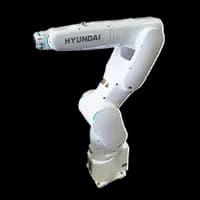
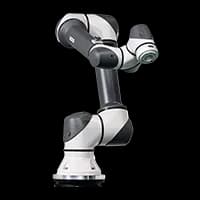
The "Mobile Manipulator," used in both the Potenit case and the Techfloor case we're looking at today, is a robot that has both legs (AMR) and an arm (ARM). It represents the first step toward complete unmanned automation due to its flexibility.
However, while a fixed robotic arm (ARM) has a repeatability* of 0.01 to 1mm, the "legs" (AMR) move around, resulting in a stopping position accuracy* error of about 10 to 50mm. To combine and utilize these two effectively, additional logic is needed to compensate for the AMR's stopping accuracy. 🤓 That’s why these solutions use a vision camera attached to the end of the robotic arm (ARM) to verify the position once more before picking up or setting down an item.
* Repeatability: The range of possible deviation when repeating tasks at the same location.
* Stopping Position Accuracy: The range of possible deviation when stopping at the same position
1. Processed Product Transfer Using Potenet Mobile Manipulator + 5G Integration

Click the image to view more details.
First, this solution from Potenit uses 5G to perform workpiece transfers between distant processes using a mobile manipulator. Thanks to 5G, communication delay is extremely low, making it very convenient to change or perform tasks based on near-real-time information.
Robots are essentially limited to moving according to a pre-programmed sequence, but by utilizing 5G, you can transmit work commands and control the robot from a distance without delay, even without pre-programming everything.

Additionally, work information between facilities can be linked with the AMR to perform necessary tasks between pre- and post-processes. For example, normally you would set a cycle time for a task and tell the robot to go to the workbench at a certain time to pick up a workpiece. In this solution, even if the cycle time is irregular, a signal that the work is "Complete" can be sent to the robot, allowing it to move to the location and pick it up at the right time.
Since no separate worker is required for any part of this process, it has the advantage of being usable 24/7, thereby increasing productivity.
2. Mobile phone transfer using the Techfloor Mobile Manipulator (M6X)

Click the image to view more details.
The second case is from Techfloor. In this solution, the mobile manipulator is responsible for moving smartphones from a display stand onto the mobile robot and then moving to the next process location.

Productivity was secured through the ability to move and stop quickly at the destination. Looking at the solution, after the robot receives a work command, it moves to the picking location and uses the vision camera at the end of the robot arm to recognize the position of the workbench. Even after loading the workpiece, it reduces stopping errors by accurately placing the transferred part at the process workbench location. This eliminates worries about work stoppages.
Applying this solution to sites with frequent part transfers between processes would help perform continuous work regardless of the hour. Since no additional labor is required, it’s a truly useful robot. 😉
Both solutions are AMR types, meaning they can be used without constructing separate infrastructure like rails (unlike AGVs), allowing for flexible responses to layout changes. Here is a final summary to help you choose:
Want to transfer workpieces easily via 5G integration? The Potenit Mobile Manipulator!
✅ Transfer distant workpieces with a single touch via 5G integration.
✅ Link work information between facilities with the AMR to perform tasks between pre- and post-processes.
Want to transfer workpieces with fast movement and precise stopping? The Techfloor Mobile Manipulator!
✅ Secure productivity with fast movement and stopping at the destination.
✅ Perform clean tasks without common stopping position errors.
There’s nothing quite like a mobile manipulator for logistics and part transfer. Both solutions, which reduce stopping errors by leveraging the repeatability of the robot arm, have clear advantages.
If you’re having trouble choosing, it’s best to select the solution that optimally fits the process you want to apply. If you film your current work process and inquire through Marosol, an expert will review it and recommend the most capable company for you.
For accurate quote information and detailed expert consultation, apply by clicking Free Consultation at the top.
Readers also liked the following posts


Price Negotiation Available Now!
Additional discounts may be available depending on your needs.