

Process Overview
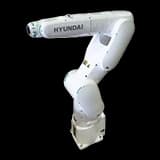
This project involved the introduction of automated loading/unloading to ensure uniform heat treatment of the carrier mid-planet, a key component of automotive transmissions. The client implemented automation to address several issues arising from the previously manual process, particularly the increased defect rate and inefficiencies caused by workers. Hyundai Robotics' HH050 six-axis industrial robot was utilized for this purpose, automating various tasks such as product stacking, pin insertion, and tray placement, ensuring high productivity and stability.
Warranty Period
- 1 Year
Performance Year
- 2024
Project Duration
- 3 Months
Components
| Robot | Hyundai Robotics' HH050 six-axis industrial robot ; |
|---|
Workflow
| STEP 1. | Product loading part: Manually place the mid-planet on the loading jig, and place 20 products per jig on the 8-segment index table to secure up to 160 product cartridges. |
|---|---|
| STEP 2. | Pin insertion part: The pins for loading are supplied and aligned through the parts feeder and placed on the mid-planet using a single-axis robot + air chuck combination. |
| STEP 3. | Loading part: Loading the mid-planet with the pin inserted, and use the servo-type to precisely control the position of the mid-planet according to its thickness. 2 sets are applied to prevent bottlenecks from occurring even when the laminated product is being discharged. |
| STEP 4. | Tray placement part: Using a 6-axis industrial robot, the loaded products are placed on a tray dedicated to heat treatment, 9 sets of fully loaded products are placed every 60' radius, and when the 360' work is completed, the worker uses a hoist to eject them with the tray, completing one cycle. |
※ The content provided by Bigwave Robotics is protected under U.S. and Canadian copyright and intellectual property laws. Unauthorized reproduction, distribution, or use of this content is strictly prohibited.
Recommended Use Cases

Product Sorting Automation using UR5 and Deep Learning
This next-generation sorting solution leverages 3D Vision, Deep Learning (Instance Segmentation), Reinforcement Learning, and Motion Planning (OMPL) to automate complex tasks such as product classification, assembly, and packing. By utilizing cost-effective 3D vision, the system recognizes the type and location of products and bins in real-time. This allows the robot to automatically compensate for shifts in the position of items or boxes without manual intervention. The integration of Motion Planning drastically reduces human teaching time, while Reinforcement Learning optimizes movements to minimize overall cycle times.

Metal Machining Machine Tending for Three WIA MCTs using Yaskawa Robots
This machine tending automation solution utilizes a YASKAWA industrial robot to automate the loading and unloading of metal workpieces for three WIA MCT (F410D) units. In the traditional process, operators had to stand by the machines constantly to manually feed workpieces. By delegating the loading and unloading tasks to the robot, operators can now focus on overall equipment management and system operation, significantly increasing operational efficiency. Furthermore, by having a single robot service three machining centers, productivity is maximized across the entire production cell.

Plastic Injection Molded Part Transport using Twinny NarGo 100
This logistics automation solution utilizes the Twinny NarGo 100 AMR to automate the transport of large plastic injection molded products to subsequent process stages. Equipped with triple safety sensors and advanced autonomous driving technology, Twinny's NarGo 100 performs tasks safely even in factories with complex layouts and high worker traffic. Previously, transporting heavy workpieces weighing around 100kg to a distant finished goods warehouse was time-consuming, causing idle time in processing and reducing productivity due to worker fatigue. Since implementing the autonomous robot, continuous processing has become possible, and worker fatigue has been significantly reduced, leading to an overall boost in productivity.
Process Overview
This project involved the introduction of automated loading/unloading to ensure uniform heat treatment of the carrier mid-planet, a key component of automotive transmissions. The client implemented automation to address several issues arising from the previously manual process, particularly the increased defect rate and inefficiencies caused by workers. Hyundai Robotics' HH050 six-axis industrial robot was utilized for this purpose, automating various tasks such as product stacking, pin insertion, and tray placement, ensuring high productivity and stability.
Warranty Period
- 1 Year
Performance Year
- 2024
Project Duration
- 3 Months
Components
| Robot | Hyundai Robotics' HH050 six-axis industrial robot ; |
|---|
Workflow
| STEP 1. | Product loading part: Manually place the mid-planet on the loading jig, and place 20 products per jig on the 8-segment index table to secure up to 160 product cartridges. |
|---|---|
| STEP 2. | Pin insertion part: The pins for loading are supplied and aligned through the parts feeder and placed on the mid-planet using a single-axis robot + air chuck combination. |
| STEP 3. | Loading part: Loading the mid-planet with the pin inserted, and use the servo-type to precisely control the position of the mid-planet according to its thickness. 2 sets are applied to prevent bottlenecks from occurring even when the laminated product is being discharged. |
| STEP 4. | Tray placement part: Using a 6-axis industrial robot, the loaded products are placed on a tray dedicated to heat treatment, 9 sets of fully loaded products are placed every 60' radius, and when the 360' work is completed, the worker uses a hoist to eject them with the tray, completing one cycle. |
※ The content provided by Bigwave Robotics is protected under U.S. and Canadian copyright and intellectual property laws. Unauthorized reproduction, distribution, or use of this content is strictly prohibited.