

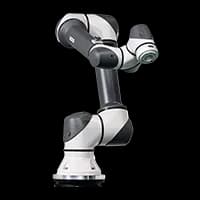



This machine tending automation solution utilizes the Doosan M1013 collaborative robot to automate the loading and unloading of workpieces for end mill machining in a machining center.
Previously, operators had to remain stationed at the machine to manually feed and remove workpieces for every cycle. With this solution, the robot takes over the loading and unloading tasks, allowing the human operator to manage multiple machines simultaneously, significantly boosting overall labor efficiency and productivity.
Components
| Robot |
|
|---|
Workflow
| STEP 1. | Picking: The robot picks raw material from the supply pallet. |
|---|---|
| STEP 2. | Loading: The robot places the workpiece into the machining center chuck (fixture). |
| STEP 3. | Seating: The robot uses a urethane pad to press the workpiece down, ensuring it is perfectly seated. |
| STEP 4. | Locking: An electric screw tool (integrated with the robot or machine) locks the chuck into place. |
| STEP 5. | Machining: The machining center performs the designated end mill processing. |
| STEP 6. | Unlocking: The electric screw tool releases the chuck lock. |
| STEP 7. | Unloading: The robot picks the finished processed part from the machine. |
| STEP 8. | Stacking: The robot places the finished part back into its original position on the pallet. |
| STEP 9. | Indexing: Once a row on the pallet is complete, the system rotates or shifts the pallet to prepare for the next set of workpieces. |
※ The content provided by Bigwave Robotics is protected under U.S. and Canadian copyright and intellectual property laws. Unauthorized reproduction, distribution, or use of this content is strictly prohibited.
Recommended Use Cases

Shaft Manufacturing Machine Tending through YASKAWA GP7
This automation solution utilizes the YASKAWA Motoman-GP7 to transfer shaft products that have completed their initial machining phase to the subsequent processing stage. The project was implemented to boost productivity by reducing standby and idle times while enhancing workplace safety by removing workers from high-risk environments. Transferring workpieces between machining stages is a process with a high potential for safety accidents. By automating this transition, the system eliminated hazards and shortened production lead times through continuous operation. With 18 units currently in operation, this project has significantly contributed to reducing fixed costs, such as labor expenses, by decreasing the required workforce by approximately 40 personnel across day and night shifts.

Support Ring Machining Assistance for WIA Turning Center using Fanuc Robot
This machine tending automation solution utilizes a Fanuc M-710iC/70 robot mounted on a linear track to automate the machining of heavy support rings across six WIA Turning Centers (LV450). By employing a high-payload industrial robot and a linear track, the system can rapidly perform continuous operations for relatively large and heavy support rings without idle time. The previous manual process, where workers pushed carts to each machine, has been replaced by a centralized input system, significantly improving both logistics flow and space efficiency.

Non-Stop Product Sorting Automation using Robostar RA007 and Deep Learning
This solution utilizes 3D vision, deep learning algorithms (Instance Segmentation), reinforcement learning, and motion planning (OMPL) algorithms to automate tasks such as product sorting, assembly, and packing. By using cost-effective 3D vision to recognize product types, product locations, and box positions in real-time, the system can automatically compensate for and continue operations even if the positions of products or boxes change. Furthermore, with two vision sensors and high-speed processing, it can significantly reduce cycle times—the most critical factor in logistics sites. Since the system compensates through learning even if the conditions change due to misalignment of the vision, robot, or work jigs, it ensures easy operation and maintenance while minimizing downtime.
This machine tending automation solution utilizes the Doosan M1013 collaborative robot to automate the loading and unloading of workpieces for end mill machining in a machining center.
Previously, operators had to remain stationed at the machine to manually feed and remove workpieces for every cycle. With this solution, the robot takes over the loading and unloading tasks, allowing the human operator to manage multiple machines simultaneously, significantly boosting overall labor efficiency and productivity.
Components
| Robot |
|
|---|
Workflow
| STEP 1. | Picking: The robot picks raw material from the supply pallet. |
|---|---|
| STEP 2. | Loading: The robot places the workpiece into the machining center chuck (fixture). |
| STEP 3. | Seating: The robot uses a urethane pad to press the workpiece down, ensuring it is perfectly seated. |
| STEP 4. | Locking: An electric screw tool (integrated with the robot or machine) locks the chuck into place. |
| STEP 5. | Machining: The machining center performs the designated end mill processing. |
| STEP 6. | Unlocking: The electric screw tool releases the chuck lock. |
| STEP 7. | Unloading: The robot picks the finished processed part from the machine. |
| STEP 8. | Stacking: The robot places the finished part back into its original position on the pallet. |
| STEP 9. | Indexing: Once a row on the pallet is complete, the system rotates or shifts the pallet to prepare for the next set of workpieces. |
※ The content provided by Bigwave Robotics is protected under U.S. and Canadian copyright and intellectual property laws. Unauthorized reproduction, distribution, or use of this content is strictly prohibited.