




This application case features Schmalz's Vacuum Handling System (HS) as presented at the SFAW exhibition. It was designed to allow visitors to personally experience the practicality of moving workpieces more safely and comfortably. By utilizing the Vacuum Handling System (HS), workers can prevent musculoskeletal injuries caused by repeatedly moving heavy objects while performing tasks faster and more securely.
Project Background & Objectives
Reduction of Worker Fatigue and Accident Prevention: Minimizing physical strain and safety risks.
Simplification of Heavy Load Transport: Making the movement of high-payload workpieces effortless.
Versatile Handling: Safely and easily handling workpieces of various shapes and materials.
Enhanced Production Efficiency: Achieving faster transport speeds and streamlined workflows.
Components
| Robot |
|
|---|
Workflow
| STEP 1. | The operator uses the vacuum handling system to grip (suction) the workpiece. |
|---|---|
| STEP 2. | Move the workpiece to the target destination. |
| STEP 3. | Lower and release the object using the vacuum handling system. |
| STEP 4. | Repeat the above process. |
※ The content provided by Bigwave Robotics is protected under U.S. and Canadian copyright and intellectual property laws. Unauthorized reproduction, distribution, or use of this content is strictly prohibited.
Recommended Use Cases

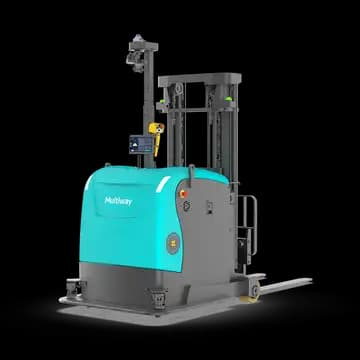
Haemil FA Unmanned Forklift SFL-COD140
This video information presents an autonomous logistics transport Forklift system based on SLAM (Simultaneous Localization and Mapping). It provides an autonomous unmanned method for logistics transport and stacking tasks, ensuring safety through Navigation Scan Lidar for positioning, Multi-Lidar for object and obstacle recognition, and 2D/3D cameras for pallet and cage loading. What is SLAM (Simultaneous Localization and Mapping)? It is a core technology for autonomous driving where a robot creates an accurate map of its work environment using only its onboard autonomous sensors while navigating the workspace. Project Background & Objectives Accurate and repetitive logistics tasks using autonomous robots.

Indoor Logistics Transport and Loading Using VisionNav VNPA15🏗️
Process Overview This case study showcases a logistics automation solution that uses VisionNav's VNPA15 autonomous mobile robot (AMR) to automate the transport and loading/stacking of packaged products in indoor material-handling operations. Built on robust safety functions, the solution minimizes changes to existing workflows while enabling unattended load/unload tasks, and provides effective monitoring and control of real-time operations.

Haemil FA Roller Conveyor AMR
Project Overview This video presents an autonomous mobile robot (AMR) logistics transport system based on SLAM (Simultaneous Localization and Mapping). It provides an optimal solution for logistics and precision repetitive tasks on production sites by implementing autonomous unmanned transport and loading. Key features include Laser Sensing-based self-mapping and optimal path securing with safety through 2D/3D cameras for object recognition and obstacle identification. The system can be equipped with various applications such as collaborative robots (Co-Bots), roller conveyors, and Jack-Up systems. What is SLAM (Simultaneous Localization and Mapping)? It is a core technology for autonomous driving where a robot creates an accurate map of its work environment using only its onboard autonomous sensors while navigating the workspace. Project Background & Objectives Accurate and repetitive logistics tasks using autonomous robots.
This application case features Schmalz's Vacuum Handling System (HS) as presented at the SFAW exhibition. It was designed to allow visitors to personally experience the practicality of moving workpieces more safely and comfortably. By utilizing the Vacuum Handling System (HS), workers can prevent musculoskeletal injuries caused by repeatedly moving heavy objects while performing tasks faster and more securely.
Project Background & Objectives
Reduction of Worker Fatigue and Accident Prevention: Minimizing physical strain and safety risks.
Simplification of Heavy Load Transport: Making the movement of high-payload workpieces effortless.
Versatile Handling: Safely and easily handling workpieces of various shapes and materials.
Enhanced Production Efficiency: Achieving faster transport speeds and streamlined workflows.
Components
| Robot |
|
|---|
Workflow
| STEP 1. | The operator uses the vacuum handling system to grip (suction) the workpiece. |
|---|---|
| STEP 2. | Move the workpiece to the target destination. |
| STEP 3. | Lower and release the object using the vacuum handling system. |
| STEP 4. | Repeat the above process. |
※ The content provided by Bigwave Robotics is protected under U.S. and Canadian copyright and intellectual property laws. Unauthorized reproduction, distribution, or use of this content is strictly prohibited.