
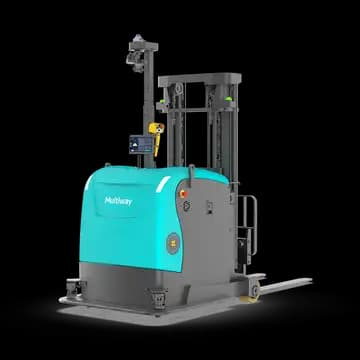
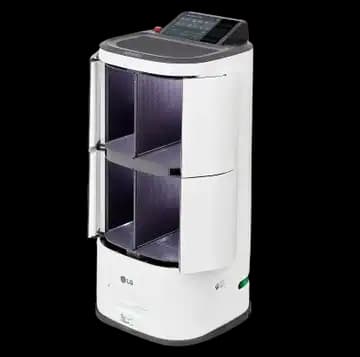
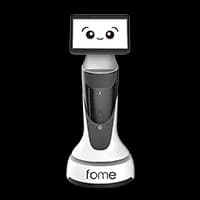
This logistics automation solution utilizes Potenit’s Lift-type AMR to automatically transfer component racks for home appliances according to the manufacturing process sequence.
Potenit’s AMR solution can be deployed easily without additional infrastructure (such as magnetic tapes or floor markers) and responds flexibly to changes in factory layout or work positions. Through the proprietary MOS (Multi-Robot Operating System), operators can monitor real-time status and issue commands via mobile devices, tablets, or PCs.
By automating material input and transfer across processes, idle time caused by preparation work has been reduced, leading to increased operational efficiency and productivity. This project was implemented as part of a Smart Factory advancement initiative to optimize worker movement, minimize production lead times, and increase overall production capacity to respond flexibly to shifting market demands.
Components
| Robot |
|
|---|
Workflow
| STEP 1. | Request: When a process is completed and the part rack is full, a transfer command is sent to the logistics robot. |
|---|---|
| STEP 2. | Loading: The AMR identifies the location of the reflectors at the bottom of the part rack, moves to the precise position, and lifts the rack. |
| STEP 3. | Initial Transfer: The robot moves to the subsequent process stage and lowers the rack. |
| STEP 4. | Re-picking: The AMR lifts the completed part rack from the current process stage. |
| STEP 5. | Process Flow: The robot moves to the next designated stage and unloads the rack (Tasks are performed in the specific order received from the MES). |
※ The content provided by Bigwave Robotics is protected under U.S. and Canadian copyright and intellectual property laws. Unauthorized reproduction, distribution, or use of this content is strictly prohibited.
Recommended Use Cases

Smart Warehouse using 70 units of Geek+ P800 (AMR)
This application case features a large-scale automated picking and replenishment system utilizing 70 units of Geek+ P800 mobile robots. By implementing a "Goods-to-Person" (GTP) model, the system optimizes warehouse layouts based on frequency of use through self-learning algorithms, maximizing storage density and operational efficiency in a compact space.

Order Picking using Yaskawa and Mech-Mind
This logistics automation solution utilizes Mech-Mind 3D Vision and the Yaskawa GP8 robot to automate the order picking of various unstructured objects. By leveraging a highly cost-effective 3D vision system that recognizes both the position and shape of products, the system can perform picking tasks without additional manual teaching—even when new products are added or existing ones are changed. The project was specifically designed to automate the picking of irregular items in logistics center picking zones.

Retail Store Inventory Replenishment using Geek+ P500
This application case features a retail inventory replenishment solution utilizing the Geek+ P500 mobile robot to assist with stocking tasks. As a safe logistics transport solution, it is designed to operate in shared spaces with humans, efficiently handling the transportation of heavy loads within the store environment.
This logistics automation solution utilizes Potenit’s Lift-type AMR to automatically transfer component racks for home appliances according to the manufacturing process sequence.
Potenit’s AMR solution can be deployed easily without additional infrastructure (such as magnetic tapes or floor markers) and responds flexibly to changes in factory layout or work positions. Through the proprietary MOS (Multi-Robot Operating System), operators can monitor real-time status and issue commands via mobile devices, tablets, or PCs.
By automating material input and transfer across processes, idle time caused by preparation work has been reduced, leading to increased operational efficiency and productivity. This project was implemented as part of a Smart Factory advancement initiative to optimize worker movement, minimize production lead times, and increase overall production capacity to respond flexibly to shifting market demands.
Components
| Robot |
|
|---|
Workflow
| STEP 1. | Request: When a process is completed and the part rack is full, a transfer command is sent to the logistics robot. |
|---|---|
| STEP 2. | Loading: The AMR identifies the location of the reflectors at the bottom of the part rack, moves to the precise position, and lifts the rack. |
| STEP 3. | Initial Transfer: The robot moves to the subsequent process stage and lowers the rack. |
| STEP 4. | Re-picking: The AMR lifts the completed part rack from the current process stage. |
| STEP 5. | Process Flow: The robot moves to the next designated stage and unloads the rack (Tasks are performed in the specific order received from the MES). |
※ The content provided by Bigwave Robotics is protected under U.S. and Canadian copyright and intellectual property laws. Unauthorized reproduction, distribution, or use of this content is strictly prohibited.